Iffa Jayyana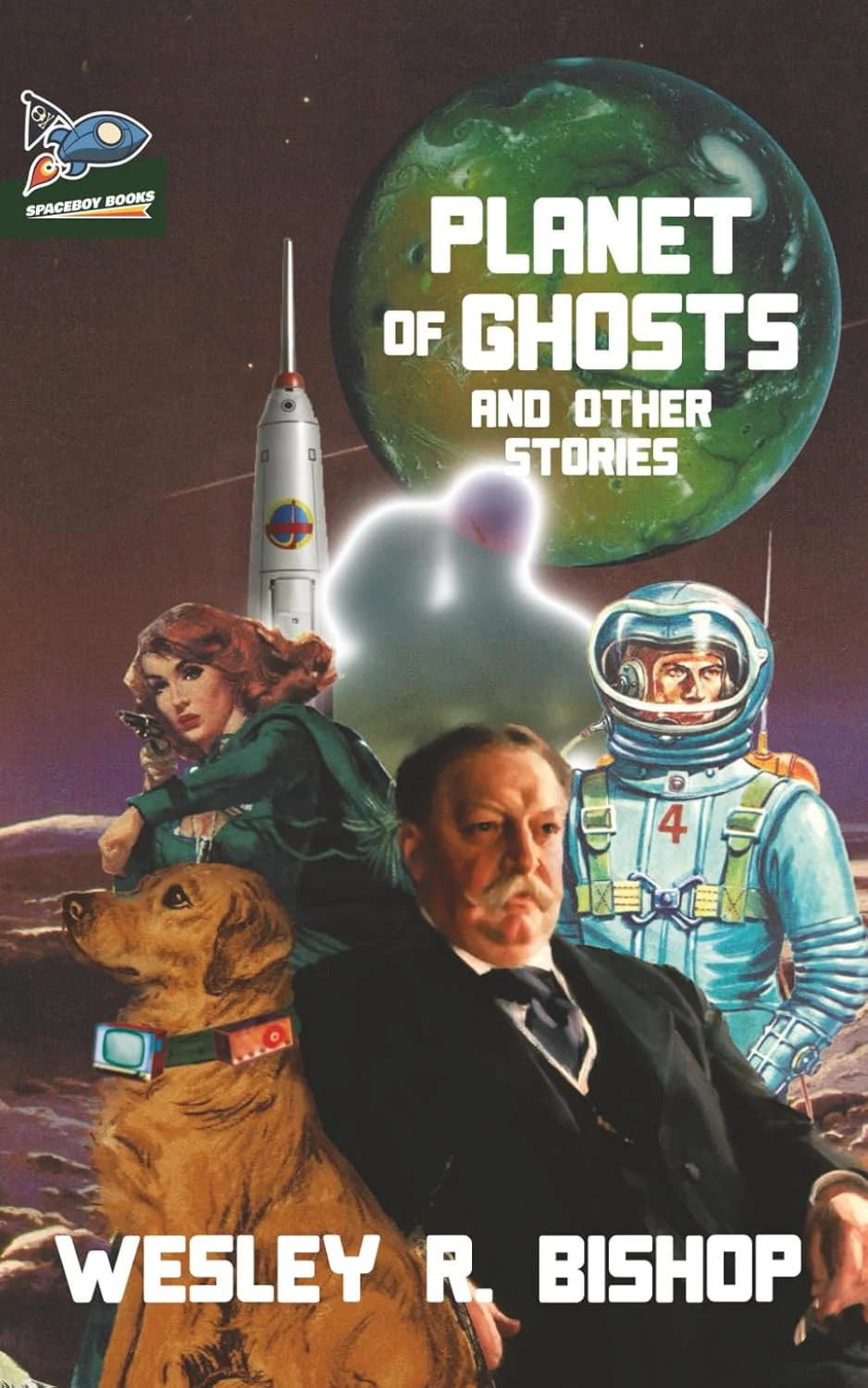
In the pantheon of science fiction, the "dystopian" label is often applied with a broad, flattening brush. It is a genre frequently reduced to grim aesthetic choices—neon-soaked rain, chrome-plated authoritarianism, and the inevitable collapse of the status quo. However, the true terror of dystopia lies not in the spectacle of destruction, but in the mundane persistence of systems that no longer serve their inhabitants. This is the central thesis of Wesley R. Bishop’s new short story collection, Planet of Ghosts.
Through a series of interconnected narratives, Bishop examines a future defined by "enshittified" technology, ecological insolvency, and the desperate, often irrational ways humanity clings to hope when the ground beneath them is quite literally dissolving.
The Genesis of a New Dystopian Vision
The inspiration for Planet of Ghosts does not stem from high-minded theoretical physics, but from the unlikely crucible of 1979’s Buck Rogers in the 25th Century. For many, the show remains a nostalgic artifact of childhood—a brightly colored, campy space opera. Yet, viewed through the lens of adulthood, the series reveals a more unsettling reality.
As one revisits the sterile, AI-governed cities of the show, the veneer of adventure fades to expose a chilling stagnation. Earth is a depleted shell, devoid of democratic process, dependent on food imports from slave states, and walled off from a mutant-ridden wasteland. This realization serves as the intellectual bedrock for Bishop’s work: the idea that our future might not be a grand, revolutionary struggle, but a slow, suffocating surrender to convenience and apathy. Bishop takes this "mess of a universe" and breathes into it a haunting, literary life, transforming the nostalgic echoes of Saturday morning TV into a visceral exploration of societal decay.
Chronology of a Crumbling World
Planet of Ghosts operates on a non-linear temporal plane. Rather than presenting a singular narrative arc, Bishop offers a mosaic of humanity’s unraveling. To understand the world of the book, one must navigate three distinct strata of time:
1. The Onset of the Unraveling
In the early stories, the reader is confronted with the familiar anxiety of our current ecological crisis—the creeping realization that the biosphere is reaching a point of no return. Bishop does not dwell on the technical specifics of the collapse; instead, he focuses on the human response to it. Here, we see the rise of the Cathedral, a cult-like entity that offers psychological sanctuary in the face of inevitable destruction.
2. The Era of Desperate Innovation
As the Earth begins to fracture, the narrative shifts to the "Wild West" of emerging technology. In this period, humanity is trapped in a feedback loop of innovation. New technologies—including a volatile form of time travel—are adopted not because they improve life, but because the populace is paralyzed by the need for an exit strategy. These tools are the digital equivalent of fad diets; they are desperate, poorly understood, and ultimately catastrophic.
3. The Far-Flung Future
Finally, we see the echoes of our own time through the eyes of the distant future. We encounter archaeologists sifting through the ruins of a defunct Walmart and the surreal, comedic tragedy of President William Howard Taft, plucked from the 20th century and forced to contend with the absurdity of a post-human landscape. These segments ground the book’s lofty themes in the tangible reality of historical objects and personalities, making the abstract concept of "the end" feel strikingly intimate.
Supporting Data: The Mechanics of the "Wesleyverse"
The strength of Planet of Ghosts lies in its internal consistency—a quality rarely achieved in short story collections. Bishop maintains a rigorous set of rules for his "Wesleyverse," even as the geography and timelines shift.
- Technological Atrophy: Technology in this world is not a savior; it is an agent of entropy. It is ubiquitous, invasive, and inherently flawed.
- The Persistence of Cults: Bishop posits that as the world loses its grip on reality, the human urge to organize under irrational belief systems intensifies. The cults in the book are not mere background dressing; they are primary characters in the story of humanity’s end.
- The "Aha" Connectivity: The collection is anchored by pivotal stories such as "The Man Who Saved the Dead." This story, which explores the ethics of consciousness downloading, serves as the narrative keystone. When a reader realizes that this tale is connected to the wider themes of the book, the implications of other, seemingly minor stories are radically recontextualized.
Perspectives on the Human Condition
Bishop’s refusal to provide a tidy resolution is the collection’s most daring artistic choice. As a scholar and history professor, one might expect Bishop to adopt the role of the Cassandra, warning us of specific paths to avoid. He rejects this didactic impulse.
Instead, the stories focus on individual survival strategies. In one instance, a character might be an interstellar colonizer; in another, a victim of time-travel displacement. Bishop treats each character with a profound sense of empathy, acknowledging that when the world is dying, there is no "correct" way to cope.
The collection suggests that hope is not a grand political movement, but an individual, stubborn refusal to succumb to despair. As noted in the book (p. 180), "every problem humanity faces is always only one generation away from a solution." This sentiment is not offered as a panacea, but as a rallying cry for the individual characters who continue to build, tinker, and care for one another in the shadow of the apocalypse.
Implications: Why This Collection Matters Now
In an era defined by rapid technological shifts, climate anxiety, and the erosion of public discourse, Planet of Ghosts arrives as a vital piece of literature. It serves as a mirror, reflecting our own tendencies toward irrational optimism and catastrophic denial.
The book’s structure—185 pages of dense, interrelated narratives—is a deliberate mirror of the brevity of our own time. Bishop reminds the reader that we are not living in a static state; we are in a state of transition. By stripping away the tropes of traditional space opera and replacing them with the raw, messy reality of human fallibility, Bishop forces us to confront the uncomfortable question: If we knew the end was coming, what would we actually do?
The "Wesleyverse" is not a cautionary tale in the traditional sense; it is a meditation on the persistence of the human spirit. It asks us to consider whether our obsession with "exits"—be it technology, cults, or fantasy—is actually distracting us from the only work that matters: the work of being present with one another, even when the stars are going out.
Ultimately, Planet of Ghosts is a triumph of contemporary science fiction. It is a work that demands to be read not once, but repeatedly, with each pass revealing new connections in the grand, broken design of Bishop’s vision. For those who feel the walls of the modern world closing in, this collection offers no easy answers, but it offers something far more valuable: the recognition that we are not alone in our desire to find meaning in the chaos.

 Laily UPN
 Evan Lee Salim