

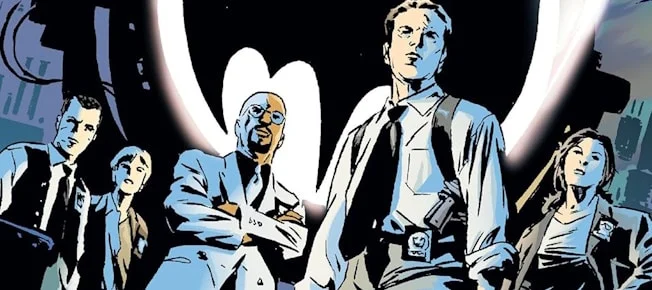
When we think of Gotham City, our minds often drift to the jagged silhouette of the Bat-Signal piercing the night sky or the theatrical madness of costumed supervillains. However, there is a side of Gotham that exists in the harsh, unflattering glare of fluorescent office lights—a world of paperwork, jurisdictional disputes, and the heavy, lingering trauma of working in a city that defies logic.
This is the world of Gotham Central, the seminal series by Ed Brubaker, Greg Rucka, and Michael Lark. With the release of the new Gotham Central: DC Compact Comics Edition, a new generation of readers is being invited to witness the daily grind of the Gotham City Police Department (GCPD). It is a story that proves you don’t need a cape to be a hero, and sometimes, the most dangerous thing in Gotham isn’t a clown with a smile, but the bureaucracy that keeps you from doing your job.
Main Facts: A Police Procedural in the Shadows of Titans
Gotham Central is a radical departure from the standard superhero fare. While Batman and his rogues gallery occupy the periphery, the narrative focus is squarely on the men and women of the Major Crimes Unit (MCU).
The newly released DC Compact Comics Edition collects the first ten issues of this Eisner and Harvey Award-winning run. These issues establish the series’ core identity: a grounded, hyper-realistic police procedural that treats the presence of superheroes not as a source of wonder, but as an existential professional hazard.
The plot kicks off with a devastating premise: the murder of one of their own at the hands of Mr. Freeze. This isn’t just a crime; it’s an indictment of the police force’s inability to fully protect their own against the meta-human threat. The collection captures the tension between the "normal" police work of solving homicides and the "abnormal" reality of investigating crimes where the perpetrator can freeze a room solid or turn a city block into a psychological funhouse.
Chronology: The Evolution of a Modern Classic
To understand the weight of this collection, one must look at the timeline of the series’ publication and its subsequent legacy in the comic book industry.
- 2003: The Debut: Launched in 2003, Gotham Central arrived at a time when the "gritty realism" of comics was finding a new footing. Brubaker and Rucka, two titans of the crime-noir genre, were the perfect architects for this vision.
- 2003–2006: The Original Run: Over the course of 40 issues, the series explored the shifting landscape of Gotham, detailing how the police force reacted to massive events like the exposure of Two-Face’s secrets and the perpetual pressure of dealing with a vigilante who operates outside the law.
- The Eisner/Harvey Legacy: The series quickly garnered critical acclaim, winning multiple awards for its writing and art. It became a masterclass in how to integrate "super" elements into a grounded, procedural framework.
- 2024/2025: The Compact Era: With the release of the DC Compact Comics Edition, DC is re-introducing the series to a modern audience, highlighting its timeless nature. The compact format—designed for portability and accessibility—signals that this story is essential reading, not just a niche artifact of the early 2000s.
Supporting Data: The Creative Engine
The strength of Gotham Central lies in its creative team, a roster of talent that treated every panel with the weight of a detective’s notebook.
- Storytelling: Ed Brubaker and Greg Rucka are masters of the slow burn. Their dialogue is clipped, professional, and dripping with the cynicism of public servants. They excel at character-driven conflict, where the friction between a detective’s moral compass and the city’s corruption provides the tension.
- The Visuals: Michael Lark’s art is the soul of the book. His work eschews the hyper-muscular, flashy aesthetic of mainstream superhero comics in favor of shadows, textured environments, and faces that show the wear and tear of a life spent in precinct basements.
- The Color Palette: With Noelle Giddings, Matt Hollingsworth, and Lee Loughridge providing colors, the book maintains a muted, urban atmosphere. The colors serve the story—the cold blues of a crime scene, the jaundiced yellow of streetlights, and the washed-out grays of the GCPD headquarters.
Official Responses and Critical Reception
The critical consensus on Gotham Central has remained overwhelmingly positive for two decades. Reviewers often point to it as the definitive "Batman book without Batman."
"The brilliance of Gotham Central is in the peripheral," notes a critic from the Graphic Policy archives. "It asks the question: What happens when the hero leaves? What happens to the victim who isn’t a billionaire or a super-genius?"
Industry insiders frequently cite the series as a primary influence for television shows like Gotham and the procedural elements found in modern prestige crime dramas. By stripping away the capes, the creative team forced the readers to confront the human cost of the "Bat-mythos," turning the police into the true protagonists of the city’s ongoing struggle for justice.
Implications: Why ‘Gotham Central’ Still Matters Today
The re-release of these initial ten issues in the Compact Comics format has significant implications for both current fans and new readers.
The Humanization of the GCPD
In many superhero narratives, the police are portrayed as either incompetent or purely antagonistic. Gotham Central humanizes them. We see detectives struggling with divorce, substance abuse, and the PTSD of having faced costumed lunatics. It reminds us that behind every badge is a person who is trying to hold back the tide of chaos.
The "Street-Level" Narrative
The success of this series paved the way for "street-level" comics to flourish. It proved that you don’t need cosmic-level threats to keep a reader engaged. Sometimes, the most compelling drama is found in a detective trying to prove a case against a corrupt official, or in the quiet tragedy of a family affected by a crime that the police are under-equipped to solve.
The Accessibility Factor
The DC Compact Comics line is a strategic move by DC to put high-quality, long-form narratives into the hands of a broader audience. By offering a smaller, more affordable physical format, DC is acknowledging that Gotham Central is not just a collector’s item—it is a foundational text. It is a story that belongs on the bookshelves of people who love The Wire, Law & Order, or True Detective just as much as those who love comic books.
Conclusion: A Must-Read for Any Genre Enthusiast
If you have ever wondered what it feels like to live in a city where the sky can turn dark with the shadow of a flying man, or where your partner might be killed by a man who turns moisture into ice, Gotham Central is your window into that reality.
It is a somber, gripping, and deeply human work of fiction. It doesn’t rely on explosive set pieces or world-ending stakes to hook the reader; instead, it relies on the quiet, steady tension of men and women doing their jobs in a city that refuses to be saved.
The DC Compact Comics Edition of the first ten issues is more than just a reprint; it is a gateway to one of the most respected runs in comic book history. Whether you are a lifelong fan of the Dark Knight or a newcomer looking for a gritty, well-written procedural, this collection is essential.
You can pick up your copy of Gotham Central at your local comic shop—find one near you via the Comic Shop Locator—or purchase it digitally and online through Bookshop or Amazon. In a city of capes and masks, the detectives of the Major Crimes Unit are the ones who truly keep the lights on. It’s time to see Gotham through their eyes.










No comments yet. Be the first to join the conversation!