In a move that has caught both market analysts and PC enthusiasts by surprise, Nvidia’s aging workhorse—the GeForce RTX 3060 12GB—is making a significant return to retail shelves. Years after its original debut, this "legacy" graphics card is reappearing as a viable, budget-friendly option for gamers and AI hobbyists alike. With the recent discovery of an MSI Ventus 2X 3060 12GB OC listed at Newegg for $329.99, the industry is witnessing a rare phenomenon: a hardware manufacturer reviving a previous-generation product to bridge a widening gap in the entry-level and mid-range market.
The Current Landscape: A Surprise Retail Resurgence
Barely a week after initial reports surfaced suggesting that Nvidia might be dusting off its older GPU designs to bolster inventory, the evidence has materialized in the form of active retail listings. The MSI GeForce RTX 3060 12GB, a card that had become increasingly scarce over the past two years, is once again available for purchase.
For many, this is a welcome development. During the height of the recent GPU volatility, when this card was available, it often carried inflated price tags nearing the $400 mark. Seeing it reappear at $329.99, complete with free shipping, signals a strategic pivot by Nvidia and its board partners. This is not merely a clearance of old warehouse stock; it is a calculated response to the persistent demand for affordable hardware that doesn’t sacrifice VRAM capacity for price.
Chronology: From Launch to Legacy and Back
To understand why this return is significant, one must look at the timeline of the RTX 3060.
- February 2021: The RTX 3060 12GB launches to massive fanfare. Positioned as the entry-level gateway to the Ampere architecture, it was lauded for its generous 12GB frame buffer—a feature that arguably saved it from premature obsolescence.
- 2022–2023: As the RTX 40-series began its rollout, the 3060 was slowly phased out of primary production lines. The market shifted toward the RTX 4060 and 4060 Ti, which, while more power-efficient, featured tighter 8GB memory buses.
- Late 2024: Industry murmurs began circulating regarding Nvidia’s intent to sustain older architectures. Supply chain analysts noted that despite the dominance of the Ada Lovelace architecture, there was a vacuum in the sub-$350 tier for cards capable of handling modern, memory-intensive workloads.
- Present Day: The card has officially returned to major e-commerce platforms, confirming that the "resurrected GPU" strategy—a concept CEO Jensen Huang has previously alluded to as a "good idea"—is now in full execution.
Supporting Data: Why 12GB Remains the "Sweet Spot"
The primary driver behind the continued relevance of the RTX 3060 is its 12GB of VRAM. In the contemporary gaming landscape, 8GB is rapidly becoming a significant bottleneck. Modern titles, particularly those utilizing high-resolution textures, ray tracing, and complex shaders, frequently exceed the 8GB threshold at 1440p and even demanding 1080p settings.
Performance Breakdown
- 1080p Gaming: The RTX 3060 remains a "king of the hill" for 1080p. It handles virtually every modern AAA title at maximum settings with ease. When coupled with Nvidia’s DLSS (Deep Learning Super Sampling) 4.5, it can maintain high frame rates even in the most visually demanding environments.
- 1440p Versatility: The card performs with surprising competence at 1440p. While it may require moderate graphical settings in the most punishing titles, the extra VRAM allows it to avoid the stuttering and texture-swapping issues that plague 8GB cards in the same price bracket.
- 4K Capabilities: While not a native 4K card, it can handle less intensive titles or well-optimized games at 4K resolution, provided the user exercises "judicious care" with settings and leans on upscaling technologies.
Beyond gaming, the 12GB of VRAM makes this card a formidable entry point for the "homelab" AI community. As locally hosted Large Language Models (LLMs) and Stable Diffusion image generation become increasingly accessible, the memory ceiling is the most critical factor. The RTX 3060 provides enough headroom to run many sophisticated AI models without the need for expensive, data-hungry cloud subscriptions.
Technical Specifications: The MSI Ventus 2X Variant
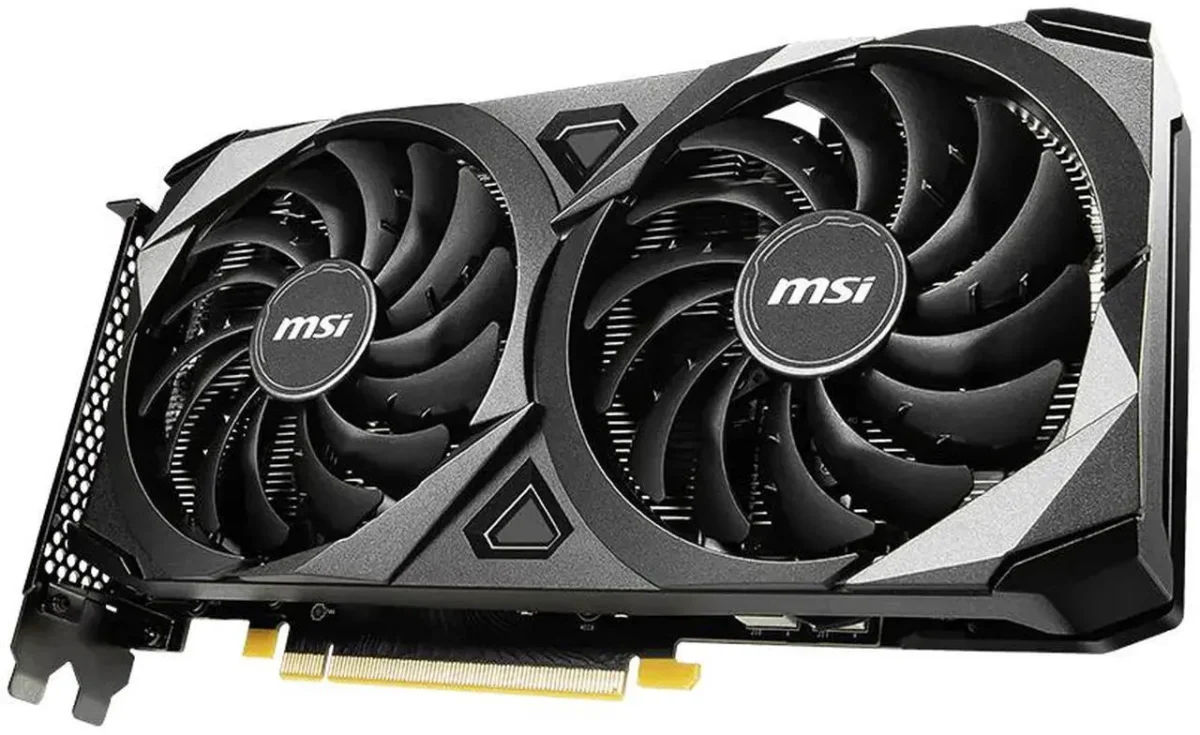
The specific unit spotted at retail is the MSI GeForce RTX 3060 Ventus 2X 12GB OC. This model is a testament to the longevity of the Ampere design. Key features include:
- GPU Boost Clock: A factory-overclocked boost of 1087 MHz.
- Thermal Management: The card utilizes a dual-fan cooling solution, which is more than sufficient given the RTX 3060’s relatively frugal power envelope.
- Build Quality: A dedicated steel backplate is included, which serves a dual purpose: it acts as a heat sink to aid in thermal dissipation and provides structural rigidity to prevent the PCB from bending or "sagging" over time.
- Connectivity: The I/O panel features three DisplayPort outputs and one HDMI 2.1 connector, ensuring compatibility with a wide range of modern monitors and VR headsets.
Official Responses and Industry Implications
Nvidia has remained characteristically tight-lipped regarding specific production quotas for "legacy" cards. However, the move suggests a broader shift in how the company views product lifecycles. By keeping the RTX 3060 in circulation, Nvidia effectively creates a "value tier" that prevents potential customers from jumping to competing AMD Radeon offerings, which are also aggressively priced in the budget sector.
Industry analysts interpret this as a strategy to mitigate the impact of AI-driven supply chain shortages. By leveraging existing manufacturing processes for the Ampere architecture—which are already highly optimized and cost-effective—Nvidia can maintain volume in the market without needing to divert precious wafer allocations from their flagship H100 or RTX 4090 production lines.
The AI Factor: The "Budget-Friendly" Laboratory
Perhaps the most intriguing implication of this re-release is the democratization of AI. For many users, the barrier to entry for experimenting with Generative AI has been the cost of high-VRAM hardware. By offering a card with 12GB of VRAM at the $330 price point, Nvidia is essentially providing a subsidized entry point into the AI ecosystem.
Users looking to run local chatbots, automate productivity tasks, or generate art can now do so on a stable, well-supported platform. This move sidesteps the privacy concerns associated with commercial AI agents, as all processing is handled locally on the user’s own machine. For the hobbyist or the student, the RTX 3060 12GB is arguably the most cost-effective "AI appliance" available on the market today.
Conclusion: A Rational Choice in an Irrational Market
The return of the RTX 3060 12GB is a fascinating case study in market adaptation. While it is rare for a previous-generation product to be actively marketed alongside its successors, the move makes perfect sense in the current economic climate.
For the average consumer, the choice is simple: pay a premium for the newest architecture, or opt for a proven, well-supported, and feature-rich card that delivers exactly what is needed for modern gaming and local AI development. With its 12GB buffer, solid cooling, and competitive pricing, the MSI Ventus 2X 3060 12GB OC proves that sometimes, the best new hardware is the one that has been around for years.
As we look toward the future of GPU releases, it will be interesting to see if this "legacy strategy" becomes a permanent fixture in Nvidia’s business model. For now, however, those in need of an affordable, high-utility graphics card have a clear winner to consider. Whether you are building a budget-friendly gaming rig or starting your journey into the world of local AI, the RTX 3060 is officially back—and it remains as relevant as ever.