Asep Darmawan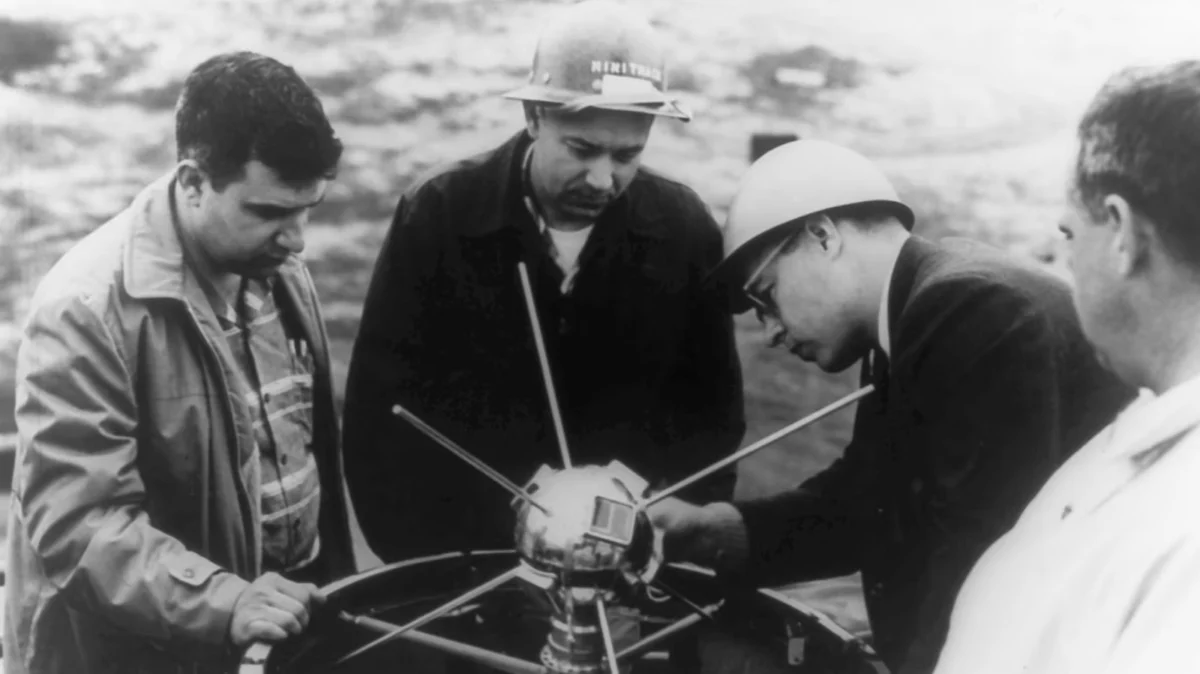
In the vast, cluttered tapestry of Earth’s orbit, where thousands of active satellites provide the backbone for global telecommunications, GPS navigation, and climate monitoring, one object stands apart. It is not a marvel of modern miniaturization or a sophisticated quantum-encrypted relay station. It is a small, grapefruit-sized sphere, pitted by decades of cosmic radiation and orbital debris. This is Vanguard 1, the oldest human-made object still circling our planet, a silent testament to the dawn of the Space Age.
Launched in 1958, Vanguard 1 was more than a satellite; it was a proof-of-concept that fundamentally changed the trajectory of space exploration. While its active mission ended over half a century ago, its continued presence in the heavens serves as a unique laboratory for scientists studying the long-term degradation of materials in the harsh vacuum of space.
The Dawn of the Space Age: A Chronology of Innovation
To understand the significance of Vanguard 1, one must look back to the mid-1950s—a period of intense geopolitical tension and rapid technological acceleration. Following the shocking success of the Soviet Union’s Sputnik 1 and 2, the United States was under immense pressure to demonstrate its own capabilities in orbit.
1957: The International Geophysical Year (IGY)
The United States committed to launching a satellite as part of the IGY, an 18-month international scientific campaign. The U.S. Naval Research Laboratory (NRL) was tasked with the development of the Vanguard program. Unlike the military-driven efforts of the time, the Vanguard program was initially framed through a scientific lens, aimed at studying the Earth’s upper atmosphere, its magnetic field, and the composition of the near-Earth space environment.
March 17, 1958: The Successful Launch
After several humiliating failures—most notably the Vanguard TV3 rocket that exploded on the launchpad in December 1957—Vanguard 1 was successfully placed into orbit by a Vanguard rocket from Cape Canaveral. It became the fourth human-made satellite to reach orbit, following the two Sputniks and the U.S. Army’s Explorer 1.
1958–1964: Scientific Utility
Vanguard 1 was a pioneer in power management. It was the first satellite to utilize solar cells, a technology that was in its infancy at the time. While the satellite’s chemical batteries died within 20 days, the solar panels continued to power its internal transmitters for six years, until 1964. During this time, the data it returned—specifically concerning the Earth’s shape—was groundbreaking. It revealed that the Earth is slightly "pear-shaped," with a bulge at the North Pole and a depression at the South, a discovery that fundamentally altered geodetic science.
Technical Specifications and Supporting Data
Vanguard 1 is a masterpiece of 1950s engineering. Measuring just 16.5 centimeters (6.4 inches) in diameter and weighing a mere 1.47 kilograms (3.25 pounds), it was designed for simplicity and resilience.
The Solar Revolution
The satellite carried six small, rectangular solar cells mounted on its aluminum body. At the time, the conversion efficiency of these cells was low, but their durability was sufficient to keep the satellite’s radio beacons alive far longer than traditional batteries could have. This success effectively cemented the future of solar energy as the primary power source for all subsequent long-duration space missions.
Orbital Mechanics and Cosmic Drag
Initially, mission planners estimated that Vanguard 1 would remain in orbit for up to 2,000 years. However, as our understanding of the upper atmosphere evolved, this estimate was significantly downgraded. Scientists discovered that the Earth’s atmosphere is not a static shell; it expands and contracts based on solar activity. This creates "atmospheric drag," which exerts a subtle but constant force on orbiting objects. Current models suggest that Vanguard 1 will likely remain in orbit for approximately 240 years, meaning it will eventually re-enter the atmosphere and burn up, likely sometime in the mid-22nd century.
The Challenge of Recovery: Engineering the Impossible
The prospect of "recovering" Vanguard 1 has been a subject of debate among aerospace engineers for years. The allure is undeniable: bringing back an object that has been in space for over 65 years would provide an unprecedented look at how space radiation, vacuum, and micro-meteoroid impacts affect materials over human-relevant timescales.
Technical Obstacles to Capture
Retrieving an object as small as Vanguard 1 is fraught with immense difficulty:
- Spin-Stabilization: Vanguard 1 was launched with a spin-stabilized design. To capture it, a robotic craft would need to match its rotational speed precisely to avoid damaging the delicate, fragile antennas that protrude from its surface.
- Lack of Grapple Points: Unlike the massive, modern satellites of today, which feature docking rings or capture fixtures, Vanguard 1 is a smooth, spherical object with no "handles." Designing a robotic end-effector capable of safely grasping a small, tumbling sphere without crushing it is a significant engineering hurdle.
- Debris Environment: The orbital path of Vanguard 1 has become increasingly crowded. Navigating a recovery vehicle to the satellite requires high-precision orbital maneuvering to avoid the very debris that poses a threat to the satellite itself.
The Financial and Regulatory Reality
Beyond the engineering challenges, there is the question of "Why?" and "Who pays?" NASA and the NRL have not officially greenlit any recovery missions. Such a project would require a multi-million dollar budget, likely necessitating a public-private partnership. Critics argue that the funds required to retrieve a historic relic could be better spent on active debris removal (ADR) missions targeting much larger, more dangerous pieces of space junk that threaten the safety of the International Space Station and commercial satellite constellations.
Implications: The Legacy of a Silent Pioneer
The story of Vanguard 1 is not merely one of antique technology; it is a lens through which we view our own evolution as a spacefaring civilization.
Scientific Value vs. Historical Preservation
If Vanguard 1 were returned to Earth, it would likely be housed in a museum, perhaps the National Air and Space Museum. However, the data gleaned from its metallic surface would be of immense interest to material scientists. Understanding how the alloys used in the 1950s have resisted corrosion and fatigue in space can inform the design of future deep-space habitats, such as those planned for the Moon or Mars.
The Ethical Question of Space Cleanup
The existence of Vanguard 1 also highlights the growing crisis of space debris. If we cannot—or choose not to—retrieve a harmless, small sphere from the 1950s, how do we tackle the thousands of tons of hazardous debris currently orbiting our planet? The debate over Vanguard 1 serves as a microcosm for the larger conversation regarding our responsibility to clean up the orbital environment.
Conclusion: A Monument in the Void
As Vanguard 1 continues its lonely, silent journey, it stands as a poignant reminder of human ingenuity. It was the first to harness the sun’s power to communicate from the heavens; it was the first to map the true shape of our world; and today, it is our longest-running experiment in orbital endurance.
Whether or not humanity ever manages to pluck this relic from the sky and bring it home, its place in history is secure. Vanguard 1 is not just a piece of metal; it is the bridge between the pre-space era and the modern age of digital connectivity. It is a sentinel that has watched the world transform from below, a small, polished sphere that remains a beacon of the incredible potential inherent in the human spirit to explore the unknown.
For now, the satellite continues to drift, a silent time capsule waiting for the day when technology finally catches up to the ambition of the engineers who sent it into the stars. Until then, it remains a proud inhabitant of the void, a silent witness to the generations that followed in its wake.


 Azzam Bilal Chamdy