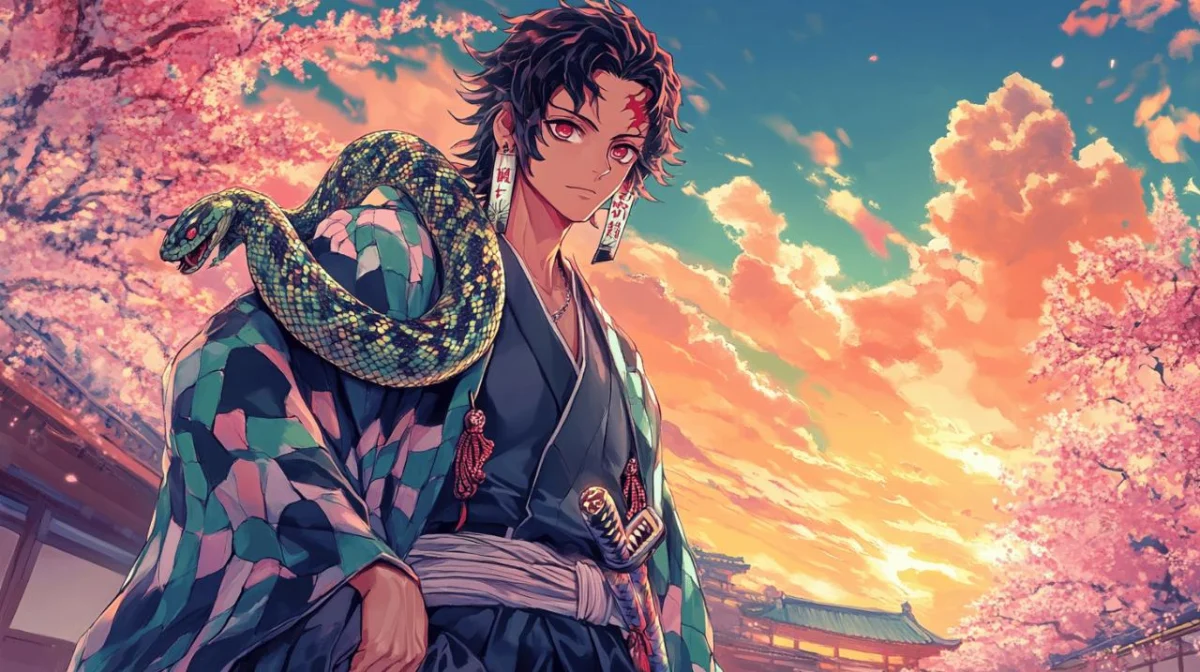
Within the rich, atmospheric tapestry of Koyoharu Gotouge’s Demon Slayer: Kimetsu no Yaiba, few characters command as much intrigue, pathos, and tactical brilliance as Obanai Iguro, the Serpent Hashira. Beneath his signature bandages and the watchful gaze of his serpentine companion, Kaburamaru, lies a narrative of profound trauma, redemption, and an unyielding commitment to justice. As one of the most enigmatic members of the Demon Slayer Corps, Iguro’s journey from a prisoner of a cursed lineage to an elite warrior serves as a cornerstone for the series’ thematic exploration of fate and human resilience.
Main Facts: The Anatomy of a Pillar
Obanai Iguro stands as a testament to the idea that one’s origins do not dictate their final contribution to the world. Born into a clan of criminals who worshipped a monstrous serpent demon, his early life was defined by entrapment and ritualistic abuse.
- Identity: The Serpent Hashira of the Demon Slayer Corps.
- Defining Physical Traits: A permanently scarred face—hidden beneath bandages—a result of a forced mutilation in his youth; a partially blind right eye; and his constant companion, the white snake Kaburamaru.
- Combat Specialization: The Serpent Breathing style, a derivative of Water Breathing characterized by erratic, slithering strikes that mimic the unpredictable movements of a serpent.
- Weaponry: A distinct, wavy-bladed Nichirin sword, designed to facilitate his fluid and complex attack patterns.
Iguro is not merely a swordsman; he is a tactical genius. Despite being physically smaller and possessing less raw muscular strength than many of his peers, such as Gyomei Himejima, he compensates with unparalleled agility, precise swordplay, and the ability to enter the "Transparent World"—a state of heightened perception that allows him to perceive the musculature and blood flow of his enemies.
Chronology: A Life Forged in Shadows
The trajectory of Obanai’s life can be divided into three distinct phases: the period of confinement, his ascension as a Hashira, and his final, defining stand against the Progenitor of Demons.
The Cursed Lineage (Childhood)
For over 370 years, the clan into which Obanai was born had not produced a male heir. His arrival was met with both reverence and cruelty. The clan’s prosperity relied on a pact with a female snake demon, and the young Obanai was treated as a sacrificial lamb. His mouth was forcibly cut to resemble that of the serpent deity, a permanent physical reminder of the trauma he endured. His eventual escape—facilitated by his own ingenuity and the death of his family at the hands of the demon he was meant to appease—marked the beginning of his life as a hunter of the very darkness that claimed his youth.
The Path to the Hashira
Rescued by Shinjuro Rengoku (the former Flame Hashira), Obanai channeled his bitterness into discipline. He joined the Demon Slayer Corps, training until his fingers bled and his instincts sharpened to a razor’s edge. His training regimen, which involved sparring in a confined space filled with human obstacles, allowed him to develop the extreme spatial awareness and flexibility that would later define his Serpent Breathing.
The Final Conflict: The Infinity Castle
The culmination of his life’s work occurred during the Infinity Castle Arc and the final battle against Muzan Kibutsuji. Here, Obanai’s growth—not just as a fighter, but as a person capable of forming deep emotional bonds—reached its zenith. He fought with a ferocity that transcended his physical limitations, eventually manifesting the Demon Slayer Mark and turning his blade crimson through pure force of will and grip strength.
Supporting Data: Tactical Prowess and Combat Philosophy
The combat efficacy of the Serpent Hashira is a subject of great interest among lore analysts. His "Serpent Breathing" is uniquely suited for multi-target engagement and unpredictable dueling.
Synergistic Combat: The Iguro-Kaburamaru Connection
Unlike other Hashira who fight alone, Obanai’s style is inherently dualistic. Kaburamaru is not merely a pet; he acts as an extension of Obanai’s senses. Because of Obanai’s blindness in his right eye, the snake serves as his peripheral vision, alerting him to threats from his blind spot. This symbiotic relationship allowed him to survive against Muzan’s relentless, high-speed assaults long after others had fallen.
The "Transparent World" and Crimson Nichirin
Obanai’s late-stage development in the final arc provides crucial insight into the ceiling of human potential. His ability to access the "Transparent World" allowed him to anticipate Muzan’s shifting internal organs, effectively countering the demon’s regeneration. Furthermore, the activation of his Crimson Nichirin blade, which effectively burns the demon’s flesh and slows its regeneration, was a critical factor in holding the line against the Demon King until sunrise.
Official Records: The Dynamic with Mitsuri Kanroji
The relationship between Iguro and the Love Hashira, Mitsuri Kanroji, is perhaps the most humanizing element of his character. In an organization defined by mortality and impending death, their bond provided a rare glimpse into the life these characters might have led under different circumstances.
Their connection was built on mutual respect and shared combat experience. For a man who felt "tainted" by his bloodline and his physical scars, Mitsuri’s genuine acceptance and sunny disposition were catalysts for his emotional transformation. The official records of their final moments in the series are often cited as one of the most poignant sequences in modern manga, highlighting that for all his talk of justice and duty, Iguro’s true motivation was the protection of the person who made him feel human.
Implications: The Legacy of the Serpent
The influence of Obanai Iguro extends beyond the immediate plot of Demon Slayer. He represents the archetype of the "Tragic Hero" who overcomes a cycle of abuse.
Impact on the Demon Slayer Corps
Iguro’s legacy is one of unwavering resolve. He was notoriously critical of other Hashira, often seen as cold or dismissive. However, this coldness was a defense mechanism; he knew the cost of the war and expected the same level of commitment from his peers that he demanded of himself. His ultimate sacrifice—laying down his life to ensure the survival of Tanjiro Kamado—served as the final seal of his dedication to the cause.
Thematic Significance
Obanai serves as a narrative mirror to the demons themselves. Like them, he was a victim of a cruel, restrictive environment. Yet, while the demons surrendered to their baser instincts and chose to prey upon humanity, Obanai chose to fight for it. He proves that while we cannot choose our birth or the traumas inflicted upon us, we have absolute agency over the legacy we leave behind.
Conclusion: A Pillar of Iron and Shadow
Obanai Iguro remains a complex, divisive, and deeply respected character. He is the embodiment of the phrase "strength through adversity." His story reminds readers that even the most broken individuals can become pillars of strength for others. As the Demon Slayer saga concludes, the image of the Serpent Hashira remains fixed in the collective memory of the fandom: a man who, despite a lifetime of darkness, fought with everything he had to ensure that the dawn would finally come for those who followed him.
His journey was not one of seeking glory, but of finding a way to wash away the blood of his ancestors with the service of a hero. In the annals of the Demon Slayer Corps, the name of Obanai Iguro is etched in the same crimson as the blade he carried—a permanent, defiant mark against the encroaching night.