Lina Irawan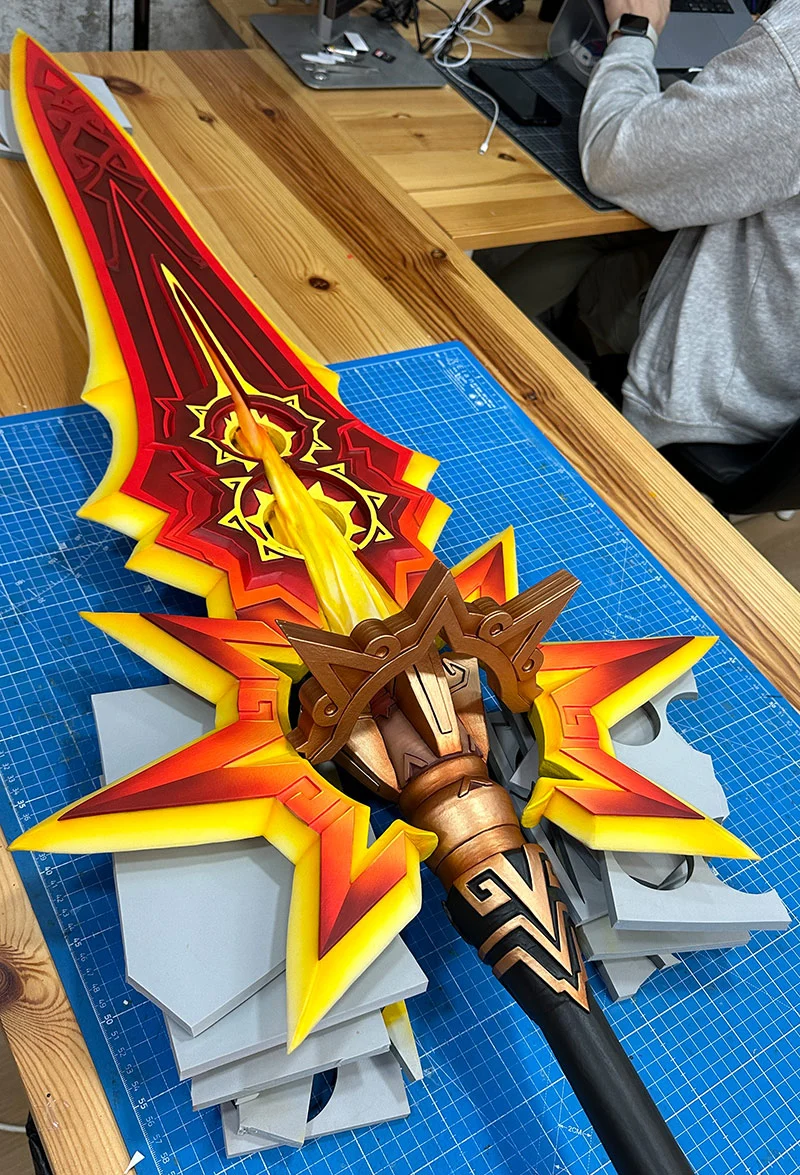
In the high-stakes world of professional cosplay, where character designs often push the boundaries of physics and reality, few projects capture the imagination like the weapons of Teyvat. Recently, renowned cosplay artist Kamui Cosplay took on her most ambitious challenge to date: bringing "A Thousand Blazing Suns," the legendary greatsword wielded by Mauvika, the Fire Archon of Natlan from Genshin Impact, into the physical realm. This project, born from a unique official collaboration with HoYoverse, represents a masterclass in modern crafting, blending traditional EVA foam artistry with advanced laser-cutting technology and intricate programmable lighting.
The Intersection of Passion and Professionalism
Cosplay has always been an exercise in merging personal obsession with technical skill. For Kamui, whose portfolio includes detailed recreations of characters like Yelan and Beidou, the allure of the Fire Archon was instantaneous. The design of Mauvika—defined by her striking aesthetics and the sheer, imposing scale of her signature weapon—presented a perfect opportunity to showcase the potential of EVA foam.

"Cosplay is all about combining passions," the artist notes. "I’ve always loved working with EVA foam and adding as many LEDs as possible to make props feel alive."
This project was elevated from a personal fan endeavor to a high-profile production when HoYoverse approached Kamui to create promotional content for the release of the new character. The coincidence was serendipitous; the studio needed a professional-grade representation of the Fire Archon’s gear, and Kamui was already mid-conceptualization. The resulting collaboration highlights a growing trend in the gaming industry: developers increasingly recognizing and partnering with top-tier creators to bridge the gap between digital assets and real-world fan engagement.

Chronology of a Craft: From Digital Model to Physical Prop
The creation of "A Thousand Blazing Suns" was a rigorous seven-day, full-time marathon. The process began with the essential step of blueprinting, which relied heavily on digital resources.
Step One: The Digital Blueprint
To achieve the level of accuracy expected in an official collaboration, Kamui bypassed standard reference screenshots in favor of official 3D models. By accessing resources like aplaybox.com, where HoYoverse hosts character assets, the team was able to extract the exact proportions of the weapon.

"Having the 3D model was incredibly helpful," Kamui explains. "It isn’t just great for understanding the overall look; it’s perfect for figuring out the correct scale." Interestingly, the final prop, while standing at an impressive two meters, was technically scaled down from the original game model’s massive, impossible dimensions. This decision was a deliberate aesthetic choice, ensuring the sword felt "natural" and wieldable for a human frame, rather than being restricted by the exaggerated proportions common in fantasy animation.
Step Two: Foam Architecture and Laser Precision
The structural integrity of the sword was paramount. Given its size, the core was reinforced with a sturdy PVC pipe, around which multiple layers of 10mm high-density EVA foam were sculpted. To accelerate the production phase, the team utilized a CO2 laser cutter to carve the foam pieces.

While the laser cutter offers unparalleled precision, the artist emphasizes that it is not a "shortcut" in the traditional sense. It requires complex vector files and meticulous preparation. "Using a laser cutter might actually make things more complicated rather than easier," she notes, highlighting that the tool’s value lies in consistency rather than reduced effort.
Step Three: Integrating the Light Engine
The "fire" element of the sword—the rocket-engine core—required sophisticated electronics. Kamui implemented a lighting rig featuring an Adafruit Feather M4 Express and an Adafruit Prop-Maker FeatherWing, powering 300 addressable RGB NeoPixel LEDs. The result is a dynamic lighting effect that can be triggered by physical interaction: when the sword strikes the ground, the pulsing fire animation is interrupted by a burst of brilliant white light. Hiding the battery packs and complex wiring within the grip was a significant engineering hurdle, but essential for the sword’s "clean" look.

Step Four: The Marathon Paint Job
Painting the sword proved to be the most grueling phase. Using a high-quality airbrush system with Vallejo metallic paints, the team had to work in stages, using layers of Frogtape and Tamiya tape to mask intricate sections. The high-stakes nature of this step—where one error in masking could peel the paint from a previous layer—kept the team in a near-constant state of focus. The work concluded at 6:00 AM after a twelve-hour painting sprint, followed by fine detailing using high-pigmentation acrylics.
Technical Specifications and Materials
The success of such a prop relies as much on the materials as the technique. The project utilized:

- Core Material: 10mm High-Density EVA Foam for structure; 2mm LED-diffusing foam for the glowing edges.
- Electronics: Adafruit Feather M4 Express and 300-pixel digital RGB LED strips.
- Painting Equipment: Iwata Eclipse HP-CS airbrush pistol with a master airbrush compressor.
- Adhesives: Standard contact cement for foam bonding.
The artist’s reliance on specialized materials—such as the Plastazote LD45 LED foam—demonstrates the professional evolution of the cosplay craft. By choosing materials that allow light to bleed through naturally, the prop achieves a professional finish that standard craft foam cannot emulate.
The Impact of Official Collaborations
This project serves as a case study for the implications of modern creator-developer partnerships. By providing assets like 3D models and commissioning high-quality physical replicas, companies like HoYoverse foster a community where fan creativity is treated as an extension of the brand’s marketing.

For the artist, this creates a unique pressure to deliver "official-level" quality. The response from the Genshin Impact community has been overwhelmingly positive, with the making-of videos serving as both educational content for aspiring crafters and promotional hype for the game’s expansion. The collaboration effectively transforms the "Fire Archon" from a digital code on a server into a tangible icon that fans can see, interact with, and aspire to replicate.
Conclusion: The Value of "Good Enough"
Perhaps the most poignant takeaway from the project is the artist’s philosophy regarding accuracy. Despite the ability to produce a one-to-one replica of the in-game asset, Kamui chose to prioritize human proportions and artistic balance over strict adherence to the game’s exaggerated scale.

"In the end, it’s far more important to be happy with your piece than to create something perfectly scaled to the insane proportions of a fictional character," she states.
As cosplay continues to transition from a niche hobby to a respected art form, the work of Kamui Cosplay and the support of major studios like HoYoverse highlight a new era. It is an era where the boundary between the digital game world and the physical reality is thinner than ever, built, layer by layer, with EVA foam, LED lights, and a staggering amount of dedication. For those inspired to try their hand at crafting their own version of "A Thousand Blazing Suns," the blueprints are available, but as the artist warns: "Getting into animated LEDs is highly addictive."

 Siti Muinah
 Azzam Bilal Chamdy