


In the high-stakes world of social media marketing, momentum is the only currency that matters. Campaigns are built on the precision of timing, and engagement is predicated on consistency. Yet, beneath the polished exterior of agency operations, a structural fragility exists that can bring even the most robust creative teams to a grinding halt.
It starts with a simple, common occurrence: one person calls in sick. Or they take a long-awaited vacation. Or they get pulled into a crisis meeting that runs for two days. Suddenly, the entire content engine stops. It isn’t because the creative team lacks vision, nor is it because the content isn’t ready. It happens because of a single, rigid point of failure: the approval chain. When a senior manager or a client’s marketing director is the only gatekeeper, the workflow is only as fast—and as resilient—as their availability.
The Anatomy of a Content Blackout
Social media agencies are increasingly finding themselves in a state of paralysis. We have witnessed countless campaigns missed during crucial conference weeks, content queues left untouched over long weekends, and clients questioning why their brand’s digital presence has gone dark while their competitors flood the feed with timely announcements.
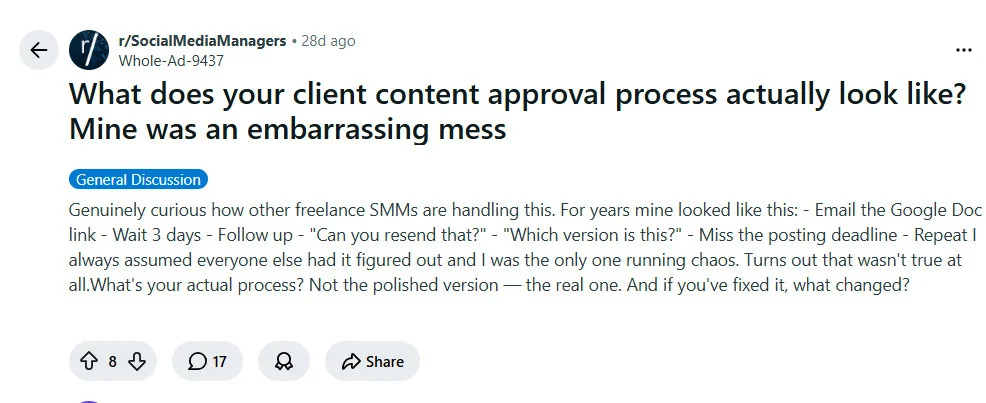
As one frustrated social media manager recently lamented on r/SocialMediaManagers, the issue is rarely about the quality of work or the competence of the team. It is a fundamental design flaw. When an agency relies on a "single-node" approval system, they are essentially outsourcing their operational continuity to the unpredictable schedules of a few individuals.
This is not a "people problem"; it is an architectural crisis. It is a design debt that accumulates in the background until the moment of greatest pressure, usually when there is no time left to fix it quietly.
Chronology of a Failed Workflow: From Growth to Stagnation
To understand how these bottlenecks form, one must look at the lifecycle of an agency’s growth.
1. The Startup Phase: The "Obvious" Choice
In the early days of an agency, a single-approver setup is not a bad idea—it is an efficient one. The owner or lead strategist approves every post because they possess the deepest understanding of the client’s voice and objectives. At this stage, it creates cohesion.
2. The Scaling Phase: The Habit of Dependency
As the agency grows to manage five, then eight, then fifteen clients, the approval habit remains unchanged. The team expands, but the workflow remains tethered to the same inbox. There is rarely a conscious decision to maintain this dependency; rather, it is a byproduct of institutional inertia. Nobody asks, "What happens when the primary contact is unreachable?" until they are forced to answer that question during a crisis.

3. The Crisis Phase: The Domino Effect
Once a primary approver becomes unavailable, the downstream effects are immediate and severe. A single unread email stalls the entire production line: the copywriter’s script, the designer’s edit, the scheduler’s queue, and the analytics tracking. When the client notices the silence, the blame falls on the agency, even though the agency was technically "ready to go."
Supporting Data: The High Cost of Stagnation
The numbers paint a bleak picture of the industry’s reliance on manual, siloed approval processes. According to research from Gleanster and Kapost, a staggering 92% of marketers identify approval delays as the primary culprit behind missed deadlines.
The operational damage is quantifiable. Data from the Content Marketing Institute’s 2025 report reveals that 47% of B2B marketers view workflow and approval management as a significant operational bottleneck. Furthermore, a 2023 report by Ziflow on the "State of Creative Workflow" highlights that 65% of marketers lose more than a day of productivity per week simply chasing feedback.
These statistics confirm a singular truth: the bottleneck is not the volume of work, but the process by which that work is validated. When the system requires a human "traffic cop" to sign off on every movement, the traffic will inevitably back up the moment that person steps away from their post.
Official Perspectives: The Industry Consensus
The discourse among industry professionals—from Reddit forums to executive boardrooms—is shifting toward a demand for decentralized workflows. Agency owners are beginning to realize that "Quality Control" has morphed into "Quality Inhibition."
One agency owner noted on r/freelance that client approval delays had become their single largest operational challenge. The frustration is not just with the client, but with the lack of a standardized recovery plan. The consensus is clear: the fix is not to hire faster communicators or to send more follow-up emails. The fix is to remove the "Single Point of Failure" (SPOF) entirely from the equation.
Reimagining the Workflow: Decentralized Approval
Agencies that have successfully eliminated content blackouts have abandoned the idea of a singular, gatekeeping authority. Instead, they have moved toward a system defined by three pillars:
1. Designated Redundancy
A professional agency does not rely on a "mental" backup plan; they codify it. Every approval role must have a named, secondary contact with the same access and context. When the primary contact is unreachable, the backup is authorized to step in without needing to request login credentials or catch up on weeks of context.
2. Policy-Driven Operations
Coverage policies should not be verbal assumptions; they must be written into client agreements. These policies answer the critical questions: Who steps in when the primary is out? At what point does the backup assume authority? By defining these boundaries, agencies remove the ambiguity that leads to hesitation and delay.
3. Tool-Enabled Agility
The final component is the adoption of technology that enforces these policies. Platforms like SocialPilot, for instance, are engineered to prevent individual dependencies. By allowing multiple administrators to clear a queue, the system ensures that content flows regardless of one person’s status.
With features like "shareable approval links," clients can provide feedback without complex logins. And, crucially, the implementation of "Auto-Approve" toggles ensures that if a client remains unresponsive, the campaign maintains its momentum on schedule, preventing the dreaded "posting gap."
Implications for the Future
The implications of maintaining a single-approver workflow are profound. Beyond the loss of revenue and the damage to client relationships, there is a significant impact on employee morale. When a team is constantly blocked, their ability to execute is stifled, leading to burnout and frustration.
If your organization’s answer to "what happens when the approver is away" is "we will figure it out," you have already failed the test of scalability. You have built an operation where one person’s absence becomes everyone else’s emergency.
To determine if your agency is currently at risk, consider these five benchmarks:
- Is there a named backup for every client account?
- Is the backup procedure documented in your client contracts?
- Does the backup possess the necessary tool access today?
- Is there a defined timeline for escalation or auto-publishing?
- If you disappeared for 48 hours, would your client’s social media presence remain active?
If you answered "No" to more than two of these questions, your next content blackout is not a possibility; it is a mathematical certainty. You simply do not yet know the date.
The shift to a resilient, decentralized approval workflow does not require a total overhaul of your business model. For most agencies, it is a matter of spending an afternoon configuring roles, drafting clear policies, and ensuring your software stack supports the new reality. The question is no longer whether you have the time to implement these changes—it is whether you can afford to continue operating without them while your competitors move forward in real-time.











No comments yet. Be the first to join the conversation!