

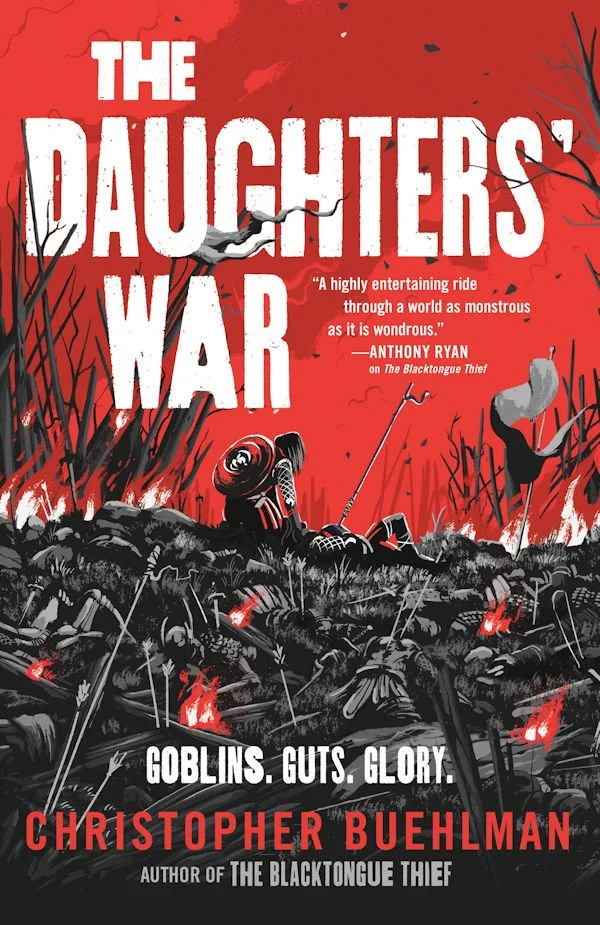
The landscape of modern fantasy has long been populated by familiar tropes, but few authors possess the visceral, bone-chilling clarity of Christopher Buehlman. With the release of The Daughters’ War, the highly anticipated prequel to his cult-classic The Blacktongue Thief, Buehlman has once again thrust readers into a world where humanity is not merely fighting for territory, but for its very survival against an enemy that views them as livestock.
Set against the backdrop of a continent besieged by a relentless goblin horde—the terrifying "Biters"—the novel follows Galva, a woman born into the noble Dom Braga family who trades her inheritance for the blood-soaked reality of the front lines. As she joins the "Raven Knights," an all-female unit tethered to magically engineered war corvids, the narrative unfolds not as a glorious epic of conquest, but as an intimate, harrowing account of the cost of total war.
The Genesis of Conflict: Main Facts and Premise
The Daughters’ War serves as a foundational text for the world established in The Blacktongue Thief, focusing on the origin story of Galva. The premise is stark: the goblins have decimated the traditional military, annihilated the cavalry, and reduced cities to ash. With the male population largely exhausted, the burden of defense falls upon the daughters of the realm.
The core of the story revolves around the Raven Knights. These are not traditional soldiers; they are a specialized, untested unit forged in the darkest magics. They fight alongside giant, intelligent, and lethal black birds—corvids—that act as both weapons and companions. The narrative tracks Galva’s progression from a sheltered noble to a hardened warrior, providing the necessary context for the stoic, formidable presence she embodies in Buehlman’s earlier work.
Chronology of Despair: A Narrative Arc
The novel is structured as a chronological descent into the machinery of war, yet it maintains a human heartbeat through its pacing and perspective shifts.
The Opening Gambit
The story begins in the wake of societal collapse. Readers are dropped into the conflict with minimal exposition, forced to acclimate to a world where the rules of engagement have been rewritten by a monstrous enemy. While the opening chapters may feel deliberately paced, they serve a vital purpose: establishing the suffocating, grounded reality of a world under siege.
The Interludes of Amiel
The narrative is primarily anchored in Galva’s viewpoint, but it is punctuated by journal entries from her younger brother, Amiel. These interludes provide a critical tonal contrast. While Galva’s voice is sharp, resolute, and increasingly hardened, Amiel’s entries offer a more sensitive, introspective, and at times romanticized perspective of the struggle. This juxtaposition highlights the tragedy of a generation lost to a war they were never meant to fight.
The Climax
As the Raven Knights march toward a fallen city, the tension escalates from a simmering dread to a high-octane, emotional peak. The final movement of the book is a masterclass in tension, oscillating between moments of raw terror and surprising, earned elation. It is a conclusion that does not merely resolve the plot; it solidifies the character arc of a protagonist who has been irrevocably changed by the "short life, bloody hand" philosophy of her era.
Supporting Data: The Anatomy of the Enemy
One of the most striking aspects of The Daughters’ War is its rejection of the "comic relief" trope often associated with goblins in fantasy literature. Buehlman draws from the darkest wells of medieval folklore to craft the "Biters."
- The Nature of the Biters: These are not mere soldiers; they are predators. They view humans (referred to in the text as "kynd") as cattle—resources to be caged, butchered, and consumed.
- The Psychological Toll: The horror of the Biters is not just their physical prowess, but their absolute, casual disregard for human sentience. This existential threat creates a constant, oppressive atmosphere that informs every tactical decision Galva makes.
- The Corvids as a Strategic Asset: The corvids represent a desperate gamble. By weaving these creatures into the narrative, Buehlman introduces a magical element that feels as dangerous as it is useful. The bond between the knights and the birds serves as a mirror for the themes of trust and survival in an environment where neither is guaranteed.
Official Perspective and Artistic Intent
While Christopher Buehlman has not issued a formal "manifesto" regarding the book, his artistic intent is clear through the craftsmanship of the prose. In interviews and through the structure of the text, it is evident that the goal was to provide an "eyewitness account" rather than a strategic overview.
The author emphasizes that this is not a story about the politics of war, but the experience of it. By focusing on the emotional evolution of Galva—her exploration of her sexuality, her grief for her brothers, and her growing reliance on her corvids—Buehlman elevates the story from a grimdark combat manual to a deeply human portrait of resilience. The "official" stance of the narrative, if one can call it that, is that war does not build character; it strips away everything until only the core of the individual remains.
The Implications: A New Standard for Grimdark
The success of The Daughters’ War has profound implications for the Blacktongue series and the genre at large.
The Re-contextualization of The Blacktongue Thief
For those who have already read the author’s previous work, this prequel changes the landscape. Galva’s temperament, which might have seemed simply "tough" or "stoic" in the original novel, now carries the weight of her formative traumas. Returning to The Blacktongue Thief after reading this will undoubtedly be a richer, more melancholy experience.
Pacing and the "Quiet" Moment
Buehlman’s use of pacing is a critique of the modern "escalation-only" trend in epic fantasy. By inserting moments of absolute stillness—quiet scenes of reflection and companionship—he gives the reader the space to process the carnage. This balance prevents the "war fatigue" that often plagues long-form fantasy, ensuring that when the violence returns, it carries the necessary weight.
The Humanization of the Warrior
Perhaps the most significant implication of the book is its success in humanizing the "hardened soldier" archetype. Galva’s evolution is not a result of a magical quest or a destiny-driven prophecy; it is a result of trauma, survival, and the slow, painful process of finding something worth living for in a world that wants you dead.
Conclusion: The Road Ahead
The Daughters’ War is a testament to the idea that some hopes are worth any risk. It is a brutal, unflinching, and quietly devastating exploration of what it means to be human when the world has decided you are merely prey. By stripping away the layers of heroism often applied to war, Buehlman exposes the raw, pulsing nerve of survival.
As the series continues, the bar has been set exceptionally high. Readers looking for a lighthearted romp will find no solace here; however, those seeking a complex, character-driven descent into the blood-soaked mire of history will find The Daughters’ War to be a triumph.
With The Thrice-Bound Fool set to release in October, the momentum of this series is undeniable. Whether you are a long-time fan of the Blacktongue universe or a newcomer to Buehlman’s evocative prose, the story of Galva stands as one of the most compelling narratives in modern fantasy. The promise remains: "Short life, bloody hand." It is a promise kept with brutal, exquisite precision.










No comments yet. Be the first to join the conversation!