

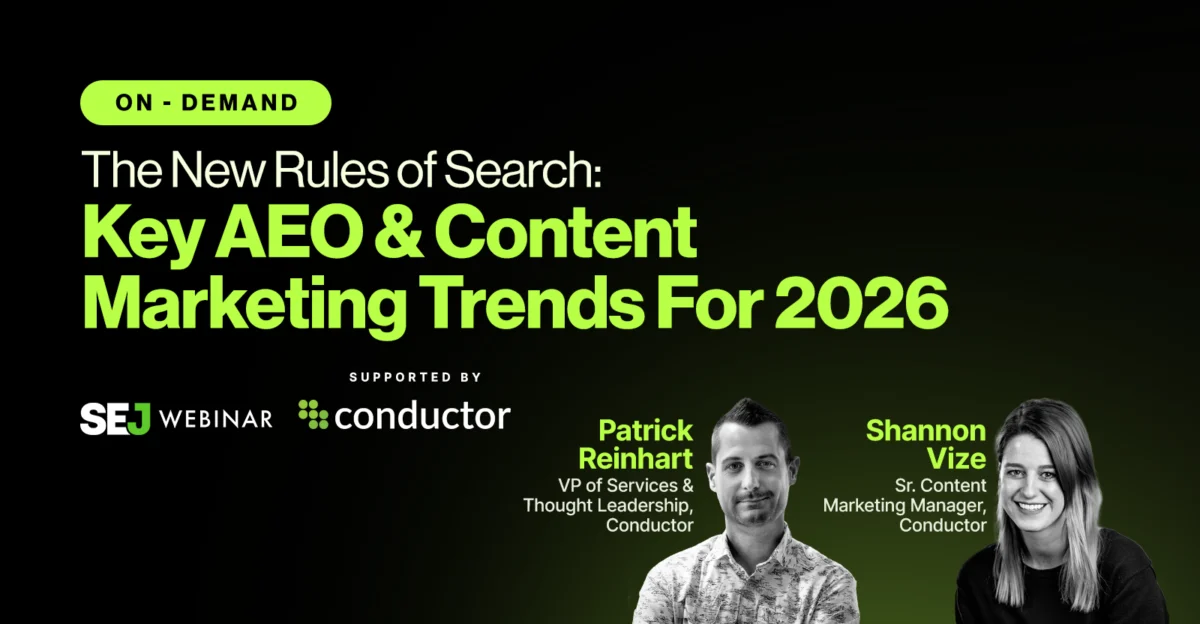
The landscape of search is undergoing its most radical transformation since the inception of the World Wide Web. As we move further into 2026, the era of the "ten blue links" has largely ceded territory to the era of the "answer engine." For digital marketers, SEO professionals, and brand strategists, the shift from traditional search engine optimization (SEO) to Answer Engine Optimization (AEO) is no longer a forward-looking trend—it is an immediate operational imperative.
In a recent industry deep dive, experts from Conductor—Shannon Vize, Senior Content Marketing Manager, and Pat Reinhart, VP of Services and Thought Leadership—unpacked the complexities of this transition. Their insights provide a roadmap for brands navigating a fragmented search environment where AI, not just algorithms, determines visibility and consumer trust.
The Core Shift: From Traffic to Authority
The fundamental question facing every digital marketing department today is: How do you measure success when the AI answer replaces the click?
Historically, SEO success was binary: did the user click the link, and did that click lead to a conversion? Today, the primary objective is citation. When a user queries a Large Language Model (LLM) like ChatGPT, Claude, or Perplexity, the model synthesizes information from across the web to provide an immediate response. If your brand is not the source of that synthesized data, your visibility effectively drops to zero.
Understanding the AEO Framework
AEO is not merely "SEO for AI." While traditional SEO focuses on keyword stuffing and backlink acquisition, AEO prioritizes entity authority, semantic clarity, and factual accuracy.
"Brands need to stop thinking about ranking for keywords and start thinking about owning the conversation," says Pat Reinhart. This requires a two-pronged strategy:
- Technical Semantics: Structuring data so that AI models can crawl, parse, and trust your content as a primary source.
- Brand Entity Strength: Ensuring your brand is recognized as an authoritative entity by the model’s training data and real-time indexing.
Chronology of the Search Evolution
To understand where we are in 2026, we must look at the rapid progression that led us here:
- 2022–2023 (The Generative Inflection Point): The public release of ChatGPT triggered a massive shift in user behavior. Search behavior moved from "find me a website" to "answer my question."
- 2024 (The Era of Search Generative Experience): Major search engines integrated generative AI directly into the SERP (Search Engine Results Page). Brands began to see the "Zero-Click" phenomenon accelerate, as answers were presented directly on the results page.
- 2025 (The Fragmentation Phase): The rise of specialized LLMs and agentic AI tools meant that search was no longer centralized. Users began querying specific tools for coding, shopping, or research, forcing brands to diversify their visibility strategies across multiple platforms.
- 2026 (The Operationalization Phase): We have entered a period where "wait and see" is no longer a viable strategy. Companies are now building dedicated AEO teams, integrating AI-ready content formats into their CMS workflows, and prioritizing citation metrics over traditional click-through rates (CTR).
Supporting Data: Why Visibility is at Risk
Current industry benchmarks indicate that traditional organic traffic for many B2B and B2C brands has plateaued or declined as users increasingly rely on AI-assisted summaries.
According to data presented by Conductor, brands that fail to adapt their content to the "Answer Engine" paradigm are seeing a direct correlation between the decline in their brand entity mentions in AI responses and a loss of top-of-funnel customer acquisition.
Key Performance Indicators for 2026
Traditional metrics like domain authority and keyword ranking are becoming secondary. The new "North Star" metrics include:
- Share of Answer: What percentage of queries related to your industry result in your brand being cited by the leading LLMs?
- Sentiment Alignment: Is the AI representing your brand’s value proposition accurately?
- Citation Velocity: The rate at which your new content is picked up and referenced by AI models.
Official Perspectives: Expert Strategies for 2026
During their presentation, Vize and Reinhart emphasized that AEO is not about gaming the system, but rather about operationalizing transparency and value.
The "Visibility-First" Content Strategy
Content must be structured in ways that are "AI-friendly." This involves:
- Modular Content: Breaking information into clear, distinct units (tables, bulleted summaries, and concise definitions) that an AI can easily extract.
- First-Party Data Integration: AI models crave unique, proprietary data. Brands that publish original research and exclusive insights are significantly more likely to be cited as sources.
- Agentic Workflows: Utilizing AI to help create content that is optimized for AI consumption. This recursive process—using AI to refine content that is then used to train or inform other AI—is the hallmark of a mature 2026 marketing strategy.
Implications for Modern Marketing
The transition to an AI-first search landscape has profound implications for brand management and budget allocation.
Budgeting for AI
Companies are shifting budget away from high-volume, low-intent keyword SEO toward high-authority content production. This includes investment in:
- Thought Leadership: Senior executives are now being tasked with producing content that establishes the brand’s "entity authority."
- Technical Infrastructure: Investing in schema markup and structured data that makes brand information "machine-readable."
The Risk of Inaction
The greatest risk to any brand in 2026 is becoming "invisible." If your brand does not appear in the AI-generated answer, you are effectively excluded from the consumer’s decision-making process. For e-commerce brands, this means missing out on product comparisons; for B2B brands, it means missing out on being listed as a viable vendor.
Conclusion: Preparing for the Future
As we look toward the remainder of 2026, the message is clear: The "rules" of search have been rewritten. The brands that win will be those that view AI not as a competitor, but as a distribution partner.
By focusing on authority-building formats, embracing agentic workflows, and shifting metrics to prioritize citations, marketers can regain control over their digital visibility. The transition to AEO is not a temporary trend; it is a fundamental evolution of how knowledge is surfaced and consumed.
For those looking to stay ahead, the priority is simple: Start optimizing for the answer, not just the link.
For those interested in the full tactical framework and in-depth trend analysis discussed by the experts at Conductor, the full on-demand session is available for viewing. By integrating these strategies, your team can ensure that when an AI speaks about your industry, it is speaking about your brand.












No comments yet. Be the first to join the conversation!