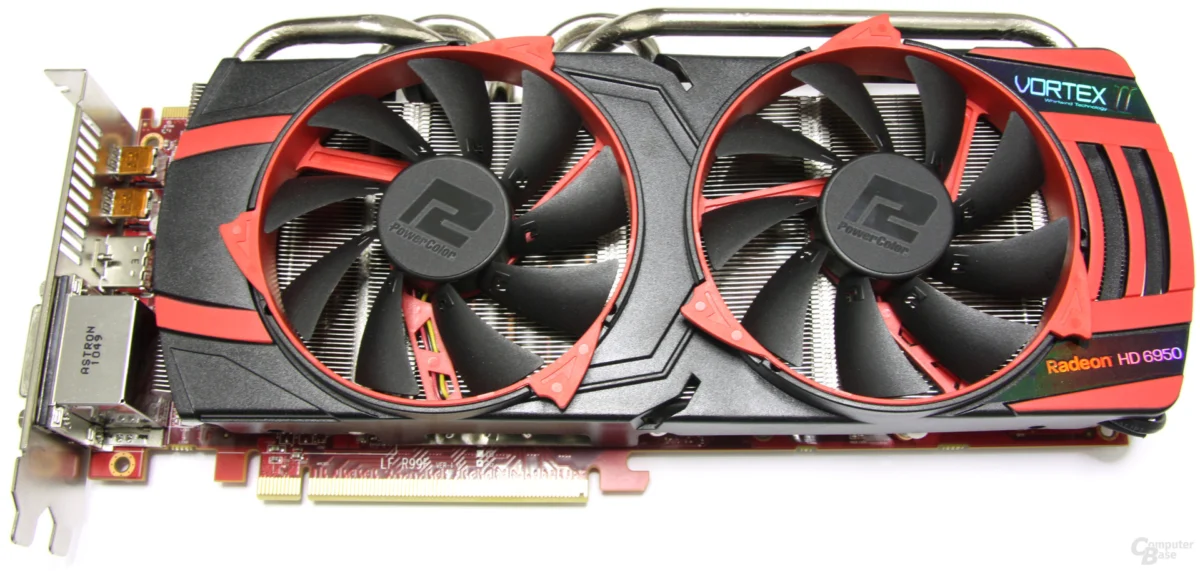
In the competitive landscape of the early 2010s, GPU manufacturers were constantly seeking innovative ways to differentiate their products from the sea of reference-design cards. Among these, PowerColor stood out with its "Vortex" series, a line of graphics cards characterized by unconventional cooling solutions. The PowerColor Radeon HD 6950 Vortex PCS+ remains one of the most curious artifacts from this era—a product that attempted to solve the cooling and noise issues of the Cayman architecture through a mechanical gimmick that, while innovative in design, ultimately struggled to prove its worth in practice.
Main Facts: A Bold Experiment in Thermal Management
The PowerColor Radeon HD 6950 Vortex PCS+ was not merely a factory-overclocked card; it was a structural reimagining of how a graphics card could occupy space within a PC chassis. At its heart, the card utilized a modified Printed Circuit Board (PCB) derived from the more powerful Radeon HD 6970, providing a robust power delivery system that hinted at overclocking potential.
The defining feature of the Vortex PCS+ was its bespoke Dual-Slot cooling assembly. Composed of a copper baseplate and an extensive aluminum radiator, the heat was managed by four high-performance heatpipes. The cooling was driven by two 85mm axial fans, which were housed in a unique mechanism: the user could physically rotate the plastic fan shrouds, causing the fans to extend outward. This action effectively transitioned the card from a standard Dual-Slot footprint to a Triple-Slot design. PowerColor’s marketing rationale was straightforward: by increasing the clearance between the fans and the heatsink, they aimed to improve airflow efficiency, thereby reducing both operating temperatures and acoustic output.
Chronology: A Diverse Portfolio
The Vortex PCS+ arrived at a time when the Radeon HD 6950 was a staple of the enthusiast market. It was PowerColor’s fourth iteration of the card, highlighting a strategy of extreme market segmentation. The lineup included:
- The Reference Design: The standard AMD implementation.
- The "Dual-Fan" Model: An entry-level custom cooling solution.
- The "PCS++": A high-tier card that featured official support for unlocking the card’s dormant shader units, effectively transforming it into a full-fat HD 6970.
- The "Vortex PCS+": The engineering showpiece, focusing on thermal customization.
The release of the Vortex PCS+ underscored a period of rapid iteration for PowerColor. While other manufacturers were focused purely on board power or factory clocks, PowerColor was experimenting with the physical form factor of the cooling shroud, trying to find a balance between performance and the inherent noise constraints of the Cayman architecture.
Supporting Data: The Performance Gap
In our laboratory testing, the Vortex PCS+ demonstrated a solid, if not revolutionary, performance profile. Out of the box, it offered a four percent performance lead over the reference Radeon HD 6950. This gain was primarily attributed to the modest factory overclock applied to the core and memory.
However, when measured against the "PCS++" variant—which featured the unlocked shader units—the Vortex trailed by approximately three percent. This raised a fundamental question for consumers: was it better to have an "extensible" cooling solution or an unlocked core? In terms of raw frame rates, the unlocked shaders were consistently the superior choice for gamers, leaving the Vortex to appeal to those interested in thermal engineering rather than pure performance-per-dollar.
Thermal and Acoustic Analysis
The most critical aspect of the review was determining if the mechanical "Vortex" fan extension actually delivered on its promise. Under heavy load, the card registered 49.5 dB(A). When the fans were extended to the Triple-Slot position, the noise level dropped by a marginal 1 dB(A).
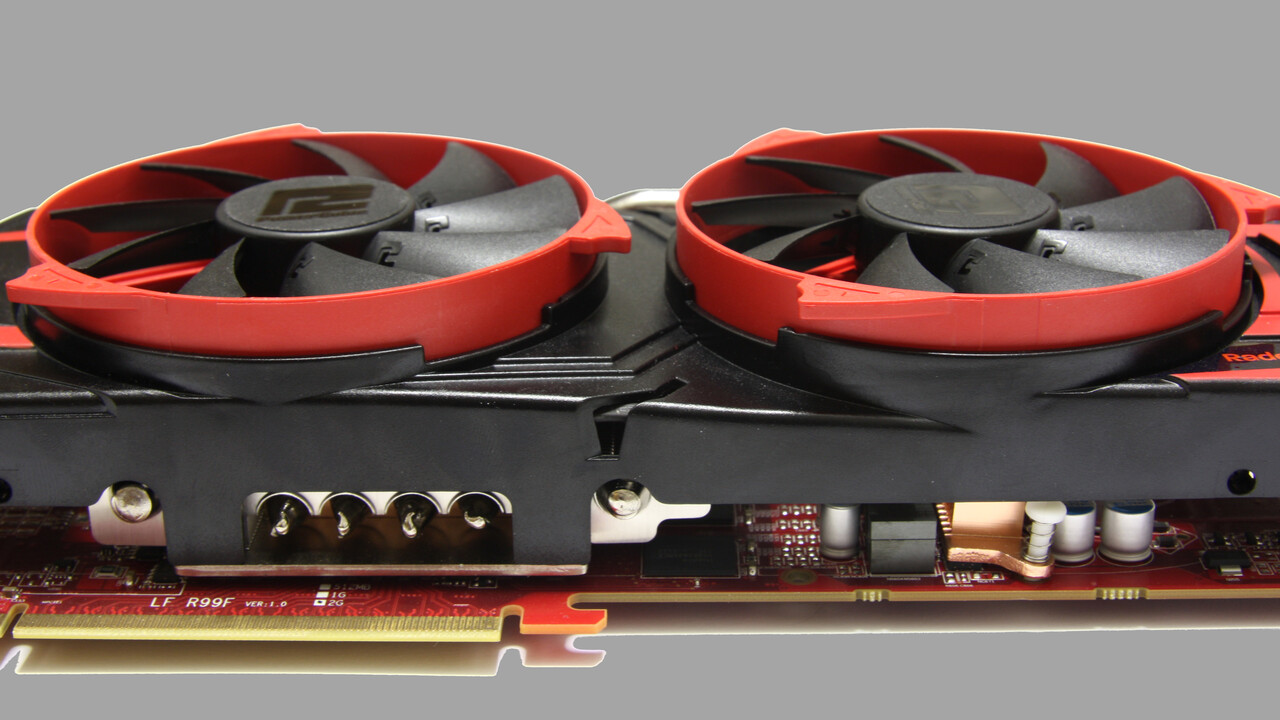
In objective terms, this was a negligible difference. Furthermore, the GPU temperature remained identical regardless of whether the fans were in the Dual-Slot or Triple-Slot position. The thermal efficiency gain promised by the increased airflow was essentially non-existent. Overclocking attempts were similarly underwhelming; the card offered little headroom, yielding a maximum performance increase of only three percent beyond the factory settings.
Official Responses and Market Positioning
At launch, the Vortex PCS+ was listed by retailers at approximately 248 Euro—a premium of roughly 50 Euro over the reference design. PowerColor’s official communication suggested that this high entry price was a result of initial scarcity and that the real-world premium should have been closer to 20 Euro.
Even at a 20-Euro markup, the value proposition was debatable. While the cooling solution was undeniably quieter and more robust than the reference blower-style fan, the mechanical complexity of the "extendable" shroud added a point of failure without offering a measurable cooling benefit. For the average user, the card was a "cool-looking" piece of hardware that looked impressive in a showcase but failed to provide the functional utility its name implied.
Implications: A Lesson in Over-Engineering
Looking back at the PowerColor Radeon HD 6950 Vortex PCS+ fifteen years later, it stands as a poignant reminder of the "innovation trap." During this period, GPU vendors were desperate to avoid the negative stigma associated with the loud, inefficient reference coolers of the era.
The implications of the Vortex experiment are twofold:
- The Limits of Mechanical Tinkering: The card proved that simply increasing physical space for airflow does not equate to better thermal performance if the underlying heatpipe and radiator architecture are not optimized to utilize that space.
- Consumer Value: The industry eventually learned that consumers prioritize reliable, static cooling solutions—such as high-quality triple-fan designs—over mechanical gimmicks that require user interaction. The "Vortex" concept, while intellectually interesting, was essentially a placebo. It was a solution in search of a problem.
Despite these shortcomings, the Vortex PCS+ is a beloved piece of "retro" hardware. It represents a time when GPU manufacturers were willing to take significant risks in industrial design. The card was well-built, looked distinctive, and performed adequately. It remains a fascinating case study for students of hardware history, illustrating the thin line between a revolutionary feature and a marketing-driven novelty.
As we look back from the vantage point of today’s highly efficient, triple-fan cooling solutions, the PowerColor Vortex serves as a reminder that the most effective cooling solutions are usually those that prioritize simplicity and airflow dynamics over moving parts. It remains a noteworthy chapter in the evolution of graphics card design—a bold attempt to redefine the form factor that ultimately served as a stepping stone toward the more refined, effective cooling systems we enjoy in the modern era.