Nila Kartika Wati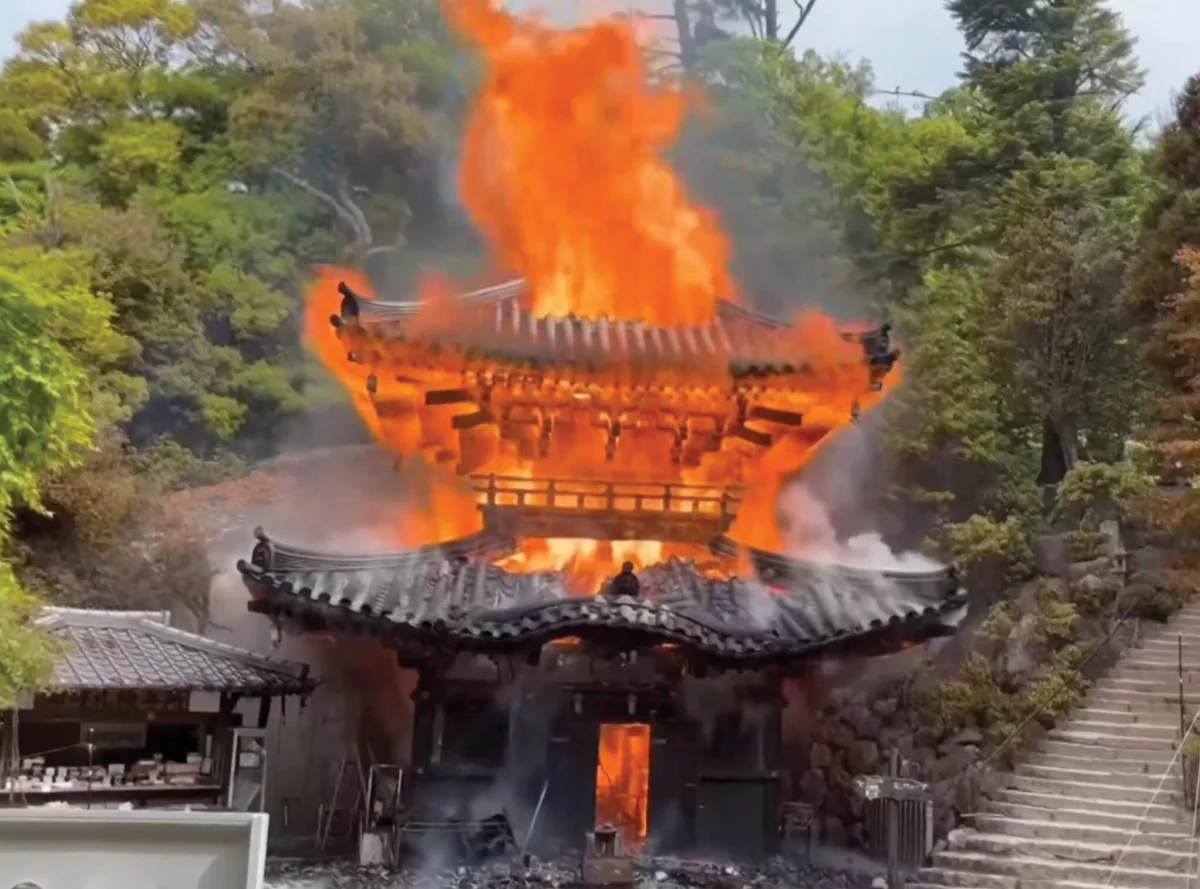
By Investigative Desk
Updated: May 21, 2026
The morning silence of Mount Misen, the sacred peak overlooking the UNESCO World Heritage site of Miyajima Island, was shattered on Wednesday by the sight of thick, black smoke billowing from the mountainside. By the time emergency responders arrived, the historic Reikado Hall—a site of profound spiritual significance—had been reduced to charred timber and ash.
This devastating loss marks the latest chapter in a harrowing series of fires that have plagued Japan’s religious landmarks throughout the first half of 2026. As investigators sift through the embers, a nation grapples with the potential loss of not just physical architecture, but the tangible threads of its cultural and spiritual heritage.
The Destruction of Reikado Hall: A Spiritual Tragedy
At approximately 8:30 a.m. on Wednesday, local fire services received an urgent distress call reporting smoke rising from the slopes of Mount Misen. The blaze, which originated within the Reikado Hall, proved difficult to combat due to the site’s rugged, remote location on the island. While firefighting efforts successfully prevented the inferno from consuming the surrounding ancient woodlands, the hall itself could not be saved.
Reikado Hall served as a pivotal component of the Daishoin Temple, one of the primary seats of the Omuro School of Shingon Buddhism. Its destruction is particularly poignant due to the loss of the Kiezu-no-hi, or "Eternal Flame." According to long-standing tradition, this flame was kindled by the monk Kobo Daishi (Kukai) in 806 AD. For nearly 1,200 years, the fire was said to have burned without interruption.
The flame’s historical resonance extends far beyond the temple walls; it is revered as one of the source fires that feeds the Flame of Peace at the Hiroshima Peace Memorial Park. The disappearance of this specific fire, which has served as a symbol of endurance and prayer for over a millennium, has left a void in the local community that many fear cannot be easily replaced.
A History of Resilience and Ruin
The Reikado Hall is no stranger to the volatile relationship between Japan’s wooden architecture and the element of fire. The structure has suffered multiple cycles of destruction and rebirth throughout its long history.
In 2005, a significant blaze completely destroyed the hall. At that time, investigators concluded that the fire was likely sparked by the improper disposal of combustible materials and the burning of dead wood within the sanctuary. The site was painstakingly reconstructed by 2006 to preserve both the architectural integrity of the Daishoin temple complex and the continuity of the sacred flame.
The fact that the hall was once again lost to fire less than two decades after its last reconstruction has sparked intense public scrutiny. While police are currently treating the incident as a subject of active investigation, the recurring nature of fires at this location raises uncomfortable questions regarding fire safety protocols in historic, highly flammable wooden structures.
A Nationwide Crisis: The 2026 Surge in Temple Fires
The destruction of Reikado Hall is not an isolated event; it is part of a broader, alarming trend that has seen Japan’s religious heritage sites under siege throughout 2026. Data from the first five months of the year reveals a statistically significant rise in fires affecting temples and shrines, many of which date back centuries.

The Chronology of Destruction
The year began with a series of tragic incidents that have left the religious community in mourning:
- February 2026: Two separate incidents occurred in Ehime Prefecture. Horenji Temple in Kumakogen was destroyed, and a fire at the residence of the head priest at Hotoji Temple resulted in a tragic loss of life, with the priest’s wife perishing in the flames.
- Late February 2026: A catastrophic fire at Shorinji Temple in Yamaguchi Prefecture claimed the lives of five individuals, drawing national attention to the vulnerability of temple complexes that serve as both residences and places of worship.
- April 2026: Reports emerged of fires at Renshoji Temple in Toyama Prefecture and the Urufushine Shrine in Nabari, Mie Prefecture.
- May 6, 2026: The Furumachi Atago Shrine in Niigata Prefecture, a 300-year-old Shinto landmark famously dedicated to the deity of fire prevention, was lost entirely.
- May 16, 2026: Just ten days prior to the Miyajima incident, the 573-year-old Daihoji Temple in Takaoka, Toyama, was reduced to ruins. Founded in 1453, the temple’s main wooden hall was completely decimated.
Official Responses and Investigative Challenges
Government agencies, including the Agency for Cultural Affairs and local prefectural police, are under mounting pressure to provide a cohesive strategy to address the crisis.
In a statement following the Miyajima blaze, local authorities emphasized the logistical difficulties inherent in protecting these sites. "Many of our most precious cultural assets are located in mountainous or remote areas where emergency access is limited," a fire service spokesperson noted. "Furthermore, the materials used in these structures—centuries-old timber, traditional paper screens, and thatched roofs—are inherently susceptible to rapid ignition."
The police investigation into the Reikado Hall fire is focused on whether the cause was accidental, such as a localized electrical fault, or if there is a broader pattern of negligence or foul play. However, officials are cautious about drawing direct links between the various fires occurring across the country, as the circumstances of each site differ significantly.
The Cultural and Economic Implications
The loss of these sites represents an incalculable hit to Japan’s "Cultural Soft Power." For many of these rural communities, the local temple or shrine is not merely a place of worship; it is the economic and social heart of the town, drawing tourism and maintaining the continuity of local traditions.
The Dilemma of Preservation vs. Safety
The current crisis has reignited a fierce debate between preservationists and safety experts.
- Strict Modernization: Some argue that historic sites must be equipped with modern sprinkler systems, fire-resistant coatings, and state-of-the-art sensors.
- Architectural Integrity: Others contend that such interventions alter the historical authenticity of the buildings, potentially damaging the very heritage they are meant to protect.
- Human Factors: The tragedy at Shorinji Temple highlighted the danger of mixing residential living quarters with wooden temple architecture. There is a growing movement to separate living spaces from active worship halls to reduce the risk of accidental household fires.
Looking Ahead: A National Effort
As the nation processes the loss of Reikado Hall, the Ministry of Internal Affairs and Communications is expected to convene a special committee to review fire safety standards for Japan’s thousands of registered "Important Cultural Properties."
The loss of the "Eternal Flame" serves as a harrowing metaphor for the fragility of the past. While fire has always been a part of the history of Japanese architecture—a reality often accepted as a part of the impermanence of life—the frequency of this year’s events suggests that the status quo is no longer sustainable.
As Japan looks toward the remainder of 2026, the question is not just how to extinguish fires, but how to ensure that the light of history is not permanently snuffed out by a combination of aging infrastructure, environmental risks, and the inevitable passage of time. The people of Miyajima, along with the thousands of devotees across the country, remain in a state of solemn reflection, awaiting answers that may never fully compensate for what has been lost.
The investigation continues, but for the faithful, the focus now turns to the prospect of renewal—and the hope that, like the phoenix, the sacred traditions of these sites might rise again from the ashes.


 Neng Nana
 Asro
Asro