

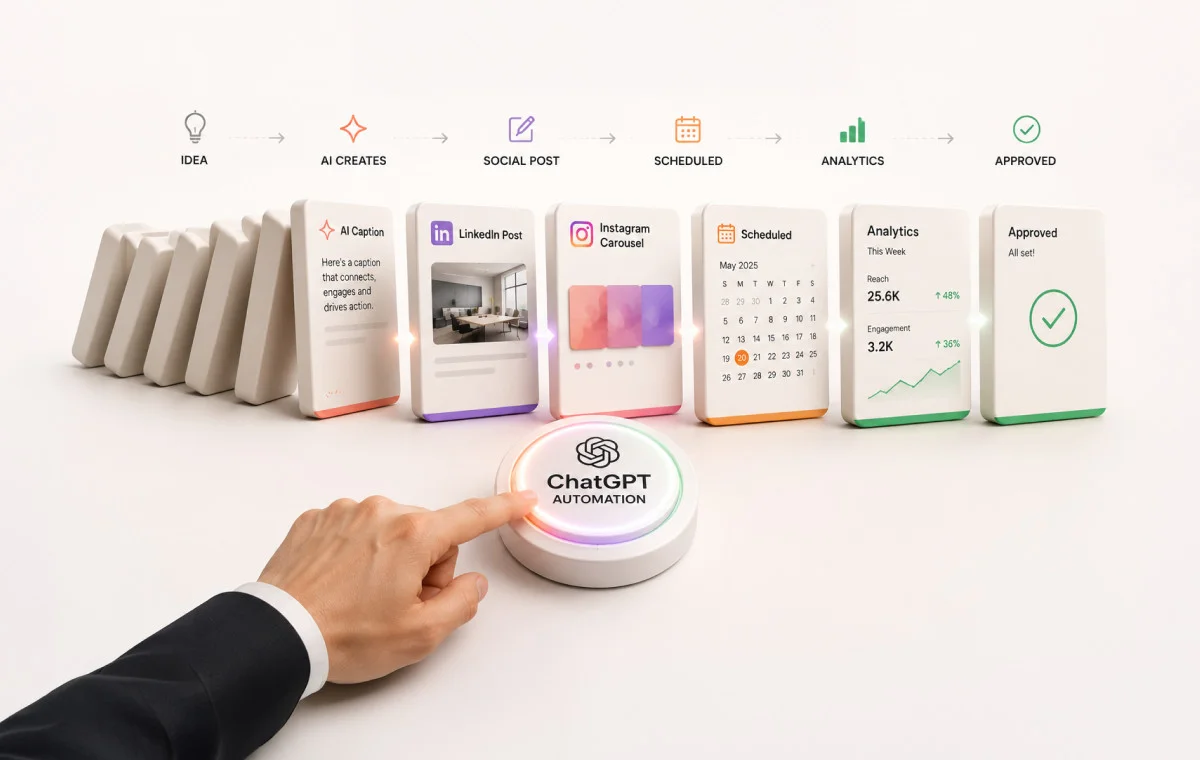
For the better part of a decade, the life of a social media manager (SMM) has been defined by the "tab-switching grind." It was a fragmented existence: brainstorming in a document, drafting in an AI tool, moving copy to a scheduler, jumping into a design platform to create visuals, and finally exporting spreadsheets to analyze performance.
Most professionals use ChatGPT today for mere ideation or caption drafting. A smaller, more sophisticated subset uses it for trend analysis. But until recently, almost no one could claim that their social media operation ran from start to finish without human intervention. That era of manual handoffs has officially ended. With the arrival of the Model Context Protocol (MCP), ChatGPT has evolved from a writing assistant into a comprehensive workflow engine.
The Paradigm Shift: ChatGPT as a Workflow Hub
Before the advent of MCP, ChatGPT was a closed-loop system. You prompted the AI, it generated text, and you—the human operator—were the bridge that carried that output into your marketing stack. This "manual handoff" was the primary bottleneck in digital marketing.
The Model Context Protocol, an open standard championed by Anthropic and rapidly adopted by OpenAI and Google, has fundamentally altered this relationship. MCP allows AI models to connect directly to external tools via API without requiring the complex, fragile web of third-party integration platforms like Zapier or Make.
When ChatGPT connects to a platform like SocialPilot via an MCP server, it gains the ability to reach out and touch the live dashboard. It can pull real-time analytics, draft content directly into the scheduling queue, and trigger design briefs within tools like Canva. It is no longer just a place to write; it is the control room where the workflow resides.
Chronology: The Evolution of AI Integration
To understand the current state of automation, one must look at the progression of the last 24 months:
- 2024 (The Era of the Assistant): AI was used in isolation. Users copied and pasted outputs between windows. The human remained the "central processor" for all data migration.
- Early 2025 (The Connector Phase): Initial plugins and basic API integrations emerged, but they were often limited, prone to breaking, and required significant technical overhead to maintain.
- Late 2025/Early 2026 (The MCP Breakthrough): The industry coalesced around the Model Context Protocol. By standardizing how AI "talks" to databases and scheduling APIs, the friction of integration evaporated.
- Current State (Autonomous Pipelines): We have entered the era of the "Self-Driving Agency." Through tools like ChatGPT Codex and persistent MCP configurations, AI systems now operate on triggers, schedules, and event-based logic.
Two Paths to Automation: Chat vs. Codex
As of 2026, there are two distinct ways to leverage these new capabilities. The choice depends entirely on whether the user wants to stay within the "workflow loop" or move to a "hands-off" autonomous model.
The ChatGPT Chat Interface (The "Fast-Manual" Approach)
This is the familiar chat interface, enhanced by Apps (the consumer-facing term for MCP connectors). Here, the user is the trigger. You open a session, activate your connected tools, and guide the AI through a series of tasks. It is ideal for SMMs who want to maintain editorial control while offloading the drudgery of data entry and formatting.
The Codex Surface (The "Autonomous" Approach)
For agencies and power users, ChatGPT Codex is the standard. It utilizes a config.toml file to keep MCP connections active indefinitely. It stores reusable "Skills" in SKILL.md files, which act as a persistent memory for brand voice, client briefs, and content pillars. Unlike the Chat interface, Codex can run complex, multi-stage pipelines on a set schedule without the user ever opening the browser.
| Feature | ChatGPT Chat | ChatGPT Codex |
|---|---|---|
| Connectivity | Session-based (Apps) | Persistent (config.toml) |
| Logic | Manual Prompting | Skills (SKILL.md) |
| Execution | Scheduled Tasks (Light) | Full Automations (Deep) |
| Ideal User | Solo SMM / Freelancer | Agencies / Power Users |
Supporting Data: The Mechanics of the Pipeline
The efficacy of these systems relies on three core components: the Connection (MCP), the Memory (Skills), and the Trigger (Automations).
The Power of Skills
A "Skill" is a structured set of instructions that tells the AI exactly how to execute a specific business function. For example, a "Research Skill" is not just a prompt; it is a repository of your specific niche, preferred angles, and performance benchmarks. By storing this in a SKILL.md file, the AI essentially learns your brand DNA.
Crucial Insight: Expert users do not write these files from scratch. They run a task manually, verify the quality of the output, and then instruct the AI to "reverse-engineer" that success into a reusable Skill. This ensures that the system is built on proven results rather than speculative prompting.
The Architecture of Automations
Automations function in two primary modes:
- Standalone: The system starts from scratch, perfect for weekly content production.
- Threaded: The system maintains context from previous runs, critical for ongoing tasks like monitoring competitor trends or tracking long-term campaign performance.
Implications for the Industry
The shift to MCP-powered operations carries significant implications for the future of digital marketing.
1. The Death of Administrative Drudgery
Tasks that once occupied hours—exporting CSVs for reporting, copying content from Notion to SocialPilot, or formatting images for different platforms—are now handled in seconds. This allows professionals to shift their focus from "execution" to "strategy."
2. The Rise of the "Content Flywheel"
Perhaps the most potent implication is the ability to create closed-loop systems. In a Content Flywheel, a blog post published on a website can act as a trigger. An MCP-connected AI detects the new post, summarizes it into five LinkedIn posts, creates three Instagram carousels, schedules them for the upcoming week, and creates a report once they have been published. The human only needs to approve the final calendar.
3. Scaling Agency Operations
For agencies, this technology effectively decouples revenue growth from headcount growth. An agency can now manage 50 clients with the same team that previously handled 10. By standardizing "Skills" across the agency, the quality of output becomes uniform, regardless of which account manager is overseeing the project.
Official Guidance: Best Practices for Implementation
If you are looking to integrate these systems, the following roadmap is recommended:
- Phase 1: Build the Foundation. Connect your primary scheduler (e.g., SocialPilot) and project management tool (e.g., Notion) via MCP. Do not attempt to automate before you have confirmed these pipes are flowing.
- Phase 2: Master the Manual Workflow. Run your processes manually in ChatGPT for two weeks. Capture the prompts that work.
- Phase 3: Codify into Skills. Once your manual process is consistent, move to the Codex environment and create your
AGENTS.mdandSKILL.mdfiles. - Phase 4: Enable Automations. Only after the logic is perfect should you attach the automation triggers.
Conclusion: Reclaiming the Human Element
Social media management has never been about the mechanical act of hitting "post" or downloading an analytics report. Those are the mechanics, not the work. The true work is the judgment—deciding what message resonates with an audience, identifying the right moment to speak, and maintaining the integrity of a brand voice.
By delegating the mechanical layer to MCP-connected agents, marketers are finally being given the opportunity to do what they were hired for: creative strategy. The posts will go out, the reports will come in, and the calendar will remain full—all while you are focusing on the high-level growth that drives business value. The future of social media isn’t just about using AI; it’s about building systems that run themselves.












No comments yet. Be the first to join the conversation!