

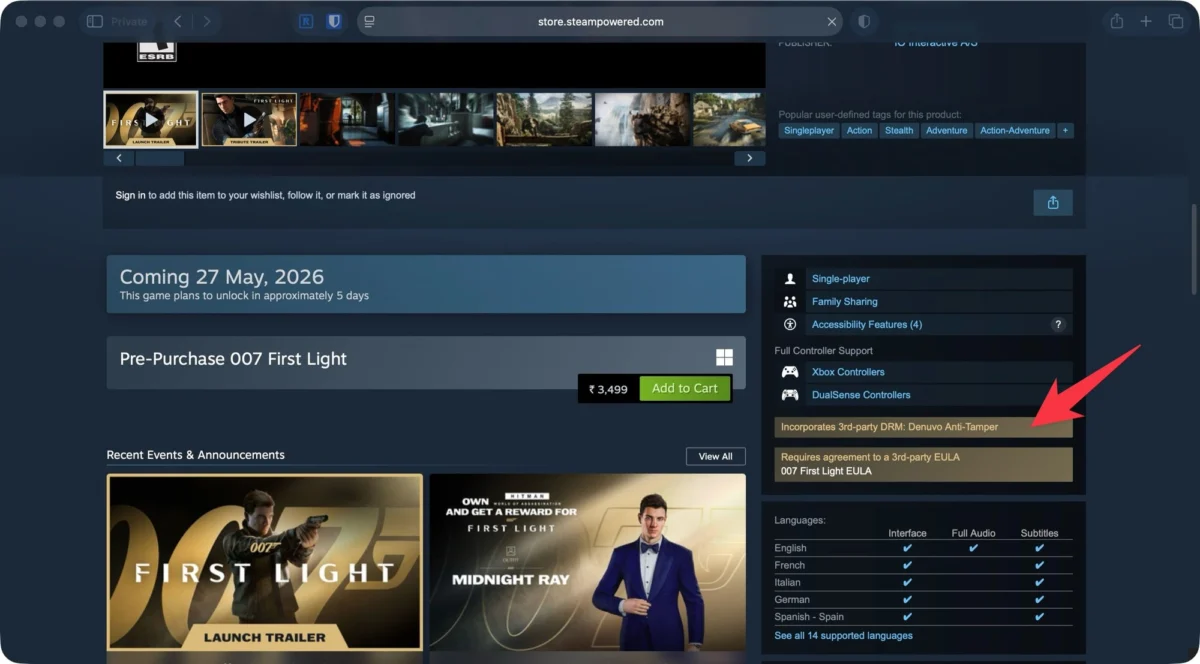
The highly anticipated return of the world’s most famous secret agent to the world of interactive entertainment has hit a significant diplomatic crisis. Just six days before the scheduled May 27th release of 007: First Light, publisher IO Interactive executed a maneuver that has left the gaming community feeling shaken—and certainly not stirred. By quietly updating the game’s Steam page to include a disclaimer for Denuvo, a controversial anti-tamper DRM (Digital Rights Management) software, the developer has triggered a wave of pre-order cancellations and a firestorm of public outcry.
For a title carrying the prestige of the James Bond brand, the move is being viewed by many as a classic "villain move," alienating a core fanbase that had been eager to embrace the franchise’s gaming resurgence.
The Chronology of a Controversy
The tension began in the lead-up to the highly anticipated launch window. For months, 007: First Light was positioned as a premium, must-play title, promising a high-fidelity cinematic experience worthy of the Bond name. However, the atmosphere shifted drastically on May 21st.

Without a formal press release or a transparent community update, the Steam store page for 007: First Light was silently amended. Tucked away in the fine print was a new notice: the inclusion of third-party Denuvo Anti-Tamper technology.
The reaction from the player base was instantaneous. Within hours of the discovery, social media platforms, Reddit, and Steam community forums were flooded with threads from disgruntled customers demanding refunds. This is not the first time such a tactic has been employed, but the timing—less than a week before the game’s debut—struck a particularly sour chord. The incident mirrors the backlash surrounding Crimson Desert in March, where a similar eleventh-hour reveal of Denuvo led to a mass exodus of pre-orders. By failing to disclose the software integration during the initial pre-purchase period, IO Interactive has effectively eroded the trust of its most dedicated supporters.
Understanding the "Denuvo Dilemma"
To understand why a simple line of text on a store page can cause such a widespread reaction, one must examine the long-standing animosity between the PC gaming community and Denuvo.

Performance Overhead and Stability
The primary concern among enthusiasts is performance. Denuvo operates by checking the authenticity of a game’s files at runtime, a process that inherently consumes CPU cycles. While developers often argue that this impact is negligible, empirical evidence from titles such as Resident Evil Village and Hogwarts Legacy has shown that Denuvo can, in certain configurations, lead to stuttering, longer load times, and reduced frame rates. For a game like 007: First Light, which already demanded high-end specifications—initially recommending a staggering 32GB of RAM for 1080p 60 FPS gameplay—the addition of an extra layer of software overhead has left many questioning whether the game will be adequately optimized for day-one performance.
The "Always-Online" Barrier
Perhaps the most egregious grievance for the average consumer is the requirement for online connectivity. Even for single-player, narrative-driven experiences, Denuvo often necessitates an internet connection to verify a user’s license. In an era where players value ownership, offline capability, and preservation, the idea that a single-player game might become inaccessible due to a server outage or a lost internet connection is a major point of contention.
System Requirements: A History of Miscalculation
The Denuvo controversy is compounded by the fact that the technical expectations for 007: First Light have been in a state of flux since the game was first revealed. When the initial hardware requirements were posted, the recommendation of 32GB of RAM for standard 1080p play was met with widespread ridicule and confusion.

While IO Interactive eventually walked back these requirements, settling on a more manageable 16GB, the damage to consumer confidence had already been done. The combination of a high-barrier entry and the late-stage addition of invasive DRM has created a narrative that the game is "bloated" or "unoptimized." For a brand that prides itself on precision and elegance, the technical rollout of 007: First Light has been anything but smooth.
The Call for Transparency: Is Valve Doing Enough?
As the debate rages on, the focus has shifted toward the platform holder: Valve. Steam users are increasingly vocal in their demand for a change in policy regarding how publishers disclose software requirements.
Petitions are circulating on community hubs, urging Valve to mandate that any anti-tamper or kernel-level DRM must be clearly listed on the store page before a game becomes available for pre-order. This movement is part of a larger push for accountability in the industry, echoing recent complaints regarding the use of undisclosed generative AI assets in video games.

Critics argue that by allowing publishers to "hide" features like Denuvo until the final week, platforms like Steam are complicit in deceptive marketing practices. For the consumer, a pre-order is a contract based on the information provided at the time of purchase; if that information changes significantly, the contract is essentially violated.
Implications for IO Interactive and the 007 Brand
The fallout from this incident extends beyond a few lost pre-orders. It touches on the broader health of the relationship between developers and their audience. IO Interactive, a studio respected for the Hitman franchise’s depth and player freedom, now finds itself in a precarious position.
The Cost of Erosion
Trust is a currency that is difficult to earn and incredibly easy to lose. When a developer treats their audience with a lack of transparency, it creates a "pre-order hesitancy" that can persist for years. For the James Bond franchise, which has been absent from the gaming space for a significant period, this was meant to be a triumphant return. Instead, the focus has shifted from the game’s quality to its backend security features.

Long-Term Accessibility Concerns
There is also the matter of long-term preservation. Denuvo is a proprietary service; if the company behind it ever folds, or if the publisher decides to stop supporting the game’s authentication servers, legitimate copies of the game could become essentially "bricked." For a title that many fans intend to keep in their digital library for years, this is a valid, existential concern for the medium of digital media.
Looking Forward: A Lesson in Public Relations
Whether IO Interactive will provide a statement or consider removing the DRM in a post-launch patch remains purely speculative. However, the historical data suggests that when a company ignores such a vocal segment of its audience, the resulting drop in sales and review scores often speaks louder than any marketing campaign.
If the industry is to learn anything from the 007: First Light incident, it is that players are more informed and more protective of their experience than ever before. In an age where digital distribution is the standard, transparency is not a luxury—it is a requirement.

As the May 27th launch approaches, all eyes will be on the game’s performance. Will 007: First Light deliver an experience so compelling that it makes the community forget this initial controversy, or will it be remembered as a cautionary tale of how to alienate a fanbase through poor communication?
For now, the situation serves as a stark reminder: even for a super-spy, there are some missions that simply cannot be completed successfully if you start by burning your bridges. The gaming community is waiting, not with baited breath, but with a finger hovering firmly over the "Request Refund" button. Whether the game survives this "villainous" move will depend on whether the final product can justify the compromises being forced upon its players.












No comments yet. Be the first to join the conversation!