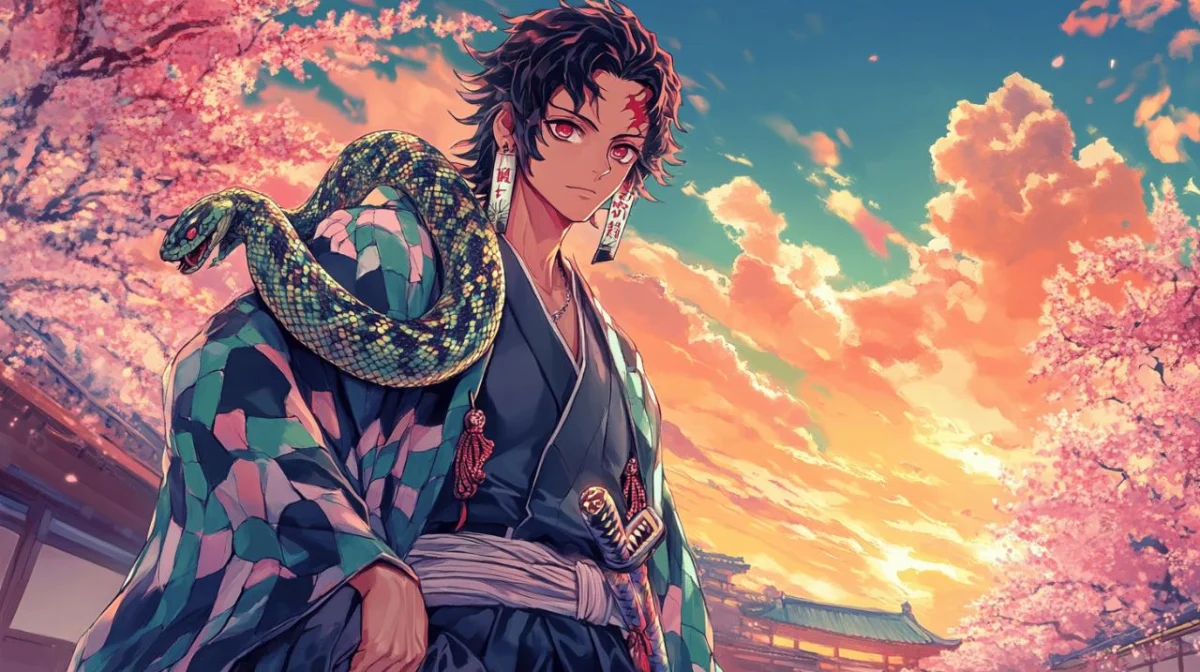
In the expansive and often brutal world of Demon Slayer: Kimetsu no Yaiba, few characters command as much respect, intrigue, and melancholic admiration as Obanai Iguro, the Serpent Hashira. As one of the elite Pillars within the Demon Slayer Corps, Obanai represents the pinnacle of human martial discipline refined through a crucible of absolute suffering. His journey from a prisoner of ancestral superstition to a guardian of humanity is not merely a tale of swordsmanship; it is a profound exploration of identity, redemption, and the enduring power of love.
Main Facts: The Anatomy of a Pillar
Obanai Iguro is defined by his duality: a man of immense, cold-blooded tactical precision and a heart capable of profound, sacrificial warmth. Standing at 162 cm and weighing 53 kg, his physical stature is deceptively slight, yet he possesses a lethal agility that defies conventional metrics.
The most striking visual elements of Obanai are his physical markers of trauma: his mouth, permanently scarred into a cruel smile, and his mismatched eyes, with the right blinded by a history he refuses to forgive. Always accompanied by his white serpent companion, Kaburamaru, Obanai operates not as a solo warrior, but as a symbiotic unit. His mastery of "Serpent Breathing"—a derivative of Water Breathing—allows for unconventional, undulating strikes that bypass traditional defenses, making him a nightmare for even the most formidable Upper Rank demons.
Chronology: From the Serpent’s Cage to the Final Dawn
To understand Obanai, one must look at the dark origins of his clan. Born into a family of opportunistic thieves who lived in the shadow of a serpentine demon, Obanai was an anomaly. He was the first male born into his lineage in 370 years, a status that invited not love, but horrific imprisonment.
The Shackles of Tradition
Obanai’s childhood was spent behind bars, pampered as a prized possession but perpetually under the threat of the demon his family worshipped. The trauma of his upbringing culminated in the brutal ritualistic scarring of his mouth, an attempt to make him resemble the demon they served. His eventual escape was not a victory of strength, but a harrowing flight fueled by desperation. After his family was decimated by the creature they worshipped—an act that left him with a deep-seated self-loathing—he was taken in by the Demon Slayer Corps, where he transformed his trauma into the weapon that would define his life.
The Path to the Hashira
Obanai’s rise through the ranks was marked by a relentless, self-punishing work ethic. His training regimen, which involved honing his sword skills while navigating human obstacles, forced him to develop a spatial awareness and unpredictability that few peers could match. By the age of 21, he had secured his position as the Serpent Hashira, armed with a Nichirin sword that could turn a vivid crimson through intense friction and grip strength—a testament to his absolute resolve.
Supporting Data: Tactical Analysis and Combat Prowess
When analyzing the combat efficiency of the Demon Slayer Corps, Obanai Obanai occupies a specific, essential niche. He is not the brute force that Gyomei Himejima represents, nor the raw speed of Tengen Uzui. Instead, he is the master of circumvention.
The Serpent Breathing Technique
The Serpent Breathing style relies on the "swerving" nature of a snake. Obanai’s strikes do not travel in straight lines; they whip around obstacles, making it nearly impossible for enemies to predict the angle of impact. This style is further enhanced by his synchronization with Kaburamaru. The snake acts as a sensory extension for Obanai, detecting incoming attacks that his blind eye cannot see.
Sensory Augmentation
During the final battle against Muzan Kibutsuji, Obanai achieved two of the most prestigious milestones for a Demon Slayer: the awakening of his Demon Slayer Mark and the ability to access the "Transparent World." The latter allowed him to see the musculature, blood flow, and organ movement of his opponents, essentially slowing down time in his perception. These, combined with the "Crimson Blade" effect, elevated him to a level where he could engage the Progenitor of Demons on even footing, despite being significantly exhausted and wounded.
The Mitsuri Connection: A Beacon of Humanity
If Obanai’s life was defined by the darkness of his past, his soul was tethered to the light by Mitsuri Kanroji, the Love Hashira. Their relationship is one of the most poignant narratives in the series, serving as a reminder of what the Demon Slayers were fighting to protect.
The Evolution of Affection
Initially, Obanai’s interactions with Mitsuri were characterized by a protective, almost cynical distance. His self-loathing—stemming from his "polluted" bloodline—made him feel unworthy of her vibrant, unfiltered kindness. However, as they fought side-by-side, the barrier between them dissolved. Mitsuri’s ability to see past his scars and his prickly exterior allowed Obanai to experience a level of acceptance he had never known. Their final moments together are not portrayed as a defeat, but as a promise of a future, a tragic aspiration that underscores the ultimate cost of their war.
Implications: The Legacy of the Serpent
The role of Obanai Iguro in the final conflict against Muzan Kibutsuji cannot be overstated. He was the catalyst that kept the offensive alive when hope was at its nadir.
A Catalyst for Victory
In the "Countdown to the Dawn" arc, Obanai’s tactical brilliance ensured that Tanjiro Kamado survived long enough to deliver the final blow to Muzan. By shielding his comrades and forcing the demon to focus on his erratic, snake-like movements, Obanai dictated the flow of the battle. His refusal to yield, even when blinded and mortally wounded, served as an inspirational bedrock for the remaining Slayers.
Philosophical Impact
Obanai represents the "Slayer’s Paradox." He hated himself for his bloodline and the evil he was born into, yet he fought with everything he had to ensure that no child would ever have to suffer the fate he endured. He proved that one’s origins do not dictate their destiny. His legacy is one of transformation—turning a life of misery into a life of purpose.
Conclusion
Obanai Iguro remains one of the most complex figures in the Demon Slayer mythos. His journey from the darkness of a viper’s nest to the blinding light of the final sunrise serves as a testament to the resilience of the human spirit. While he may have been a man of few words and hidden scars, his actions spoke with the clarity of a sharpened blade. He was the Serpent who guarded the path to the future, a hero whose sacrifice ensured that while the demon bloodline he hated ended with him, the humanity he protected would continue to flourish. In the annals of the Demon Slayer Corps, the name of the Serpent Hashira will always be synonymous with the unyielding strength of a soul that refused to be defined by its trauma.