Azzam Bilal Chamdy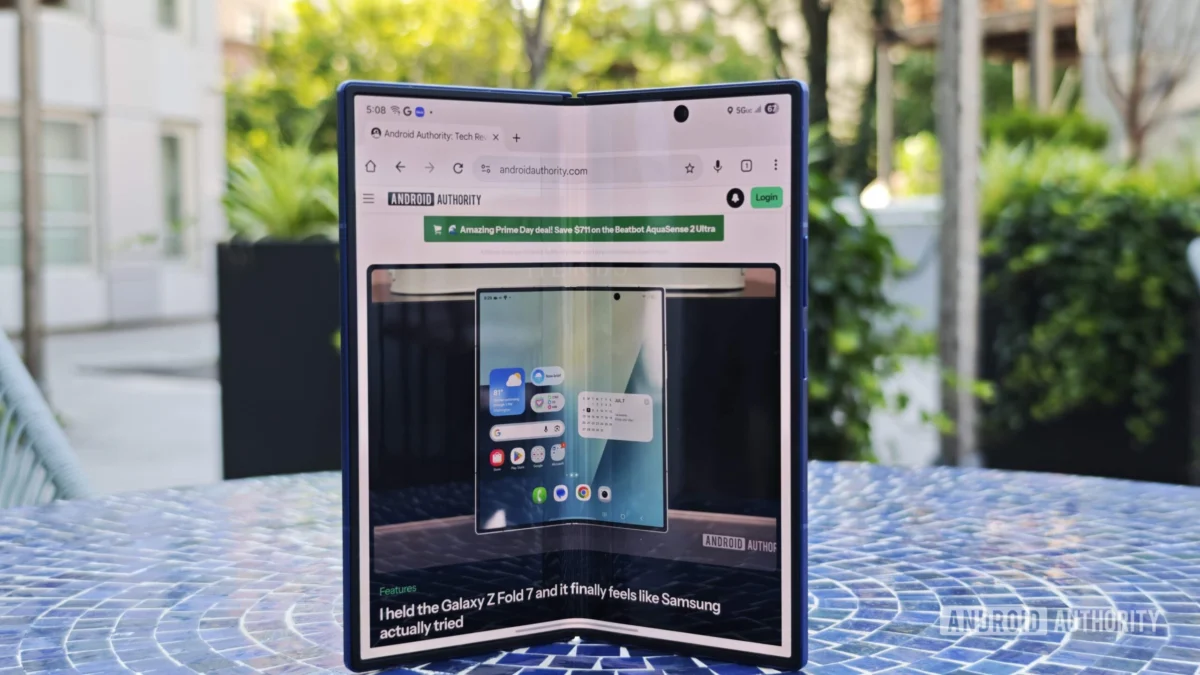
For nearly a decade, the folding smartphone has stood as the pinnacle of mobile innovation—a testament to what happens when material science meets industrial design. Yet, despite the awe-inspiring engineering required to shrink a tablet into a pocket-sized device, a persistent, physical reminder of the technology’s limitations has remained: the hinge crease.
For years, users have had to accept that a fold in the screen is the "price of admission" for a flexible display. However, a new report suggests that Samsung, the market leader in the foldable segment, is on the cusp of a breakthrough. The upcoming “Galaxy Wide Fold,” a passport-style variant of the company’s flagship line, may introduce thicker Ultra-Thin Glass (UTG) technology that could permanently diminish the visibility of the hinge crease, marking a pivotal moment in the evolution of flexible displays.
Main Facts: The 60-Micrometer Breakthrough
According to a recent report from ZDNET Korea, Samsung is preparing to implement a significant upgrade in its display stack for the upcoming Galaxy Wide Fold. The core of this innovation lies in the thickness of the Ultra-Thin Glass (UTG) protecting the internal foldable panel.
While the standard Galaxy Z Fold 8 is expected to utilize 45-micrometer glass—a standard that has served the series well but has not eliminated the physical indentation—the Wide Fold is reportedly slated for 60-micrometer-thick glass. This 33% increase in thickness is not merely a change in specification; it represents a fundamental shift in how the device handles tension and surface stress.
The primary hypothesis is that the increased rigidity provided by the 60-micrometer glass will create a more uniform surface, thereby reducing the "trough" effect that occurs when the screen is unfolded. Furthermore, the report indicates that this move is a strategic test: if the 60-micrometer glass proves durable enough to withstand the rigors of daily folding and unfolding, Samsung plans to standardize this thicker material for the Galaxy Z Fold 9 in 2026.
Chronology: The Evolution of the Foldable Screen
To understand the magnitude of this potential update, one must look back at the arduous journey of Samsung’s display technology.
2019: The Genesis
The original Galaxy Fold was an experimental proof-of-concept. It utilized a plastic-based polyimide display. While flexible, it was notoriously soft, prone to scratching, and developed a very prominent, visible crease almost immediately.
2020–2022: The Arrival of UTG
With the Galaxy Z Fold 2 and Z Fold 3, Samsung introduced Ultra-Thin Glass. This was a monumental step forward, as it provided a glass-like feel and improved scratch resistance. However, the thickness had to remain extremely low—often around 30 micrometers—to ensure the screen could bend without shattering. This "thinness" was the limiting factor that kept the crease visible.
2023–2024: Refining the Hinge
In recent iterations, Samsung focused heavily on the mechanical hinge. By adopting a "waterdrop" hinge design, the company allowed the screen to fold into a teardrop shape rather than a tight, sharp crease. This successfully reduced the severity of the fold, but the physical indentation remained a permanent feature of the hardware.
2025: The Wide Fold Paradigm
The current moment, as we approach the rumored London Unpacked event, represents the next phase. We are moving beyond hinge mechanics and focusing on the substrate material itself. The Wide Fold acts as a laboratory for this new, thicker 60-micrometer glass, signaling that Samsung is finally confident in the chemical tempering of its glass to handle more aggressive folding cycles at greater thicknesses.
Supporting Data: Why Thickness Matters
In the world of flexible displays, there is a constant tug-of-war between flexibility and durability. Thin materials are inherently more flexible, but they are also more susceptible to "crease fatigue," where the material begins to show a permanent deformation after thousands of cycles.
The Physics of the Crease
When a screen folds, the internal display layers undergo compression and tension. If the glass is too thin, it lacks the structural integrity to "bounce back" to a perfectly flat state, leaving the tell-tale divot. By increasing the thickness to 60 micrometers, Samsung is effectively increasing the "memory" of the material. A thicker sheet of glass has more resistance to permanent set deformation.
Durability Metrics
The report from ZDNET Korea suggests that the 60-micrometer glass offers two distinct advantages:
- Surface Smoothness: By bridging the gap over the hinge more effectively, the crease depth is minimized, making the transition across the center of the screen less perceptible to the touch.
- Impact Resistance: Thicker glass naturally distributes impact forces across a wider surface area. This could significantly reduce the likelihood of the internal display being damaged by stylus pressure or accidental drops.
While the "Wide Fold" was notably absent from the recent FCC listings—which confirmed the existence of the Galaxy Z Fold 8 Ultra, the Z Flip 8, and the upcoming Galaxy Watch 8 series—analysts believe its absence suggests a separate, possibly more premium, marketing strategy for this device.
Official Responses and Market Positioning
As of this writing, Samsung has maintained its standard policy of not commenting on unreleased products. However, the timing of these rumors, combined with the upcoming Unpacked event in London, suggests that the company is preparing a massive push into the "Wide" form factor.
Industry analysts observe that Samsung is facing increased pressure from Chinese competitors like Huawei, Honor, and Xiaomi, all of whom have begun to ship foldables with significantly less visible creases. By opting for 60-micrometer glass, Samsung is signaling that it is no longer willing to concede the "crease-free" narrative to its rivals.
The strategy appears to be a tiered rollout. By reserving the 60-micrometer glass for the niche "Wide Fold" first, Samsung can collect real-world data on long-term durability. If the failure rate of the thicker glass remains low, it will be mass-produced for the flagship Z Fold 9. This is a classic Samsung "top-down" innovation strategy: introduce cutting-edge tech in a niche, high-end device, and scale it to the mainstream once the production yields are stabilized.
Implications: A New Era for Foldable Productivity
If the 60-micrometer glass project succeeds, the implications for the broader smartphone industry will be profound.
1. The End of the "Foldable Aesthetic"
For years, the visible crease has been a dealbreaker for many power users who value a seamless display for media consumption and design work. A near-invisible crease would essentially remove the final aesthetic argument against foldable phones, potentially driving mass adoption among professionals who previously viewed foldables as "prototypes."
2. Enhanced S Pen Utility
One of the primary complaints regarding the S Pen on the Galaxy Z Fold series is the "bump" one feels when writing across the center of the screen. A smoother, more rigid display would make the Galaxy Wide Fold the premier choice for digital artists and note-takers, effectively replacing the tablet for a significant portion of the workforce.
3. The Competitive Landscape
If Samsung successfully implements this, it forces the rest of the industry to scramble. While Chinese manufacturers have been ahead in terms of "crease-less" design, they have often lagged in software optimization and global ecosystem integration. A Samsung device that marries their superior One UI software with a near-perfect hardware display would be a formidable combination that would be difficult for competitors to match.
4. Long-term Durability Confidence
Perhaps most importantly, the move to 60-micrometer glass builds consumer trust. The biggest barrier to purchasing a foldable phone remains the fear of a broken screen. By demonstrating that the glass is becoming thicker and more robust, Samsung is actively working to lower the psychological barrier to entry for the general public.
Conclusion: The Road to London
As we look toward the London Unpacked event, the technology landscape for foldables is shifting rapidly. The Galaxy Wide Fold is not just another device in a crowded lineup; it is a testbed for the future of mobile display technology.
While the technical details provided by ZDNET Korea remain unconfirmed by official press releases, the trajectory is clear. The industry has spent the last five years solving the "folding" problem. The next five years will be spent solving the "flawless" problem. If 60-micrometer glass can deliver on its promise of reduced creases and increased durability, the Galaxy Wide Fold will likely be remembered as the moment the foldable smartphone finally grew up—moving from a fragile novelty to a durable, seamless, and essential tool for the modern digital age.
The market is waiting. Whether the Wide Fold arrives as a limited-edition powerhouse or a precursor to the mainstream Z Fold 9, the message from Samsung is clear: the crease is not a permanent feature of the future. It is simply an obstacle waiting to be ironed out.


 Asro
Asro
 Rifan Muazin