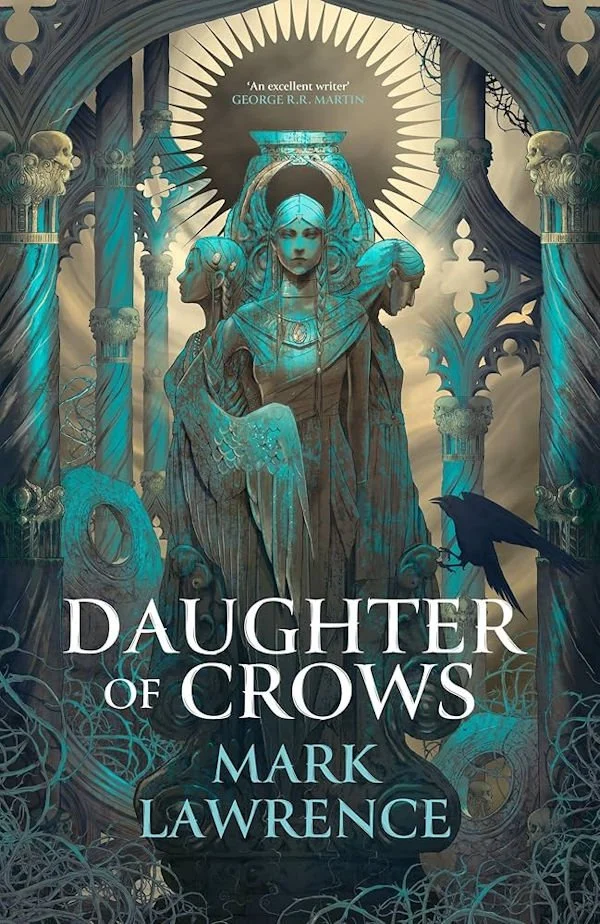
In the landscape of modern grimdark fantasy, few authors possess the surgical precision of Mark Lawrence. With his latest release, Daughter of Crows, the first installment in a new trilogy, Lawrence ventures into territory that is as emotionally harrowing as it is structurally innovative. By centering the narrative on Rue—a woman who has survived a lifetime of horrors—Lawrence challenges the genre’s preoccupation with the "chosen one" youth narrative, opting instead for a gritty, layered examination of aging, memory, and the cyclical nature of violence.
The Premise: The Academy of Kindness
The central conceit of the novel revolves around the "Academy of Kindness," a chillingly named institution that serves as a crucible for misery. Inspired by the Furies of classical antiquity—also known as the "Kindly Ones"—the Academy takes in one hundred young girls annually. The curriculum is a decade-long nightmare of survival, where the "Wound Garden" and the "Bone Garden" serve as the backdrop for indoctrination.
Only three girls emerge from this process, forged into avatars of vengeance and bound to uphold ancient, bloody laws. The narrative begins when Rue, long retired from her life as an agent of retribution and finally grasping at a fragile peace, finds her quiet life shattered by the massacre of her village. The tragedy serves as the catalyst for the return of a woman who was never meant to be crossed.
Chronology: A Life in Three Acts
Daughter of Crows utilizes a complex, non-linear structure that allows readers to witness Rue’s evolution across decades. This narrative layering is perhaps the book’s most ambitious achievement.
The Elder Years: The Present
We first encounter Rue as an old, bitter, and physically deteriorating woman. Unlike the typical fantasy protagonist who gains strength as they age, Rue must navigate a world where her mind remains a razor-sharp weapon, but her body is a fading vessel. This creates a compelling tension; the reader is forced to reckon with the indignity of aging while simultaneously witnessing the explosive, visceral capability of a woman who has forgotten more ways to kill than most people will ever learn.
The Academy Years: Mollandra’s Indoctrination
The second timeline delves into Rue’s past under the name "Mollandra." Here, the reader is subjected to the unrelenting brutality of the Academy. Lawrence does not shy away from the trauma of these formative years. The struggle for survival among the one hundred girls creates a pressure cooker of shifting alliances and betrayals. It is here that the novel’s prose feels most blunt—a refreshing, if uncomfortable, style that strips away the romanticism often found in fantasy training arcs.
The Darkest Origin: The Eldest
The final narrative thread—and arguably the most psychologically disturbing—revisits the period before the Academy. We see Rue as the "Eldest" among a group of child prisoners, held captive by parents who embody supernatural, twisted perversions of care. This segment is emotionally unsettling, highlighting Lawrence’s ability to weave horror elements into a fantasy framework. It provides the necessary context for why Rue, a character who has been betrayed by every institution she has ever known, possesses such a hardened, cynical worldview.
Supporting Data: Thematic Pillars
The success of Daughter of Crows lies in its commitment to specific, difficult themes.
The Fallibility of Memory
Memory in the novel is not merely a plot device; it is a character in its own right. Lawrence examines how we curate our own pasts—which events we suppress to maintain our sanity and which we nurture to fuel our purpose. Rue is a prisoner of her own history, and the reader is constantly forced to reevaluate her identity as the three timelines converge.
The Resilience of Connection
Amidst the pervasive darkness, Lawrence carves out space for the human necessity of companionship. These bonds, often formed in the shadow of death, are presented as both a source of strength and a potential liability. The novel poses a poignant question: how do our earliest, chance encounters forge the foundations of our adult selves?
The "Morally Compromised" Protagonist
When asked about the moral ambiguity of his lead, Lawrence remains pragmatic. "They just have to be interesting," he notes, citing the archetype of the vengeful protagonist like John Wick as a cultural touchstone for why audiences gravitate toward lethal, morally grey characters. For Lawrence, the appeal lies in the contradiction—the ability to act with extreme violence while harboring a core of humanity that is desperately trying to survive.
Official Perspectives: An Interview with Mark Lawrence
In a post-reading discussion, Lawrence clarified the origins of his unique approach to Rue. He noted that the shift to an older protagonist was a direct response to the discourse surrounding the lack of aging women in lead roles within the genre.
"I was either meeting that desire or calling their bluff," Lawrence remarked.
When discussing the multiple timelines, Lawrence revealed that his writing process is organic rather than architected. "I don’t plan my books. They just happen as I write them." This improvisational style, he suggests, allows the psychological weight of the story to develop naturally, rather than feeling forced by a pre-ordained plot structure.
Regarding the contrast between the title "Academy of Kindness" and the content, Lawrence explained that the naming was an intuitive leap. By grounding the institution in the mythology of the Furies (the Kindly Ones), he was able to create a juxtaposition that inherently signals the dark, irony-laden tone of the series.
Implications: The Future of the Trilogy
Daughter of Crows concludes with a clear sense of momentum. While the reader gains a profound understanding of Rue’s past, the question of who she chooses to become next remains open. The trilogy appears set to explore the "pushing back of the horizon," where the past and future collide for a character who has already lived a full, violent life.
For readers, the implications are clear: the series is not a standard hero’s journey. It is a meditation on the cost of survival. Lawrence’s refusal to categorize his work—trampling over the boundaries between fantasy, horror, and psychological drama—ensures that the subsequent volumes will likely remain unpredictable.
Final Assessment: A Grimdark Milestone
Daughter of Crows is an exercise in emotional ruthlessness. It is a novel that requires the reader to be as resilient as its protagonist. Lawrence manages to make the reader grit their teeth at the depictions of human cruelty while simultaneously finding moments of genuine, fragile beauty in the smallest acts of loyalty.
The pacing is deliberate, offering moments of respite that only serve to make the sudden accelerations toward the climax more impactful. For those seeking a story that treats the genre with a sense of urgency and psychological maturity, Daughter of Crows is not just a recommendation; it is essential reading.
As the final page turns, one is left with a sense of profound unease, a lingering attachment to a broken protagonist, and, perhaps most pressingly, a singular, frustrated desire: the need for the next installment. Mark Lawrence has once again proven that he is not just writing fantasy—he is writing with a pulse, creating stories that are bloody, intimate, and entirely unforgettable.