The landscape of modern horror comics is often crowded with jump scares and gore-for-the-sake-of-gore, but rarely does an anthology manage to successfully marry visceral terror with high-concept social commentary. As Cruel Universe 2 reaches its climactic conclusion with its twelfth issue, it serves as a masterclass in how the genre can function as a distorted, yet painfully accurate, reflection of our collective societal anxieties. Featuring legendary talents such as Ann Nocenti, Melissa Flores, and Greg Smallwood, the finale is a trifecta of dread that explores the corruption of the body, the environment, and the march of unbridled technological progress.
The Anthology’s Final Act: An Overview of the Triple Threat
The twelve-issue run of Cruel Universe 2 has consistently challenged readers to look beyond the page, and the final issue is no exception. By commissioning three distinct creative teams, the anthology provides a varied exploration of "horror" that spans the clinical, the political, and the nostalgic.
The issue opens with "An Hour in the Life of Lila," written by comics veteran Ann Nocenti with art by Daniel Gete. Following this is "Carbon Credit," a biting environmental thriller penned by Melissa Flores with illustrations by Jordi Tarragona. Finally, the series closes with "Terror-Form!"—a stylistic tribute to the golden age of horror comics written and illustrated by Greg Smallwood. Together, these stories form a cohesive narrative tapestry that leaves the reader unsettled, reflective, and thoroughly impressed by the aesthetic range of the volume.
Chronology and Narrative Breakdown
Part I: The Cyborg Quandary – "An Hour in the Life of Lila"
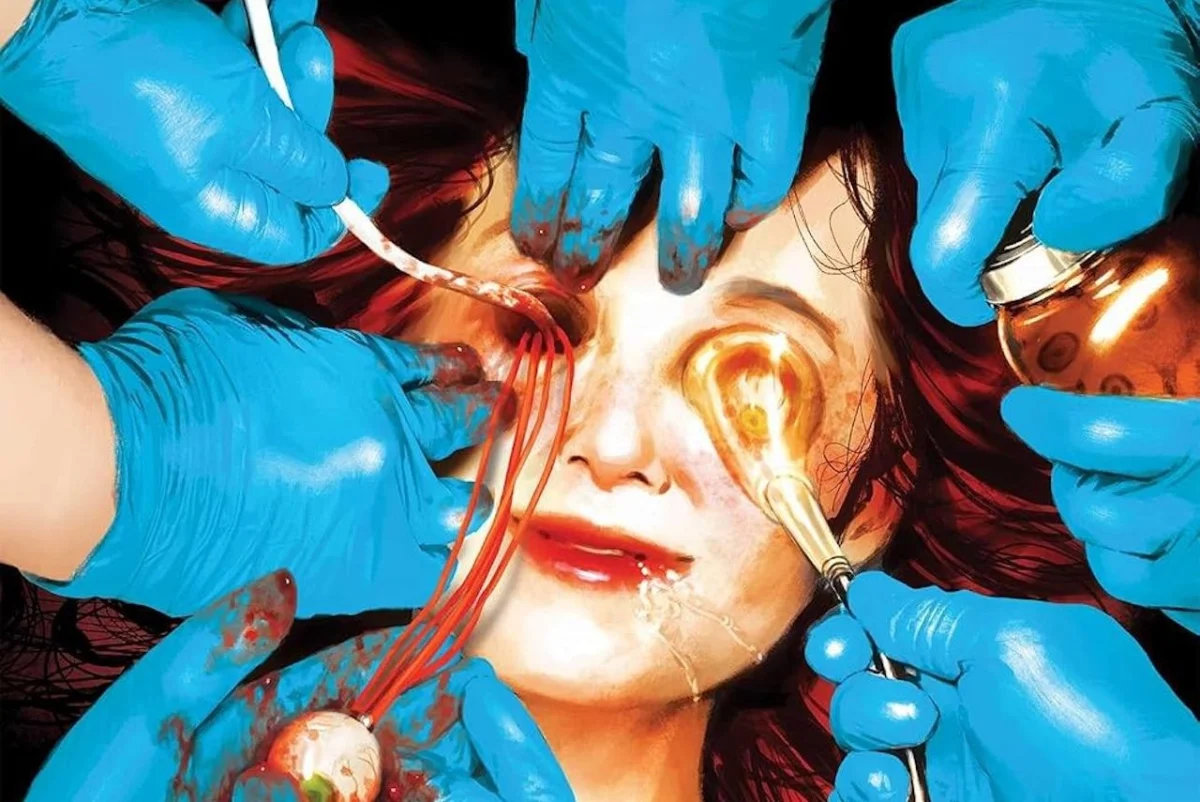
The issue launches with an immediate visual impact. Daniel Gete’s art, characterized by a meticulous, highly detailed style evocative of the visionary Frank Quitely, immediately grounds the reader in a sterile, dystopian future. The opening splash page—a jarring, close-up look at a young girl undergoing surgery as mechanical hands extract an eyeball—sets a tone of profound unease.
Nocenti’s narrative focuses on the intersection of consent and technological integration. Through the dialogue of two surgeons—one ethically apprehensive and the other callously optimistic—Nocenti explores the "ship of Theseus" dilemma. If we replace a human limb with a mechanical one, does it retain its humanity? The story follows the protagonist’s struggle as her new cybernetic components begin to communicate independently of her brain. It is a chilling exploration of body horror that questions whether we are losing our autonomy to the very tools designed to "fix" us.
Part II: The Environmental Reckoning – "Carbon Credit"
If Nocenti’s contribution is a meditation on the self, Melissa Flores’ "Carbon Credit" is a scathing indictment of corporate negligence. The story follows a data analyst tasked with enforcing environmental regulations. The horror here is not supernatural; it is systemic.
The narrative trajectory is devastatingly familiar: the protagonist defends data that claims environmental zones are safe, despite mounting evidence of illness. The turning point occurs when her own daughter becomes a victim of the corporate toxicity she was paid to ignore. Flores highlights a modern malaise—the tendency for individuals to disregard systemic issues until they hit close to home. The desperation of the protagonist as she pivots from defender of the status quo to a saboteur of the system mirrors the radicalization of the modern citizen in the face of institutional failure.
Part III: The Golden Age of Terror – "Terror-Form!"
Closing the anthology, Greg Smallwood shifts gears entirely. "Terror-Form!" is a deliberate, polished homage to the EC Comics era of the 1950s. Utilizing a glossy, mid-century aesthetic, Smallwood employs verbose captions and old-school word balloon placement to evoke a bygone era of pulp storytelling.
The plot involves a corporation launching a space mission with technology that is dangerously advanced—perhaps beyond human comprehension. Smallwood captures the cowardice of scientists who know the truth but remain silent, and the inevitable catastrophe that follows. It is a classic "be careful what you wish for" cautionary tale, wrapped in a retro aesthetic that makes the encroaching doom feel both charming and terrifying.
Supporting Data and Creative Impact
The success of Cruel Universe 2 #12 is not merely in its writing but in its visual cohesion. Each story requires a different artistic "language," and the anthology succeeds by pairing the right artist with the right theme:
- Daniel Gete (Anatomy/Detail): His ability to render the uncanny valley through medical imagery makes the body horror in "Lila" feel tangible.
- Jordi Tarragona (Realism/Grit): His work on "Carbon Credit" effectively communicates the bleakness of a decaying environment, emphasizing the grime of a dying world.
- Greg Smallwood (Style/Homage): His versatility is on full display here; he moves away from contemporary comic art standards to replicate a specific, nostalgic historical style that elevates the tone of the final story.
The anthology’s total twelve-issue arc has maintained a consistent quality threshold, but this final issue stands out for its thematic symmetry. By moving from the internal (the body) to the communal (the environment) to the universal (the cosmos), the editors have provided a structural journey that feels complete.
Implications: The Mirror Held to Society
The most significant implication of Cruel Universe 2’s conclusion is its argument that horror is the most effective genre for social critique.
- The Ethics of Technology: Through "An Hour in the Life of Lila," the series posits that as we outsource our biology to machines, we risk losing the "self." The story serves as a warning about the lack of regulation in the transhumanist movement.
- Corporate Accountability: "Carbon Credit" is a visceral reminder that data manipulation is not a victimless crime. It highlights the growing divide between corporate survival and public health, suggesting that truth is often sacrificed at the altar of profit.
- The Failure of Institutional Knowledge: "Terror-Form!" serves as a chilling reminder of the dangers of institutional silence. When those who know the truth are too afraid to speak, the result is never just failure—it is absolute catastrophe.
Conclusion: A Difficult Reflection
Cruel Universe 2 #12 does more than end a series; it solidifies the anthology’s place in the pantheon of modern horror. It is a collection that refuses to offer the reader an easy escape. Instead, it demands that we sit with the uncomfortable truths of our current era—our reliance on technology, our environmental complacency, and our fear of the unknown.
For readers seeking a mindless thrill, the density of these stories might be a hurdle. The verbose, old-school style of Smallwood’s finale, for example, is a stylistic choice that challenges modern pacing conventions. However, for those who view the medium of comics as a canvas for complex, cerebral, and socially conscious storytelling, this issue is essential reading.
The revival of Cruel Universe has been a success, not because it reinvented the wheel, but because it mastered the fundamentals: strong character motivation, high-stakes conflict, and world-class artistic execution. As the final page turns, one is left with a sense of dread, but also a sense of clarity. If horror is indeed a mirror to our failings, then the final issue of Cruel Universe 2 is a polished, terrifying reflection—one that is, as the critics have noted, quite difficult to look away from.
Key Takeaways for the Reader
- A Must-Read Anthology: The final issue is an accessible entry point for those who appreciate literary, thematic horror.
- Stylistic Range: The shift in art styles between the three stories demonstrates the versatility of the creators involved.
- Social Commentary: Be prepared for stories that prioritize intellectual discomfort over simple jump scares.
- Collector’s Note: Given the acclaim for the second volume, these twelve issues are likely to be compiled into a trade paperback, which is highly recommended for fans of the anthology format.