

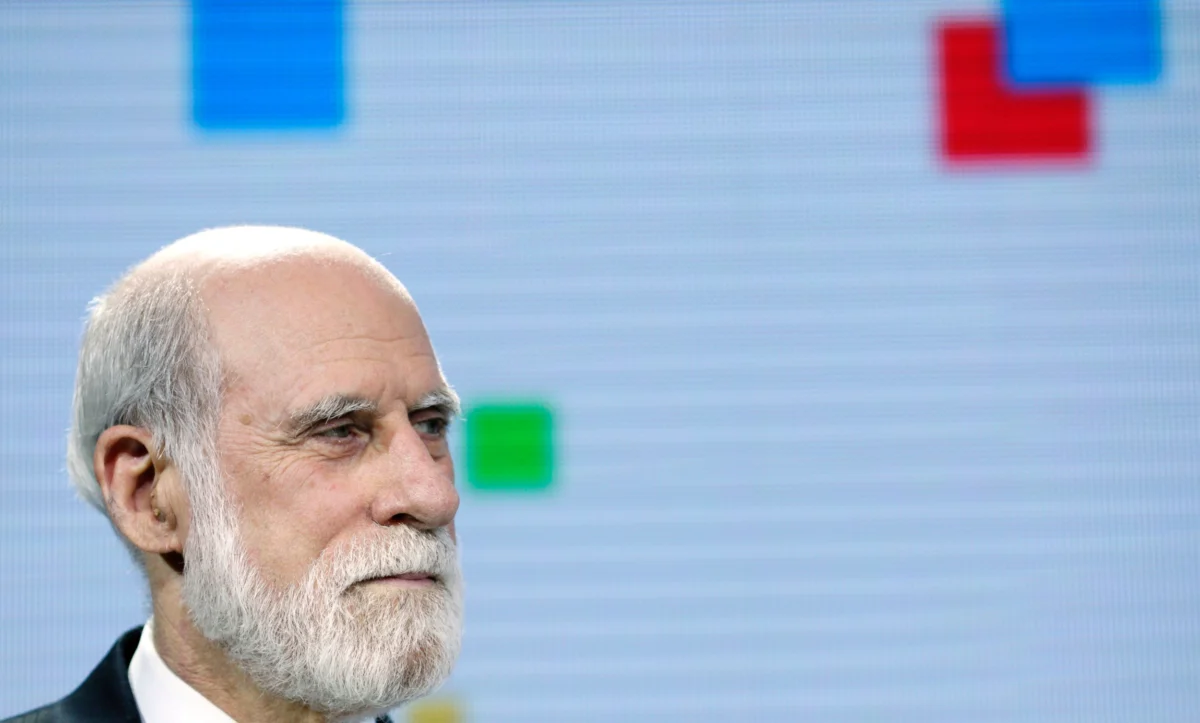
In a moment that signals the closing of a foundational chapter in digital history, Vinton "Vint" Cerf, the visionary engineer widely regarded as one of the "fathers of the internet," has announced he will step down from his role as Google’s Chief Internet Evangelist. The announcement, delivered via video link during the Open Frontier conference hosted by the Laude Institute, marks the conclusion of a two-decade tenure at the search giant and a career that has fundamentally reshaped human civilization.
Cerf’s departure is not merely a corporate personnel change; it is the retirement of a pioneer whose work in the 1970s created the "plumbing" of the modern world. As the industry grapples with the complexities of artificial intelligence and the future of open-source infrastructure, Cerf’s exit serves as a poignant reminder of the architectural choices that allowed the internet to scale from a government experiment into a global nervous system.
A Legacy Built on Protocol: The Architect of Connectivity
To understand the weight of Cerf’s retirement, one must look back to the early days of networked computing. Alongside collaborator Robert Kahn, Cerf developed the Transmission Control Protocol and Internet Protocol (TCP/IP). These protocols provided the universal language that allowed disparate computer networks to "speak" to one another, effectively forming the bedrock of the modern internet.
Before TCP/IP, networks were siloed, proprietary, and incapable of true interoperability. Cerf and Kahn’s work democratized communication, ensuring that data could be routed across multiple networks seamlessly. Their breakthrough was so profound that it earned them the prestigious Turing Award—often described as the "Nobel Prize of Computing"—along with the Presidential Medal of Freedom.
Since joining Google in 2005 as Vice President and Chief Internet Evangelist, Cerf has been a fixture of the company’s intellectual identity. In this role, he traveled the world, advocating for the expansion of digital access and defending the open architecture of the web. As many observers have noted, if any single individual could be credited with "evangelizing" the internet into existence and ubiquity, it is Cerf.
Chronology: From ARPANET to the AI Frontier
Cerf’s career trajectory mirrors the rapid evolution of the digital age:
- 1970s: Working under the auspices of the Defense Advanced Research Projects Agency (DARPA), Cerf and Kahn design the architecture for the internet.
- 1980s: TCP/IP is adopted as the standard protocol for ARPANET, setting the stage for the global expansion of networking.
- 1990s: Cerf serves as a key figure in the transition of the internet from a research project to a commercial engine.
- 2005: Joins Google, a company that by then was already the primary gateway to the information superhighway.
- 2023-2024: Cerf continues to advocate for open-source stability, participating in high-level academic and industry discussions regarding the future of AI.
- 2025: Announces his retirement from Google, stepping down at the age of 83.
During the Open Frontier conference, his longtime colleague and fellow computing luminary, UC Berkeley professor Dave Patterson, paid tribute to this storied career. "Vint has been at Google more than 20 years, and he is retiring a week from today," Patterson told the audience, prompting a standing ovation. "I think we ought to give him a round of applause for a relatively good career."
Professional Reflections: The Sartorial Pioneer
Beyond the technical achievements, colleagues remember Cerf for his distinct personality and commitment to individuality. In a lighthearted exchange at the conference, Patterson reminisced about meeting Cerf during their graduate school days in the 1970s. While most of his peers were embracing the counter-culture aesthetic of the era, Cerf was already known for his signature three-piece suits.
"He’s always been the best-dressed computer scientist I’ve ever met," Patterson remarked. "My memory of Vint is that he came as a grad student with a shirt and tie in the ’70s."
Cerf, characteristically modest yet witty, confirmed the observation. "I even had a vest," he admitted. "For some reason, I always wanted to stick out, and instead of having long hair and something in my nose, I thought just dressing differently was one way to do it."
The Future of AI: Lessons from the Internet’s Past
While the conference honored his past, the substance of Cerf’s remarks focused on the future. The event, which included industry heavyweights like François Chollet (creator of Keras), John Ousterhout (creator of Tcl), and Matei Zaharia (co-founder of Databricks), served as a forum to discuss the survival of open-source systems in an era dominated by large-scale, proprietary AI models.
The central tension of the conference was clear: the modern AI industry is trending toward extreme centralization, with a handful of labs controlling the most powerful models. This stands in stark contrast to the decentralized, "permissionless" nature of the internet that Cerf helped build.
However, Cerf remains optimistic about the role of standardized protocols. He argued that the rise of "agentic" AI—software that can act autonomously and coordinate with other programs—will eventually necessitate a return to the principles of interoperability.
"The agentic model of AI, with multiple agents from multiple sources interacting with each other, is going to force composability, and a requirement for interoperability and standardization," Cerf explained. He warned that if the tech industry repeats the "protocol wars" of the 1990s, the companies that define these new standards will exert massive influence over the future digital economy.
The Problem with Natural Language
One of the most thought-provoking portions of the discussion was Cerf’s dismissal of natural language as a primary protocol for agent-to-agent communication. While some researchers believe that Large Language Models (LLMs) can simply "talk" to each other in English, Cerf is skeptical.
"I don’t think English is going to be the best choice," he asserted. "There’s a flexibility in it, but there’s ambiguity, and I think precision for inter-agent interaction is going to be very, very important."
He invoked the classic "telephone game," where a message becomes distorted as it passes through a chain of people. "Imagine a bunch of agents talking to each other in natural language; that’s kind of terrifying," he warned. For Cerf, the future of AI requires the same rigor, precision, and standardized handshake protocols that made the internet reliable.
Implications for the Industry
As Cerf departs Google, his words offer a roadmap for the next generation of engineers. The industry is currently at a crossroads, balancing the desire for competitive advantage against the long-term necessity of a functional, interoperable ecosystem.
- Standardization as a Competitive Moat: The companies that succeed in creating the "TCP/IP of AI" will likely define the next decade of technology.
- The Risks of Ambiguity: As agents take on more autonomous tasks, the reliance on fuzzy natural language could introduce systemic failures. A shift toward formal, structured communication protocols is likely inevitable.
- The Open-Source Challenge: The move toward proprietary, closed-box AI models threatens the collaborative spirit that allowed the internet to flourish. Cerf’s legacy is a testament to the fact that open, durable infrastructure often outlasts proprietary silos.
Official Responses and Conclusion
Google has not issued a formal statement regarding the transition, which is typical for the company regarding its long-tenured fellows. However, the impact of Cerf’s departure will be felt deeply within the walls of Google and the broader tech community.
As Vinton Cerf moves into a new phase of his life, his career stands as a monument to the power of open collaboration. He leaves behind an internet that is, in his own words, "fully evangelized." Yet, his final warnings regarding AI suggest that the work of building a coherent, reliable digital world is far from finished. The next generation of builders would do well to heed his call for precision, standard-setting, and a commitment to keeping the "open" in the open frontier.











