

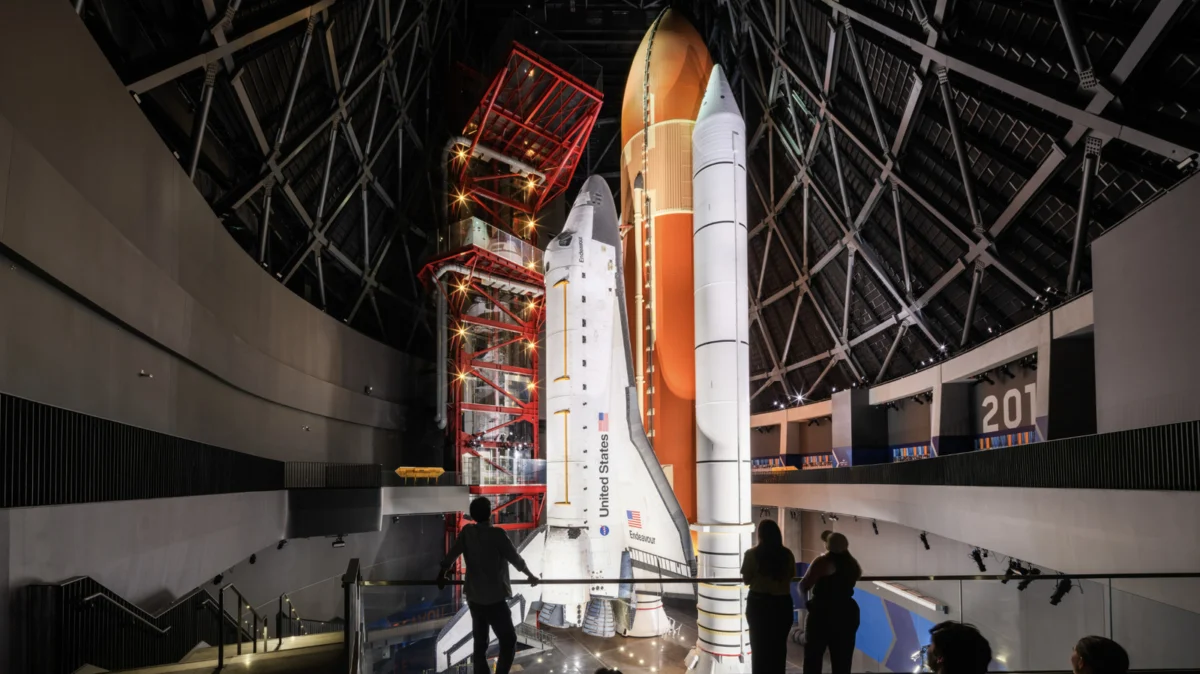
After more than a decade of anticipation, planning, and meticulous engineering, the California Science Center has confirmed that the Space Shuttle Endeavour—NASA’s youngest and most technologically advanced orbiter—will finally stand in its permanent, awe-inspiring vertical configuration. Beginning November 13, 2026, the public will be able to view the iconic vessel as it was intended to be seen: poised for liftoff, fully integrated with its solid rocket boosters and external tank, within the newly constructed Samuel Oschin Air and Space Center.
This milestone marks the culmination of a multi-year effort to create a world-class aerospace destination in the heart of Los Angeles, transforming a static relic into a dynamic educational experience that bridges the gap between the history of the space shuttle era and the future of deep-space exploration.
The Main Event: A Vertical Masterpiece
For the millions of visitors who have flocked to the California Science Center since 2012, Endeavour has been a sight to behold, resting horizontally in the Samuel Oschin Pavilion. However, the upcoming opening of the Samuel Oschin Air and Space Center represents a quantum leap in the exhibit’s presentation.
The new 200,000-square-foot facility is not merely a museum wing; it is an architectural feat designed specifically to house the world’s only authentic "space shuttle stack." Standing at a towering 200 feet, the vertical configuration includes the shuttle, two solid rocket boosters, and the massive orange external fuel tank (ET-94).
Beyond the visual spectacle of the launch-ready stack, the exhibit aims to be visceral. Museum guests will be able to ascend a 140-foot gantry elevator, providing a vantage point that mimics the sensation experienced by astronauts in the final minutes before a mission launch. This immersive element, combined with a curated collection of over 100 historic aerospace artifacts, promises to offer a comprehensive look at the legacy of the Space Transportation System (STS).
A Legacy Forged in Resilience: The Chronology of Endeavour
The story of Endeavour is one of tragedy turned into triumph. Following the devastating loss of the Space Shuttle Challenger in 1986, Congress authorized the construction of a replacement orbiter. Utilizing structural spares that had been built during the production of Discovery and Atlantis, NASA crafted Endeavour with state-of-the-art upgrades, including improved avionics, better plumbing, and a more advanced navigation system.
Key Milestones in the Life of Endeavour:
- 1987: NASA officially begins construction on the replacement orbiter.
- 1991: Construction is completed, and the orbiter is named Endeavour following a national student competition.
- 1992: Endeavour makes its maiden voyage (STS-49), during which the crew famously performed a three-person spacewalk to capture and repair the Intelsat VI satellite.
- 1993: The shuttle conducts the first of several critical servicing missions to the Hubble Space Telescope, correcting the telescope’s flawed primary mirror.
- 1998: Endeavour initiates the assembly of the International Space Station (ISS) by delivering the Unity node.
- 2011: Endeavour completes its final mission (STS-134), concluding its service as the penultimate shuttle to fly.
- 2012: After being ferried to Los Angeles, the shuttle completes a historic, high-profile 12-mile trek through the streets of South Los Angeles to reach the California Science Center.
- 2026: The Samuel Oschin Air and Space Center opens to the public, marking the beginning of Endeavour’s permanent, vertical legacy.
Engineering the Impossible: The "Stacking" Challenge
The process of moving the shuttle into its final position—a process known as "Go for Stack"—has been one of the most complex engineering challenges in modern museum history. Because the shuttle was never designed to be displayed in a vertical position while supported by its own structure, the Science Center had to collaborate with aerospace engineers to ensure the integrity of the orbiter.
The installation of the external tank and the solid rocket boosters required heavy-lift cranes and millimeter-perfect precision. Unlike the horizontal display, where the weight is distributed along the shuttle’s belly, the vertical configuration requires the structure to bear its own weight through the attachment points intended for launch, not static display. This process, completed in stages, serves as a testament to the skill of the crews who maintained the shuttle fleet for thirty years.
Institutional and Official Perspectives
The California Science Center’s leadership has emphasized that this project is about more than just preservation; it is about inspiration. Jeffrey Rudolph, President and CEO of the California Science Center, has frequently noted that the goal is to "inspire the next generation of scientists, engineers, and explorers."
"The Samuel Oschin Air and Space Center will serve as a gateway to understanding the vast complexities of our universe," a museum spokesperson stated following the announcement. "By placing Endeavour in the launch position, we are allowing visitors to visualize the sheer power of human ingenuity. We aren’t just looking at a retired vehicle; we are looking at the machine that helped build the International Space Station and expanded our reach into the cosmos."
NASA, for its part, continues to support the exhibit as a vital repository of the agency’s history. By housing the orbiter in a permanent, climate-controlled, and structurally sound facility, the Science Center ensures that the lessons learned from the STS program are never lost.
Implications: The Impact on Education and Tourism
The opening of the new center is expected to have a profound impact on the regional economy and the educational landscape of Southern California.
Educational Reach
The exhibit will feature an expanded "Air and Space" curriculum, focusing on atmospheric flight, space exploration, and planetary science. The addition of interactive modules will allow students to engage with the physics of flight, the history of aerospace materials, and the challenges of living and working in microgravity.
Tourism and Economic Vitality
As a cornerstone of the Exposition Park master plan, the Samuel Oschin Air and Space Center is projected to significantly increase visitor traffic. Los Angeles, already a major hub for aerospace and defense, solidifies its position as a premier destination for science tourism. The proximity to other cultural institutions in Exposition Park, such as the Natural History Museum and the Rose Garden, creates a "knowledge corridor" that is unique in the United States.
A Living History
Beyond the tourism numbers, the most significant implication is the preservation of the shuttle itself. By displaying the vehicle in a controlled environment, the Science Center prevents the degradation that often occurs with static displays. The "stack" will remain an object of study for future historians and engineers who wish to understand the materials and assembly methods that defined the turn of the 21st century.
Looking Toward the Horizon
As November 2026 approaches, the final stages of the museum’s construction are underway. The surrounding galleries, which will house aircraft, spacecraft, and satellite technology, are being readied to complement the majesty of the Endeavour stack.
When the doors finally open, visitors will walk beneath the massive SRBs, look up at the towering external tank, and behold the scorched tiles of the orbiter that spent nearly 300 days in space. It is a moment of reflection on what humanity can achieve when it sets its sights on the stars.
The Space Shuttle Endeavour was built to replace a dream that was lost, and it succeeded by carrying the aspirations of thousands of researchers, pilots, and engineers into orbit. Now, in its final home, it serves as an anchor for the next generation—a reminder that while the shuttle program has ended, the human drive to explore the unknown remains as potent as ever.
In the heart of Los Angeles, the Endeavour stands ready to launch once more—not into the vacuum of space, but into the imaginations of the millions who will look up at it and wonder, "What’s next?"











