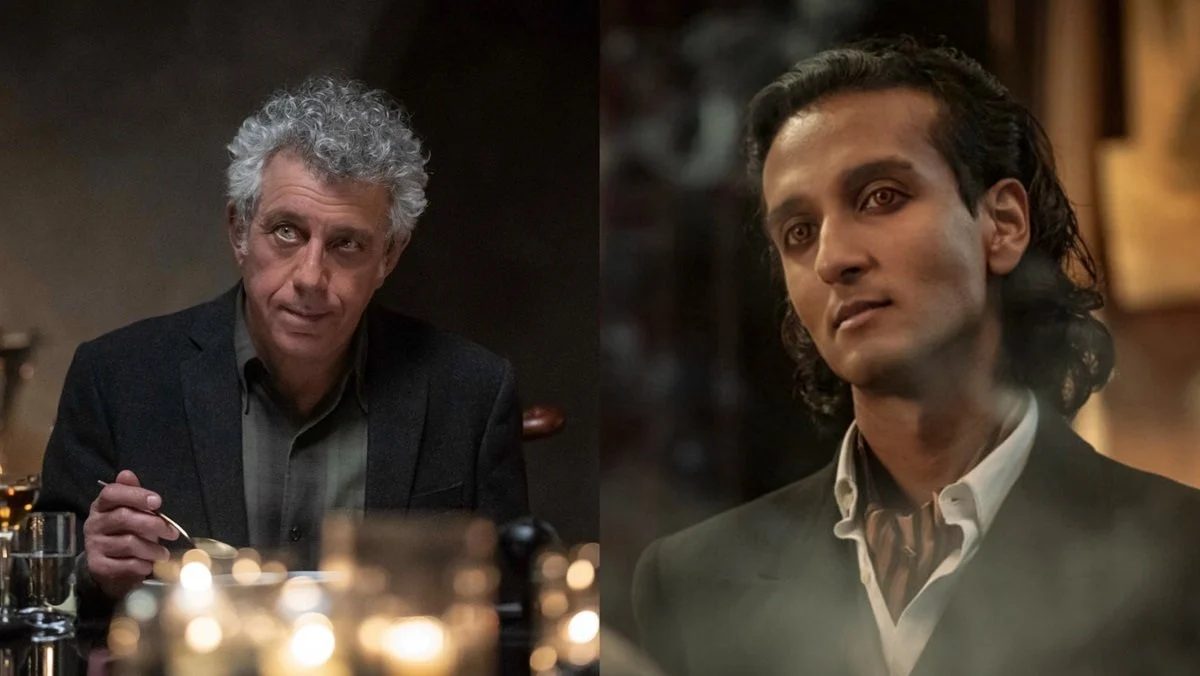
The season two finale of AMC’s Interview with the Vampire delivered a seismic narrative shift that sent ripples through the fandom: the revelation that the veteran investigative journalist Daniel Molloy (Eric Bogosian) had been transformed into a vampire by his long-time companion, Armand (Assad Zaman). This moment, presented in a haunting flash-forward, serves as a pivotal bridge between the events of Interview with the Vampire and the ongoing saga of The Vampire Lestat.
While the series has kept the precise mechanics and motivations behind this turning shrouded in mystery, the act carries the weight of decades of psychological entanglement. Is it an act of cruel spite, a desperate bid for companionship, or a twisted form of love? As the series expands its scope, the relationship between these two characters stands as one of the most compelling and enigmatic dynamics in the Anne Rice Immortal Universe.
A Legacy of Literature: From ‘The Boy’ to Daniel Molloy
To understand the complexity of the screen adaptation, one must look to the foundational texts of Anne Rice’s The Vampire Chronicles. In the seminal 1976 novel Interview with the Vampire, the interviewer was a nameless, ephemeral figure known only as "The Boy." He was a vessel for the reader, a mortal lens through which to view the decadence and misery of the vampire condition.
It wasn’t until the third novel in the series, The Queen of the Damned (1988), that Rice provided the necessary context to flesh out this character. In a chapter aptly titled "The Story of Daniel, the Devil’s Minion, or the Boy from Interview with the Vampire," the reporter finally received a name: Daniel Molloy.
In the source material, the boy’s post-interview trajectory is one of obsessive pursuit. After fleeing San Francisco with the tapes of his conversation with Louis de Pointe du Lac, he dedicated his life to tracking down Lestat de Lioncourt. However, he encountered Armand instead. At that time, Armand had claimed New Orleans as his sole territory, having systematically "cleaned out" any competing vampires to ensure his domain remained unchallenged. The initial meeting was not one of romance, but of cat-and-mouse manipulation—Armand, fascinated by the mortal who knew his secrets, began stalking Daniel across the globe, threatening death while simultaneously becoming hopelessly captivated by his prey.

The Evolution of the "Devil’s Minion"
The narrative arc of Daniel and Armand in the novels is a masterclass in gothic codependency. Over years of shared existence, the dynamic shifted from predator and prey to something resembling a partnership. Armand, wielding his vast, ancient intellect, and Daniel, serving as his "Devil’s Minion," navigated the complexities of mortal and immortal life.
Their partnership eventually birthed the "Night Island," an offshore paradise for the undead that functioned as a commercial and entertainment hub. This period in the books represents the height of their transactional intimacy. Daniel lived a life of extreme privilege—fast cars, designer clothes, and the proximity to immortality—yet he remained a mortal, constantly begging for the "Dark Gift." Armand, fearful of the change it would bring to their relationship, repeatedly denied him, leading to cycles of flight and return.
The turning itself, when it finally arrived in The Queen of the Damned, remains one of the most romanticized sequences in the Rice canon. It occurred in a moment of near-death, with Armand transporting his own mental projection of Daniel to the Villa of the Mysteries in Pompeii. There, amidst the echoes of ancient history, the gift was finally bestowed. Yet, as the novels warn, the act of creation often leads to the destruction of the intimacy that preceded it.
AMC’s Reimagining: A New Psychological Landscape
In the AMC television adaptation, the timeline and the emotional stakes are drastically altered. We know that in 1973, Armand intervened during a near-lethal encounter between Louis and Daniel, going so far as to erase the journalist’s memory. This established a foundation of trauma and manipulation that the show continues to explore.
The question of when the turning occurs in the television universe is currently the show’s most significant dangling thread. Unlike the books, where the relationship spanned years of companionship before the turning, the television series depicts a more fractured, volatile connection. There is speculation that a, perhaps, forgotten history exists—a period of time where the two were involved, only for Armand to wipe the slate clean in Daniel’s mind.

With the announced limited series The Night Island currently in development, fans are theorizing that this project will serve as the missing puzzle piece, potentially detailing a secret, decades-old past between the two that explains the intensity of their present-day connection.
Official Perspectives: Assad Zaman on the Confession
Assad Zaman, who portrays the enigmatic Armand, has offered insight into the shifting nature of this relationship. In the fourth episode of The Vampire Lestat, Armand delivers a confession that feels both raw and calculated.
"I think it comes out as an honest confession," Zaman noted in a recent interview. "Yes, you can hate me for what I did. I manipulated you. I turned you… but that pretending to let you manipulate me? That’s not true. You think you were under my spell; actually, I was under your spell."
This admission complicates the narrative of the "Devil’s Minion." It suggests that the power dynamic was never as one-sided as it appeared. The vulnerability shown by Armand implies that his decision to turn Daniel was not merely a desire to possess him, but perhaps a response to his own inability to break free from the mortal reporter’s influence.
The Implications of the Newark Turning
Recent developments in the series have confirmed that the turning occurred in a highly unconventional setting: an airplane flight to Newark. This departure from the "romantic" literary turning in Pompeii highlights the gritty, desperate, and often messy nature of the television series’ version of these characters.

The fact that Armand could not wait until they landed suggests a state of emergency—either physical or psychological—that demanded immediate action. Was Daniel dying? Was he attempting to escape again? The series has yet to confirm the catalyst, but the choice of location reinforces the idea that this relationship is built on sudden impulses rather than the grand, sweeping gestures found in the novels.
Furthermore, the bond between the two has manifested in a unique way: a psychic connection so powerful that it can render the physical world invisible to them. This "romance" is fundamentally tied to the consumption of blood and the sharing of consciousness, suggesting that while they may be physically transformed, they remain tethered to the trauma of their human past.
Looking Forward: The Future of the Pairing
As The Vampire Lestat progresses, the audience is left to grapple with the fallout of the turning. The series has promised that we will see the full context of the transformation in the upcoming fourth season.
The implications are profound. If the series adheres to the tragic trajectory of the novels, we can expect the wedge between Armand and Daniel to widen, as the power balance shifts from one of mentor/student to that of two immortal beings with conflicting agendas. However, given the show’s willingness to diverge from the source material, there is a distinct possibility that the "Devil’s Minion" will find a new, albeit dark, equilibrium.
The chemistry between Eric Bogosian and Assad Zaman has anchored the show’s emotional core. Whether they are engaging in verbal sparring or silent, psychic communion, their scenes are the crucible in which the series’ themes of memory, regret, and the nature of love are tested. As the narrative moves forward, the audience will be watching closely to see if this relationship can survive the transition from mortal to immortal, or if it will simply become another ghost story in the long, dark history of the vampires of New Orleans.

The transformation of Daniel Molloy is not just a plot point; it is the culmination of a decades-long interrogation of power. As the series continues, the question remains: is the "Dark Gift" a reward for a lifetime of service, or the final, cruelest trick of an ancient vampire who cannot bear to be alone?