

Dollar Shave Club, the brand that famously disrupted the shaving industry in 2012 with a $4,000 viral YouTube video, is once again rewriting the playbook on advertising. By embracing generative artificial intelligence (AI), the company has slashed production costs and turnaround times, proving that a lean, tech-forward approach can outperform traditional, high-budget marketing agencies.
Under the guidance of recently appointed Chief Brand and Innovation Officer Laura Higgins, the brand is returning to its roots: unapologetically bold, disruptive, and irreverent. As the company navigates a crowded grooming landscape, it is using AI not just as a tool for efficiency, but as the core creative engine for its future growth.
The Core Evolution: From Viral Roots to AI-Driven Agility
In 2012, Dollar Shave Club made waves by poking fun at the razor industry with a low-cost, high-impact video that turned the company into a household name. More than a decade later, the brand is mirroring that scrappy energy with a new, even more efficient model.
The brand’s July 1 launch, “250 Years. No BS. Still Free,” stands as a testament to this shift. Created entirely in-house using generative AI, the campaign cost a mere $400 to produce—a fraction of the price of traditional agency-led spots. This campaign has since become the most successful in the brand’s history, according to company data, validating the decision to move creative efforts inside the office walls.
For Laura Higgins, who joined the company just two months ago, the shift to AI is not merely about saving money; it is about reclaiming the brand’s identity. Having worked in traditional, legacy corporate environments, Higgins argues that the agility provided by AI would have been impossible in her previous roles. "It allows the creatives to be creative, it allows the brand managers to be strategic, and it takes that minutiae out of their job," she notes.
Chronology of a Transformation
To understand how Dollar Shave Club reached this point, one must look at the timeline of its recent pivot:
- Early 2012: The original viral sensation launches, setting the bar for "disruptive" marketing.
- The Unilever Years: Following its acquisition by Unilever, the brand’s signature voice was frequently perceived as stifled or diluted by corporate oversight.
- Early 2024: The company begins experimenting with generative AI for smaller-scale advertising efforts to test the technology’s ability to mimic the brand’s unique tone.
- May 2024: Dollar Shave Club launches its first foray into women’s grooming, signaling a brand-wide expansion.
- July 1, 2024: The “250 Years. No BS. Still Free” campaign debuts. It utilizes AI to insert the brand and its competitors into historical Revolutionary War settings, creating a narrative about "hidden costs."
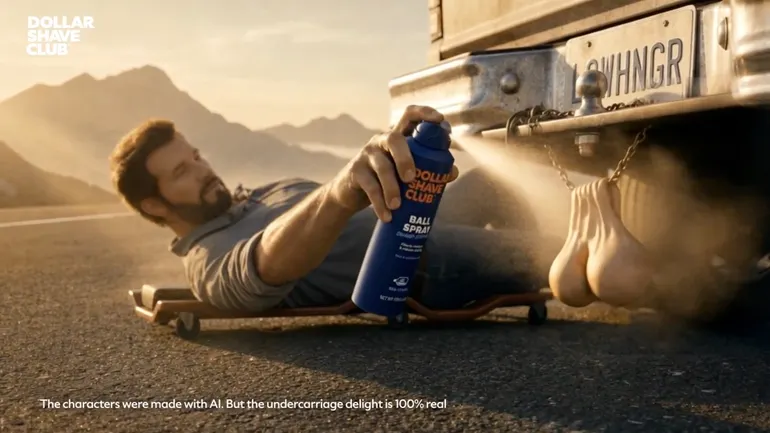
- Late July 2024: The company launches "Danglers," a bold, racy campaign for its Ball Spray product, proving that AI can handle complex, comedic, and even slightly taboo creative concepts.
Supporting Data: Efficiency vs. Tradition
The shift to an in-house, AI-first model has yielded tangible results. For the “250 Years” campaign, the creative team spent only three days concepting the work. Using tools like Higgsfield and Claude, the team moved from an initial brief to a finalized, high-quality campaign in just over a week.
This speed stands in stark contrast to the traditional agency model, where projects can take months of meetings, storyboarding, and external production cycles. The "Danglers" campaign, for example, utilizes a 15-second hero video that uses "truck nuts" as a stand-in for male anatomy to discuss the trials of "friction, sweat, and grime." According to Higgins, the complexity of this concept—which features a truck being rebuffed in bed by a woman—would have been prohibitively expensive and time-consuming to execute with human actors and traditional CGI.
By leveraging AI, the team can adopt a "cartoony," stylized aesthetic that makes the joke land while keeping production costs minimal. This approach has allowed the brand to address production issues—such as the previous stock shortages of its Ball Spray—with marketing that is both reactive and highly effective.
Official Responses and Strategic Shifts
The decision to lean into AI has fundamentally changed the brand’s relationship with its external partners. For years, Dollar Shave Club relied on specialized shops like Too Short For Modeling to craft its messaging. While the agency helped create some of the brand’s early AI experiments, the internal team has now proven that they can deliver on that promise themselves.
"We didn’t remove the human component of the comedy, but we leveraged a tool to iterate quickly and bring it to life," Higgins stated. She expects the company to continue collaborating with external shops in the future, but the nature of that relationship is shifting. The agency is now a supplementary asset rather than the primary engine of creation.
The company is also utilizing this newfound creative speed to tackle market saturation. Higgins identifies the grooming market as currently flooded with "absurd" products. By asking, "How many sparkly-handled razors do you need?", the brand is positioning itself as the "original troublemaker," looking to challenge industry standards not just in price, but in product utility and honesty.
Implications: The Future of Brand Marketing
The implications of Dollar Shave Club’s strategy extend far beyond its own bottom line. The brand is effectively proving that the "moat" around traditional advertising agencies—which relied on their exclusive access to expensive production equipment and specialized talent—is rapidly evaporating.
1. The Democratization of Creative Production
By using AI, a brand can go from a thought to a national ad campaign in days. This changes the competitive landscape; smaller brands can now compete with global conglomerates by being faster, funnier, and more culturally relevant.
2. The Return of the "Irreverent" Brand Voice
Under the umbrella of large holding companies, brands often become risk-averse. Dollar Shave Club’s move to bring creative back in-house signals a desire to regain its "troublemaker" status. The use of AI allows them to test edgier, more provocative content without the massive financial risk associated with a failed $1 million ad spend.
3. Human-AI Collaboration
Contrary to fears that AI will replace humans, the Dollar Shave Club model highlights a "human-in-the-loop" philosophy. The AI handles the heavy lifting of rendering, editing, and animation, while the human brand managers focus on the "punchline," the strategic positioning, and the emotional resonance of the brand’s voice.
4. Expansion and Sustainability
With its first push into the women’s grooming market and a major brand-level platform campaign scheduled for October, the company is using its AI-driven efficiency to scale. By spending less on production, the company can reinvest in product development and R&D, ensuring they remain "all in" on innovation.
Conclusion
Dollar Shave Club is at a critical juncture. By leveraging AI to reclaim its identity as an industry disruptor, the company is not only surviving the transition to a digital-first economy but is actively defining the next era of advertising.
Whether it is through historical commentary or racy, humor-forward product spots, the brand’s "no BS" philosophy is finding new life in the machine age. As Higgins noted, the goal is to "break through the marketing clutter." With a combination of AI-powered speed and a return to its original, confrontational brand voice, Dollar Shave Club is well-positioned to ensure that it remains a household name for the next decade—and beyond.











