

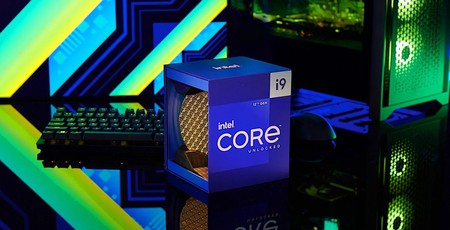
In a move that marks the most significant architectural shift for the company in nearly a decade, Intel has officially pulled back the curtain on its 12th Generation "Alder Lake-S" desktop processors. Following months of speculation and a formal teaser during the Intel Architecture Day in August, the semiconductor giant confirmed the initial lineup of six enthusiast-grade chips. This launch represents a strategic pivot toward a hybrid architecture, signaling Intel’s attempt to reclaim the performance crown in both the gaming and content creation sectors.
Main Facts: The New Guard of Intel Performance
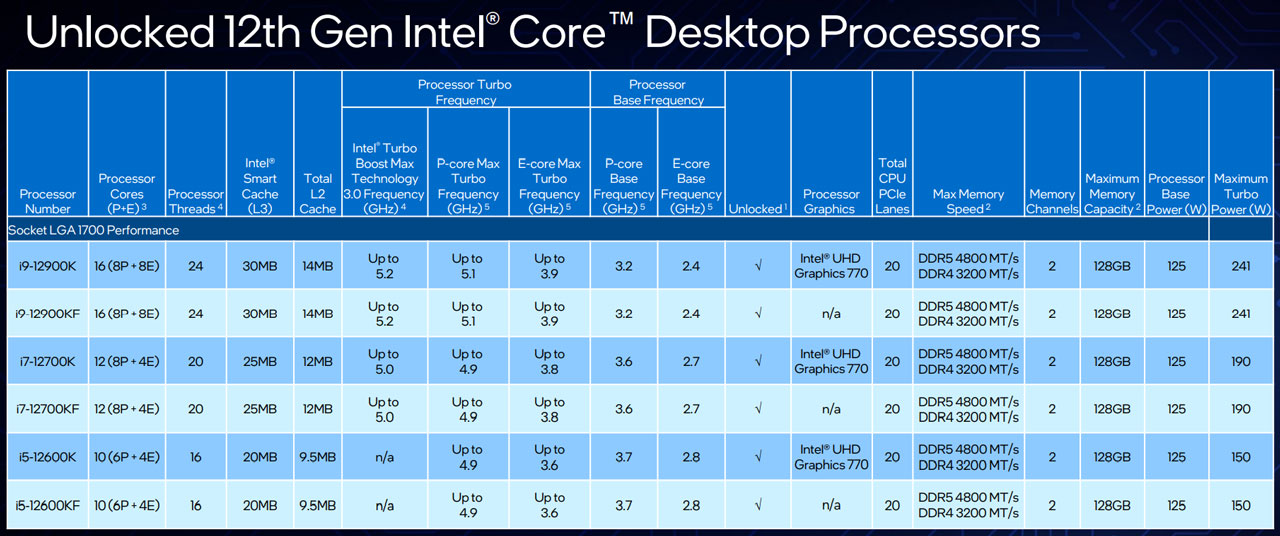
The initial roster of 12th Gen processors focuses on the high-end enthusiast market, featuring three core tiers with unlocked multipliers for overclocking. The lineup consists of the Intel Core i9-12900K and KF, the Core i7-12700K and KF, and the Core i5-12600K and KF.
For those unfamiliar with Intel’s naming conventions, the "K" suffix denotes unlocked multipliers for enthusiasts, while the "KF" suffix indicates the same silicon, but with the integrated GPU (iGPU) disabled. This allows users who intend to pair their system with a dedicated graphics card to potentially save a marginal amount on the purchase price.
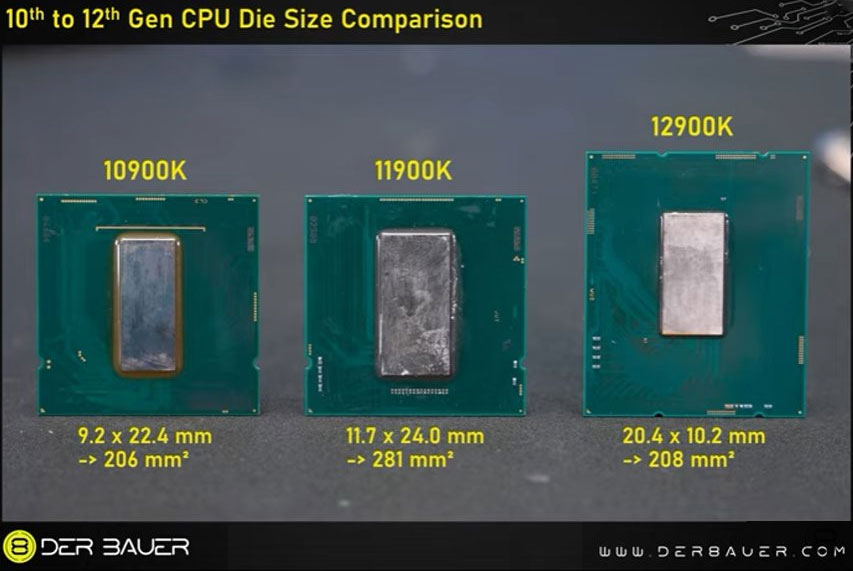
At the heart of these processors is the "Intel 7" manufacturing process, a refinement of the company’s 10nm lithography. The most striking innovation is the implementation of a Performance-hybrid architecture, which combines two distinct types of cores on a single die: Performance-cores (P-cores) for heavy-duty, single-threaded tasks, and Efficient-cores (E-cores) designed to handle background processes and multi-threaded scaling.
A Chronology of the Alder Lake Rollout
The path to the 12th Gen launch has been a carefully orchestrated campaign of information disclosure.
- August 2021: Intel Architecture Day provided the industry with a deep dive into the underlying technology of Alder Lake. We learned about the Performance-hybrid architecture and the shift toward the LGA 1700 socket, but specific SKU information and performance benchmarks remained under wraps.
- Late October 2021: Intel officially launched the first wave of processors. Alongside the announcement, motherboard partners (such as Asus, MSI, and Gigabyte) and memory manufacturers (G.Skill, Corsair, and others) unveiled their support ecosystem.
- November 4, 2021: This serves as the critical embargo date. While the information is now public, third-party reviewers and tech media outlets are restricted from publishing independent performance data until the hardware reaches the public market on this date.
Supporting Data: Power, Performance, and Architecture
The technical specifications revealed by Intel illustrate a dramatic shift in how power is managed in a high-performance PC. Each CPU now lists a "Processor Base Power" and a "Maximum Turbo Power." While the base wattage figures are modest, enthusiasts are being warned that these chips will effectively operate at their maximum power limits under sustained workloads.
The Flagship: Core i9-12900K
Intel is positioning the i9-12900K as the "world’s best gaming processor." With 16 cores (8 P-cores and 8 E-cores) and 24 threads, the chip can boost up to 5.2GHz. However, this power comes at a cost: under heavy synthetic loads, the chip is expected to draw over 240W, necessitating high-end thermal solutions, such as 360mm AIO liquid coolers or custom water loops.
Benchmarks and Competitive Claims
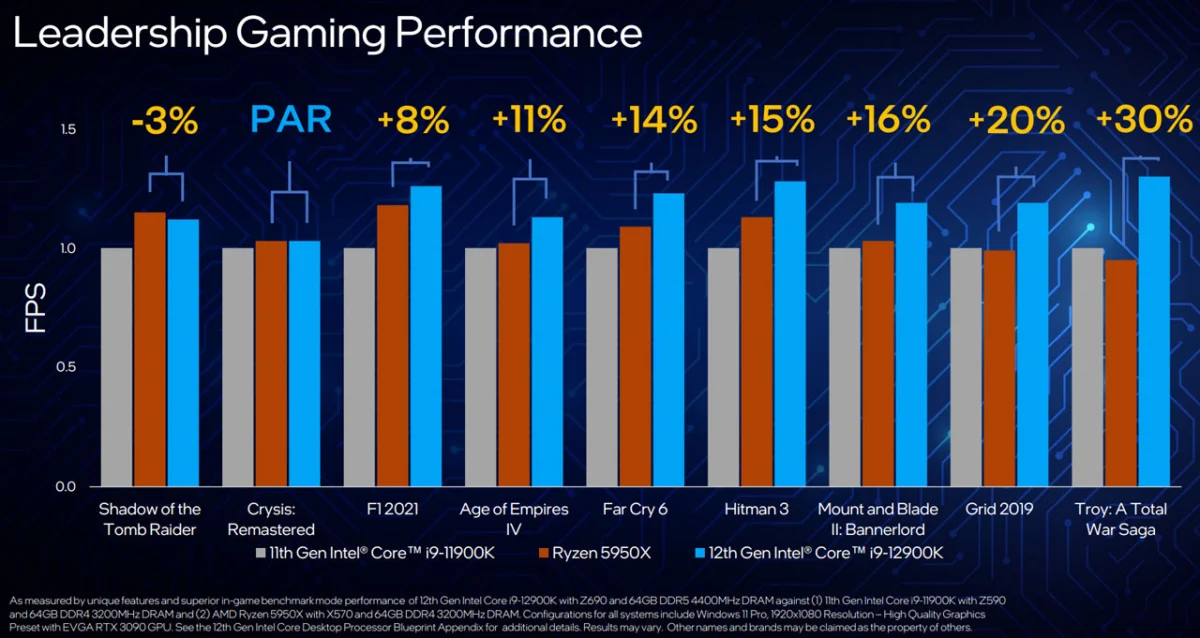
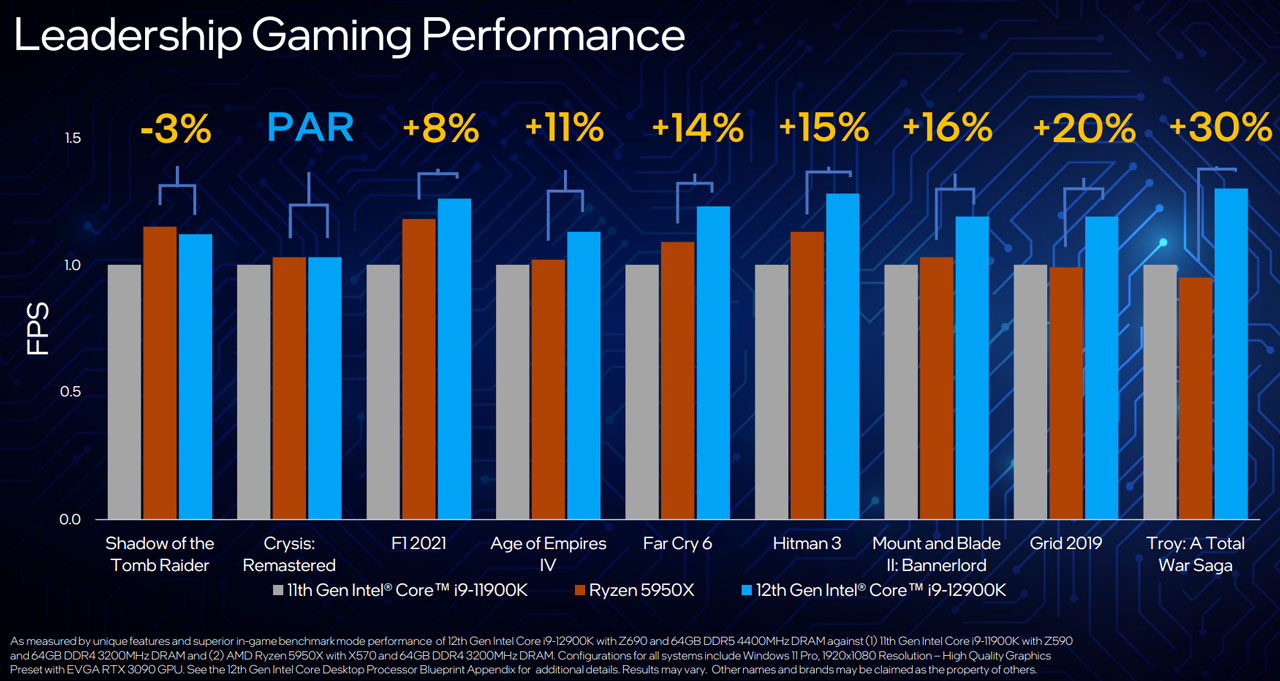
During the launch presentation, Intel shared internal testing comparing the i9-12900K to the AMD Ryzen 9 5950X. The data suggests a 12% lead in modern PC gaming performance for the Intel chip. However, industry analysts have been quick to add an asterisk to these figures. At the time of testing, the Windows 11 systems used for the AMD benchmarks were reportedly missing critical patches related to L3 cache latency and the "preferred core" technology. Without these patches, Ryzen performance can be hampered by as much as 15%, leaving many to wonder how the chips will compare on an even playing field once the Windows 11 optimizations are fully rolled out to all users.
In content creation—a sector where core counts dictate speed—Intel claims a 30% improvement over its 11th Gen predecessors. This leap is largely attributed to the increase in core count and the efficiency of the P-core and E-core distribution in multi-threaded creative applications.
The Ecosystem: 600 Series Chipsets and DDR5
The Alder Lake launch is not merely about silicon; it is about a total platform overhaul. The introduction of the Z690 chipset brings a host of modern I/O standards to the mainstream desktop market.
PCIe 5.0 and DDR5
The Z690 platform is the first to bring PCIe 5.0 support to consumers, providing twice the bandwidth of PCIe 4.0 for future-proofed storage and graphics cards. Furthermore, the shift to DDR5 memory is a significant milestone. While the transition will inevitably be expensive, the performance potential is immense; companies like G.Skill are already demonstrating memory kits capable of reaching speeds of 6800MT/s.
The Motherboard Landscape
The enthusiast market is responding with vigor. Asus has announced a massive catalog of nineteen Z690 boards, spanning the full spectrum of form factors from massive E-ATX boards for liquid-cooled builds to compact mini-ITX motherboards for small-form-factor enthusiasts. This diversity suggests that motherboard manufacturers are confident in the longevity and demand for the new LGA 1700 socket.
Implications: A New Era for Computing?
The launch of the 12th Gen Core processors has several profound implications for the computing industry:
- The End of the "One-Size-Fits-All" Core: Intel has successfully challenged the industry status quo by proving that a hybrid architecture (combining high-power and high-efficiency cores) can be effective in a desktop environment. This mirrors the design philosophy of modern mobile processors and represents a maturation of PC silicon.
- The Thermal Challenge: With the flagship i9-12900K pushing 240W, the industry is entering an era where thermal management is becoming as important as raw clock speeds. The days of "stock coolers" for flagship-level performance are effectively over; consumers must now factor in high-end cooling solutions as a prerequisite for ownership.
- OS Dependency: The reliance on Windows 11 to effectively manage the "Thread Director" (the hardware-level scheduling technology that tells the CPU which tasks go to P-cores and which go to E-cores) is a major development. Users on Windows 10 may not see the full potential of these chips, effectively forcing a platform-wide migration to Microsoft’s latest operating system.
- Competitive Volatility: By pricing the i9-12900K at $590, the i7-12700K at $410, and the i5-12600K at $290, Intel has set a competitive baseline that directly challenges AMD’s current Ryzen 5000-series pricing. This sets the stage for a price-to-performance war that will benefit the end consumer, provided that supply chain constraints do not inflate retail prices.
As we approach the November 4th release date, the tech community remains in a state of high anticipation. While Intel’s internal testing paints a picture of a dominant new generation, the true test will occur when the processors land in the hands of independent reviewers. Will the P-core/E-core hybrid architecture hold up under the diverse, unpredictable workloads of real-world computing? Will the platform stability of the new Z690 motherboards and DDR5 memory hold firm? The stage is set for a monumental confrontation in the CPU market, and for the first time in several years, the landscape feels genuinely unpredictable.











