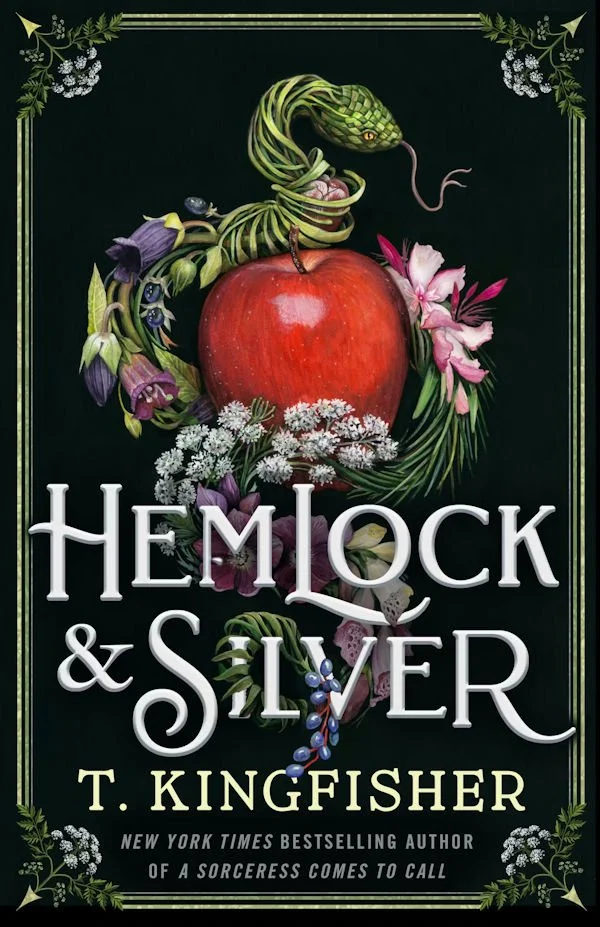
In the ever-expanding bibliography of Ursula Vernon—widely celebrated under her pen name, T. Kingfisher—the boundaries between cozy fairy-tale wonder and bone-chilling existential horror have always been porous. However, with her latest release, Hemlock & Silver, the author has achieved a masterclass in genre synthesis. By blending the scientific rigor of a 17th-century toxicologist with the dark, surrealist dread of a fractured mirror-realm, Kingfisher has delivered what may well be her most sophisticated narrative to date.
Hemlock & Silver is not merely a retelling; it is a clinical dissection of a classic archetype, stripping away the sanitized veneer of the Brothers Grimm to reveal the rot underneath. For fans of Kingfisher’s previous works, such as Nettle & Bone and What Moves the Dead, this novel represents a maturation of style that balances character-driven humor with genuinely unsettling supernatural mechanics.
The Premise: A Poisoner’s Call to Duty
The narrative centers on Anja, a 35-year-old healer whose expertise lies in the lethal rather than the restorative. Haunted by a childhood encounter with hemlock, Anja has dedicated her life to the study of toxins, treating them as complex puzzles to be solved through the scientific method. Her quiet, herb-focused existence is abruptly shattered when she is summoned by the King to the royal castle.
The task is grave: Princess Snow, the monarch’s daughter, is suffering from a wasting illness that defies all conventional medical intervention. As Anja begins her investigation, she discovers that the ailment is not physiological, but metaphysical. The castle is haunted by enchanted mirrors—portals to a dark, inverted realm—that are actively draining the Princess’s life force. Accompanied by a taciturn guard and an insufferably narcissistic cat, Anja must venture into the reflection to save the Princess, all while grappling with the realization that the world she understood is fundamentally broken.
Chronology: From Scientific Skepticism to Supernatural Horror
The trajectory of the novel follows a distinct three-act structure that shifts the reader’s perception of the world alongside Anja’s own.
- Phase I: The Empirical Approach. The early chapters establish Anja as a character of logic. She rejects the supernatural, viewing the world through the lens of chemistry and botany. During this period, the tone is reminiscent of a procedural, with Anja conducting physical examinations of the Princess and the castle’s staff.
- Phase II: The Breach of Reality. The midpoint of the novel marks the shift into horror. Upon discovering the mirror-realm, Anja is forced to abandon her scientific worldview. The pacing accelerates as she navigates the "nightmare fuel" of the reflections—stitched-together creatures and shifting landscapes that challenge her sanity.
- Phase III: The Convoluted Denouement. The final act descends into a complex web of betrayals and shifting loyalties. This is where the narrative density peaks, as the antagonist’s machinations involve multiple layers of deception that test the reader’s ability to track the sequence of events.
Supporting Data: Why Hemlock & Silver Succeeds
To understand why this book stands out in a crowded market of fairy-tale retellings, one must look at the character dynamics and thematic depth.
The Protagonist as a Pivot Point
Unlike many fantasy protagonists who are "chosen ones" or magically gifted, Anja is a product of her environment. Her wealth, her merchant-class background, and her age ground her. At 35, she possesses a cynical, sharp-witted exterior that functions as a defense mechanism. Her reluctance to accept magic is not a plot device to create mystery, but a deeply held philosophical stance that makes her eventual surrender to the truth of the mirror-realm more poignant.
The Subversion of the "Snow White" Tropes
Kingfisher manages the rare feat of utilizing the iconography of Snow White—the poisoned apple, the mirror, the princess—without adhering to the tired narrative beats of the original tale. By focusing on the mechanics of the curse rather than the "damsel in distress" narrative, Kingfisher elevates the story. The mirrors are not just magical objects; they are conduits of ecological and psychological decay.
The Supporting Cast
The cast is notable for its restraint. The castle staff are portrayed as laborers—practical, limited, and distinctly human. The guard, whose archetype is often elevated to "heroic protector," is kept grounded, functioning as a logistical necessity rather than a romantic interest. The cat, meanwhile, provides the necessary levity, serving as a chaotic element that bridges the gap between the mundane and the surreal.
Official Critical Reception and Internal Tensions
While Hemlock & Silver has been largely lauded as a standout, critical discourse has highlighted specific friction points regarding the novel’s conclusion.
The "Missing" King
A primary critique leveled against the novel is the sudden disappearance of the King. Having established him as an intelligent, proactive father in the opening chapters, his absence during the climax feels discordant. Readers have noted that his lack of resolution—or even a reaction to the final revelations—leaves an emotional void that the ending fails to fill.
The Complexity of the Antagonist’s Plot
The climax of the novel is intentionally obfuscated. The sequence of deaths and the layered deceptions utilized by the antagonist have been described by some readers as "convoluted to the point of frustration." While the confusion is thematically appropriate—as the characters themselves are meant to be misled—the execution leaves some readers struggling to piece together the causality of the final scenes, even after multiple readings.
Implications: A New Benchmark for Fairy-Tale Fantasy
The success of Hemlock & Silver signals a shift in the fantasy genre. Readers are increasingly seeking "fairy tale fantasy" that refuses to be "cozy." Kingfisher has successfully tapped into a demand for stories that retain the whimsy of the genre while injecting the visceral, psychological terror of contemporary horror.
The "Kingfisher Effect"
This novel serves as a perfect entry point for those new to T. Kingfisher’s body of work. It captures the charm of Nettle & Bone without the low-stakes criticism, while borrowing the structural dread of What Moves the Dead. It suggests that the future of the fairy-tale retelling lies in "subversion through specificity"—using unique, non-magical lenses (such as toxicology) to examine supernatural events.
Literary Value
Ultimately, Hemlock & Silver asks difficult questions about the nature of knowledge. When a scientist is forced into a world where laws of physics no longer apply, how do they retain their identity? Anja’s journey is not just about saving a princess; it is about the trauma of being proven wrong by the universe.
Despite the minor issues with pacing and the untied loose ends regarding the King, Hemlock & Silver is a triumphant addition to modern fantasy. It is a haunting, witty, and deeply intelligent book that proves T. Kingfisher is currently operating at the height of her powers. Whether you are a fan of the macabre or a devotee of classic folklore, this novel offers a rare, balanced experience that will stay with you long after the final mirror is shattered.