

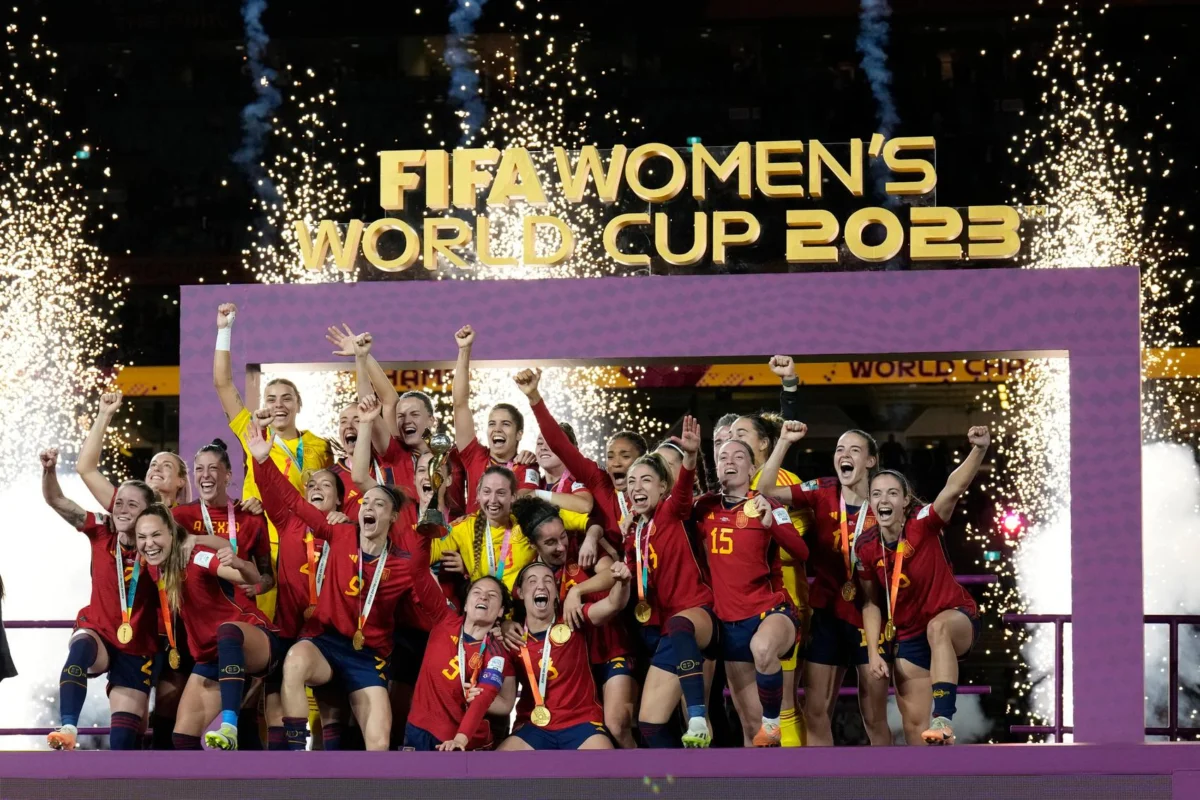
As the dust settles on the exhilarating conclusion of the men’s international summer circuit, the spotlight of the footballing world is rapidly shifting to the Southern Hemisphere. With the next FIFA Women’s World Cup set to unfold in Brazil next summer, the global game is preparing for a landmark tournament that promises to redefine the landscape of women’s sports. Following Spain’s historic triumph in 2023, the stage is set for a high-stakes competition where the parity between traditional powerhouses and rising contenders has never been more evident.
The State of Play: Spain’s Reign and the American Reset
The current hierarchy of women’s football is dominated by the Spanish national team, whose tactical sophistication and technical brilliance have set a new benchmark. Having captured the 2023 Women’s World Cup title in Sydney with a clinical 1-0 victory over England, Spain enters the Brazil cycle as the undisputed team to beat. Their roster is a veritable “who’s who” of world-class talent, featuring the creative genius of Ballon d’Or winners Aitana Bonmati and Alexia Putellas, alongside the blistering pace of Salma Paralluelo.
The dominance of the Spanish side is so profound that it has even commanded the respect of their male counterparts. Following Spain’s victory in the men’s tournament, star midfielder Rodri famously remarked during a television interview that he was “trying to see if I can get to her [Bonmati’s] level,” a testament to the surging profile and perceived quality of the women’s game.
For the United States, however, the road to 2027 is paved with a mandate for redemption. After an uncharacteristic exit in the round of 16 at the hands of Sweden in 2023, the four-time world champions are currently ranked No. 2 globally. Under the guidance of head coach Emma Hayes, the USWNT is undergoing a critical evolution. Hayes has been vocal about the necessity of embracing "moments of chaos"—the ability to adapt to high-pressure, hostile environments. This philosophy was put to the test during the team’s June tour of Brazil, where the U.S. fell 2-1 in São Paulo before responding with a resilient 1-0 victory in Fortaleza.
A Crucial Prelude: The October Friendlies
The tactical chess match between the world’s top two ranked teams begins in earnest this October, when the United States hosts Spain for a pair of high-profile friendlies. These matches serve as far more than mere exhibitions; they are vital tune-ups ahead of the CONCACAF qualifying campaign, which kicks off in late November in Texas.
For players like U.S. midfielder Lily Yohannes, these matches represent an essential opportunity to measure the team’s progress against the current gold standard. "We know Spain is an amazing team, and I think we’re just really looking forward to having this prep. Especially before qualifying," Yohannes said. "Playing these players—I’ve played against them in the Champions League, and I know how great they are. It will be a really great opportunity for us."
Chronology of the Road to Brazil
The path to the 2027 tournament has been marked by a rigorous qualification process and a shift in the tournament’s structural history.
- 2023: Spain defeats England 1-0 to claim their first Women’s World Cup title in Sydney, Australia.
- 2024: FIFA confirms the selection of Brazil as the host nation for the 2027 tournament, leveraging existing infrastructure from the 2014 men’s World Cup.
- 2025–2026: Global qualification cycles intensify. To date, 14 nations have secured their berths, including Australia, the Philippines, Japan, North Korea, China, South Korea, Argentina, Colombia, New Zealand, Germany, France, Spain, and Denmark.
- June 2027: The tournament officially commences, marking the final edition to feature 32 teams before the expansion to 48 teams in 2031.
Supporting Data: Infrastructure and Global Parity
Brazil’s selection as host is a deliberate attempt to utilize proven infrastructure. The tournament will be held in eight cities that previously hosted matches during the 2014 men’s World Cup: Rio de Janeiro, São Paulo, Belo Horizonte, Brasília, Fortaleza, Porto Alegre, Recife, and Salvador. This logistical continuity is expected to provide a seamless experience for fans and teams alike.
The global competitive field is also diversifying. Germany, the two-time world champions (2003 and 2011), currently holds the No. 3 spot in the world rankings and remains a significant threat to the Spanish and American hegemony. Meanwhile, the tournament will be the last of its size; starting in 2031, the World Cup will mirror the men’s expansion to 48 teams. The host selection for the 2031 tournament—a joint bid from the United States, Mexico, Costa Rica, and Jamaica—is expected to be finalized this coming November.
Official Perspectives: The Push for Equality
The significance of the 2027 tournament extends beyond the pitch. Aline Pellegrino, a former Brazil defender and the current executive director of legacy and stakeholder affairs for the Women’s World Cup in Brazil, emphasizes the tournament’s potential to act as a catalyst for social change.
"Some time ago, the opportunities for men and women were not equal. But that’s changing," Pellegrino noted. "This World Cup has tremendous potential to make that change truly happen. There’s a great deal of excitement and expectation that we’ll have the best possible atmosphere in our stadiums, just as we recently saw in the two matches between the Brazilian national team and the United States."
Pellegrino stressed that FIFA, in conjunction with the Brazilian federal government and host city authorities, is working tirelessly to ensure maximum attendance and operational efficiency. The goal is to prove that the women’s game can command the same fervor, logistics, and prestige as the men’s edition.
Implications: The Marta Factor
The narrative of the 2027 World Cup will inevitably be anchored by the question of Marta’s participation. As Brazil’s all-time leading scorer with 122 international goals, Marta is a cultural icon. Following Brazil’s 1-0 loss to the U.S. in the gold-medal match at the Paris Olympics, the legendary captain announced her retirement from international play. However, in a surprising reversal, she returned for the Copa America Femenina.
Should she take the field in 2027, she will be 41 years old. Her presence would serve as both a swan song for one of the greatest players in the history of the sport and a massive draw for ticket sales in a nation that has yet to see its women’s team hoist the World Cup trophy.
Looking Ahead
The 2027 Women’s World Cup in Brazil arrives at a pivotal moment for the sport. With the rapid professionalization of leagues across Europe and North America, the talent pool has deepened, making the outcome of the tournament harder to predict than ever before. Whether Spain can defend its crown, if the U.S. can reclaim its throne, or if a surging Germany or a determined host nation can shock the world, one thing remains certain: the tournament will serve as a definitive statement on the growth of women’s football.
As the qualification process reaches its conclusion and the October friendlies provide a glimpse into the tactical preparations of the elite, the world waits to see who will emerge from the "moments of chaos" to lift the trophy in Brazil. The legacy of 2027 will not just be measured in goals scored or matches won, but in the permanent, irreversible shift toward equality within the global footballing hierarchy.











