

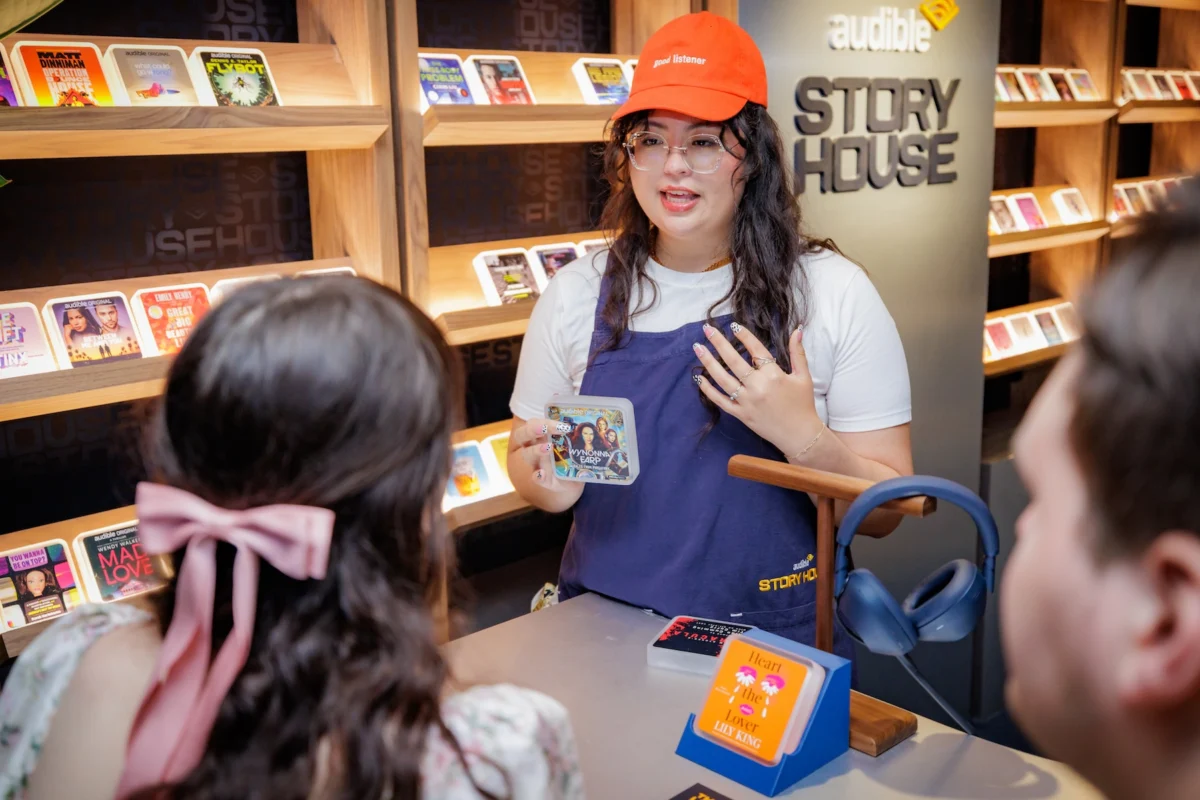
In an era dominated by screens and infinite digital scroll, the act of selecting a book has become increasingly detached from the physical world. Yet, as the Audio Publishers Association reports, the appetite for spoken-word content is at an all-time high, with more than 157 million Americans aged 18 and older having engaged with an audiobook. To bridge the gap between the invisible nature of digital files and the tactile joy of discovery, Audible—the Amazon-owned giant of the industry—recently launched an ambitious physical retail experiment: the "Story House."
Billing itself as the world’s first "bookless bookstore," the Story House served as a laboratory for the future of audio consumption. By transforming a three-story space in lower Manhattan into a multisensory hub, Audible sought to answer a fundamental question: How do you market a product that has no physical form?
A Chronology of the Audible Story House
The journey of the Story House began not in a permanent retail location, but in the frenetic environment of a convention center. Its initial iteration served as a pop-up activation during the long-awaited return of BookCon at New York City’s Javits Convention Center in April. The success of this limited showcase prompted the company to expand its reach.
From May 1 to May 31, the Audible Story House took up residence at 260 Bowery in Manhattan. Over the course of these 31 days, the space operated as a free-to-enter sanctuary for bibliophiles and casual listeners alike. During its month-long tenure, the location welcomed more than 7,000 unique visitors, creating a sustained, high-traffic environment that allowed the company to observe customer behavior in real-time.
As the calendar turned to June, the doors closed, and the physical installation was dismantled. Despite the temporary nature of the residency, the impact on those who visited—and the data gathered by the company—suggests that the Story House may have been a blueprint for a larger, global strategy.
The Architecture of Sound: Making the Invisible Tangible
The core challenge of the Story House was to solve the "invisibility problem" of audiobooks. Audible addressed this through a combination of proprietary hardware and immersive design.

The primary tool of discovery was the "Story Tile"—a physical block embedded with RFID technology. These tiles served as tangible representations of digital audiobooks. When a visitor picked up a tile, they could instantly trigger audio samples via integrated speakers, high-end headphones, or their own personal devices. This tactile engagement removed the friction typically associated with browsing a digital library, where one must rely on metadata and cover art alone.
The space was divided into seven distinct listening environments, each curated to evoke different moods and genres. The crown jewel of the location was an immersive listening theater equipped with Dolby Atmos surround sound, which allowed listeners to experience audio productions with a level of fidelity rarely achieved in home environments.
Complementing the tech-forward aspects were the "Story Tenders"—staff members trained to provide personalized recommendations. Much like a sommelier in a high-end wine bar, these tenders guided visitors through the vast Audible catalog, helping them navigate a selection of 301 titles. The space also featured a pop-up café from Brooklyn’s Land to Sea, book clubs, creator-led panels, and hands-on crafting activities, effectively cementing the Story House as a community hub rather than a sterile retail outlet.
Supporting Data: What the Listeners Told Us
The metrics gathered during the month of operation were nothing short of revealing. Audible recorded that 98% of the 301 featured titles were listened to "to any degree" by visitors, proving that the curation strategy resonated across a wide spectrum of interests.
The most popular titles included heavy hitters and fan favorites:
- Project Hail Mary by Andy Weir
- The Hive: A Thriller
- George Orwell’s 1984
- Just Kiss Already
- Audible’s full-cast production of Harry Potter and the Sorcerer’s Stone
Perhaps more telling was the engagement with niche hits like Matt Dinniman’s Dungeon Crawler Carl series. Even though the eighth book in the series, A Parade of Horribles, had only been released on May 12, the Story House saw a steady stream of visitors interacting with the title, demonstrating that even the most dedicated fans found value in the physical, communal experience of the shop.

Beyond simple "browsing," the company tracked over 15,000 "deep engagement" experiences. This classification refers to visitors who moved beyond a cursory glance, participating in community sessions, engaging with the Story Tenders, or lingering in the listening lounges. This level of retention is rarely seen in standard pop-up retail, where the average dwell time is typically much lower.
Official Perspectives: Learning from the Field
For James Finn, Audible’s global head of brand content marketing, the Story House was less about sales and more about enlightenment.
"What I was excited about was the opportunity to learn a lot more about customers and their experiences in that space," Finn told Variety. "Oftentimes, I don’t have a sample size like that, and I don’t have a situation where we show up for an entire month in a city like New York and really learn more about our existing customers and new listeners."
The closure of the space was a bittersweet milestone. "It was very hard when we closed the doors, I will be honest," Finn admitted. "A lot of people assumed that it was going to be there permanently, which was a nice compliment to the team that built the space."
The data collected is already being funneled back into the digital ecosystem. Audible is currently analyzing the "friction points" identified at the Bowery location—the moments where a user might be confused or overwhelmed—to streamline the experience within the Audible app. The goal is to replicate the "personalized, low-friction" discovery process of the Story House in a digital-first environment.
The Future: From Bowery to the World
The success of the Story House has prompted a shift in how Audible views its international marketing strategy for 2027. The company is currently repurposing the 13,000 "Story Tiles" created for the New York location, viewing them as valuable assets that can bridge the digital-physical divide in other markets.

Rather than committing to a single, permanent flagship store, Audible appears to be opting for a "roving residency" model. The company has confirmed plans to bring a version of the Story House—retaining the core fundamentals of the RFID-based discovery and immersive listening—to the Guadalajara Book Festival and the prestigious Frankfurt Book Fair.
This pivot indicates that the "bookless bookstore" is not a failed retail experiment, but a successful brand-building vehicle. By treating the audiobook not as a commodity to be downloaded, but as a narrative experience to be savored, Audible is tapping into a deeper human need for connection.
As we look toward the future, the implications are clear: the digital revolution in publishing is not the end of physical interaction, but the beginning of a new, hybrid chapter. Whether through pop-ups at global book fairs or the integration of "tactile" features into app interfaces, Audible is proving that even in a world of invisible sound, the most successful brands are those that find a way to make their content feel real. The story, it seems, is only just beginning.










