In a move that signals a seismic shift in the landscape of neurotechnology, legendary AI pioneer and futurist Ray Kurzweil has officially joined the ranks of Subsense, an ambitious startup poised to challenge the status quo of brain-computer interfaces (BCIs). While industry titans like Elon Musk’s Neuralink have captured headlines with surgical, hardware-heavy approaches to neural integration, Subsense is pursuing a far more clandestine and non-invasive path: the delivery of charged nanoparticles via a simple nasal spray.
This partnership marks a significant milestone in Kurzweil’s decades-long career, bridging his theoretical work on the "Singularity"—the hypothetical point where human intelligence and machine intelligence merge—with the practical, biological realities of neuro-engineering. By moving away from the scalpel and toward the olfactory system, Subsense is attempting to lower the barrier to entry for what could eventually become the next phase of human evolution.
The Genesis of an Idea: Chronology of an AI Pioneer
To understand the weight of Kurzweil’s involvement, one must look back at his enduring legacy. Born in 1948, Kurzweil has spent over half a century at the intersection of technology and human potential. His journey began in the 1960s, a formative era where he demonstrated a precocious ability to foresee the trajectory of computing.
Key Milestones in Kurzweil’s Career:
- 1960s-1970s: Pioneered the foundational technologies for optical character recognition (OCR), text-to-speech synthesis, and speech recognition—technologies that form the bedrock of today’s voice assistants like Siri and Alexa.
- 1990s: Published The Age of Spiritual Machines, a book that accurately predicted the rise of the internet, mobile devices, and the eventual ubiquity of artificial intelligence.
- 2005: Released The Singularity Is Near, outlining his theory that human-machine convergence is not only possible but inevitable.
- 2012: Joined Google as a Director of Engineering to work on machine learning and natural language processing.
- 2024/2025: Joins Subsense, transitioning from theoretical forecasting to active guidance of neuro-nanotechnology.
Throughout his career, Kurzweil has been a proponent of the "Law of Accelerating Returns," arguing that technological progress is exponential rather than linear. His decision to join Subsense suggests he believes the technology is finally reaching a maturity level where the "integration of mind and machine" is no longer a matter of if, but how.
The Subsense Methodology: Bypassing the Scalpel
The primary obstacle for current BCI development, including Neuralink, is the invasive nature of the procedure. Drilling into the cranium to implant electrodes carries significant surgical risks, ranging from infection to permanent brain trauma. Subsense aims to render these risks obsolete by utilizing the body’s own biological pathways.
The Nasal Pathway
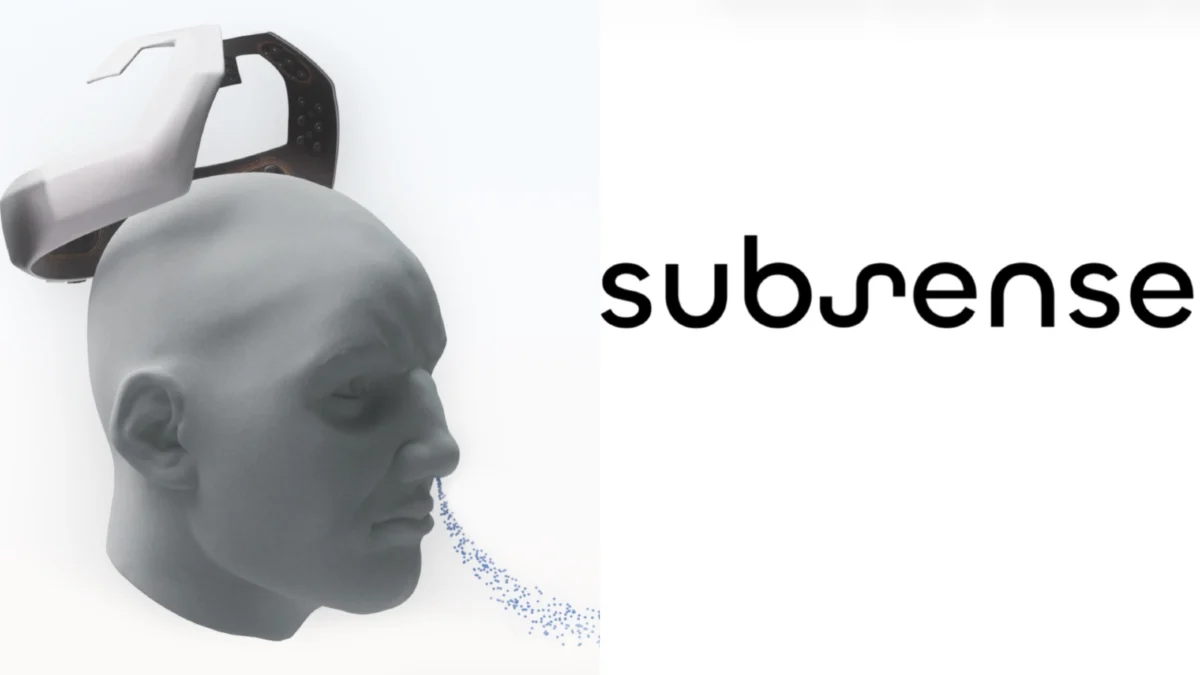
The company’s proprietary technology relies on the olfactory nerve—the sensory pathway for smell. By administering a specialized nasal spray, patients introduce charged nanoparticles into the nasal cavity. These particles are designed to travel along the olfactory nerves directly into the brain, bypassing the blood-brain barrier—a biological "gatekeeper" that usually prevents foreign substances from entering the neural environment.
Magnetic Neural Stimulation
Once the nanoparticles reach their designated target areas, they act as miniature conductive bridges. When an external headset—resembling a pair of specialized headphones—is worn, it emits localized magnetic fields. These fields interact with the nanoparticles, stimulating nearby neurons without the need for physical contact. This "wireless" neural communication could allow for high-resolution data transmission between the brain and an external computer, facilitating everything from thought-based communication to sensory enhancement.
Supporting Data and Financial Backing
Subsense has secured $27 million in initial funding, a substantial war chest for a company operating in the high-risk, high-reward field of neurotechnology. While this pales in comparison to the multi-billion-dollar valuations of more established BCI firms, it represents a significant vote of confidence from venture capital firms specializing in biotechnology and artificial intelligence.
The company has successfully moved past the theoretical stage and is currently conducting preliminary testing on murine models. While these tests are promising, the leap from rodent to human biology is vast. The scientific community remains cautious; the challenge of controlling the precise migration of nanoparticles within the complex, fluid-filled environment of the human brain is a monumental task.
Projected Timeline:
- Phase 1 (Completed): Laboratory testing, molecular design of the nanoparticle carrier.
- Phase 2 (Ongoing): Animal models, assessing long-term biocompatibility and neural migration.
- Phase 3 (Pending): Regulatory approval for human clinical trials, focusing on neurodegenerative patient cohorts.
Official Responses and Strategic Vision
Ray Kurzweil’s move to Subsense is not merely an advisory role; he has been vocal about the strategic importance of this specific approach. In a recent statement, Kurzweil noted, "For years, I have believed that the convergence of AI, nanotechnology, and neuroscience could fundamentally change how humans interact with technology."
He views the nasal-delivery mechanism as the "key" to unlocking mass adoption. "Subsense is pursuing an approach that brings those fields together in a particularly compelling way," Kurzweil stated. "With the potential to move brain-computer interfaces beyond today’s surgical constraints and, over time, toward much broader applications, we are looking at the democratization of cognitive enhancement."
The company’s leadership emphasizes that their primary objective is humanitarian. By focusing initially on ALS, Parkinson’s disease, and other neurodegenerative disorders, they aim to prove the safety and efficacy of the platform in patients who have few other options. This medical-first approach is intended to build the necessary regulatory credibility before exploring the "consumer-grade" applications that Kurzweil has often championed.
Implications: The Ethics of the "Digital Brain"
The arrival of a non-invasive BCI technology brings with it a host of profound ethical, social, and philosophical questions. If the technology becomes as simple to administer as a cold-remedy nasal spray, the implications for human autonomy are unprecedented.
Cognitive Sovereignty and Privacy
If the brain is connected to a computer via nanoparticles, the potential for data harvesting is no longer limited to what we type or click—it extends to our very thoughts and subconscious impulses. Who owns the data generated by a human brain? If a company can stimulate neurons, could they theoretically influence them? These questions will dominate the discourse as Subsense moves toward clinical trials.
The Socio-Economic Divide
There is also the risk of a "cognitive divide." If memory enhancement or direct neural-AI communication becomes a commodity, will it be limited to the wealthy? The possibility of a future where cognitive capacity is determined by one’s ability to afford the latest "neural spray" could lead to societal stratification far deeper than anything seen in the digital age.
The Evolution of the Species
Kurzweil has long argued that the merger of human and machine is the natural next step in evolution. By facilitating a seamless, non-surgical interface, Subsense is removing the final barrier to that merger. If the human brain can be augmented by the vast computational power of AI, the definition of what it means to be "human" will inevitably shift.
Conclusion: The Horizon of Neural Integration
The partnership between Ray Kurzweil and Subsense is a watershed moment in 21st-century technology. While the company faces significant hurdles—ranging from FDA regulatory hurdles to the fundamental difficulty of ensuring the stability of nanoparticles in the brain—the promise is undeniable.
By choosing a path that prioritizes biological integration over surgical intervention, Subsense has positioned itself as the disruptor in the BCI space. Whether this technology will truly usher in the era of the "Singularity" remains to be seen, but as the company moves from the lab to the testing phase, the world is watching with a mix of awe and trepidation. As we stand on the precipice of this new frontier, one thing is clear: the future of the human mind is no longer just a biological matter—it is becoming a technological one.