Iffa Jayyana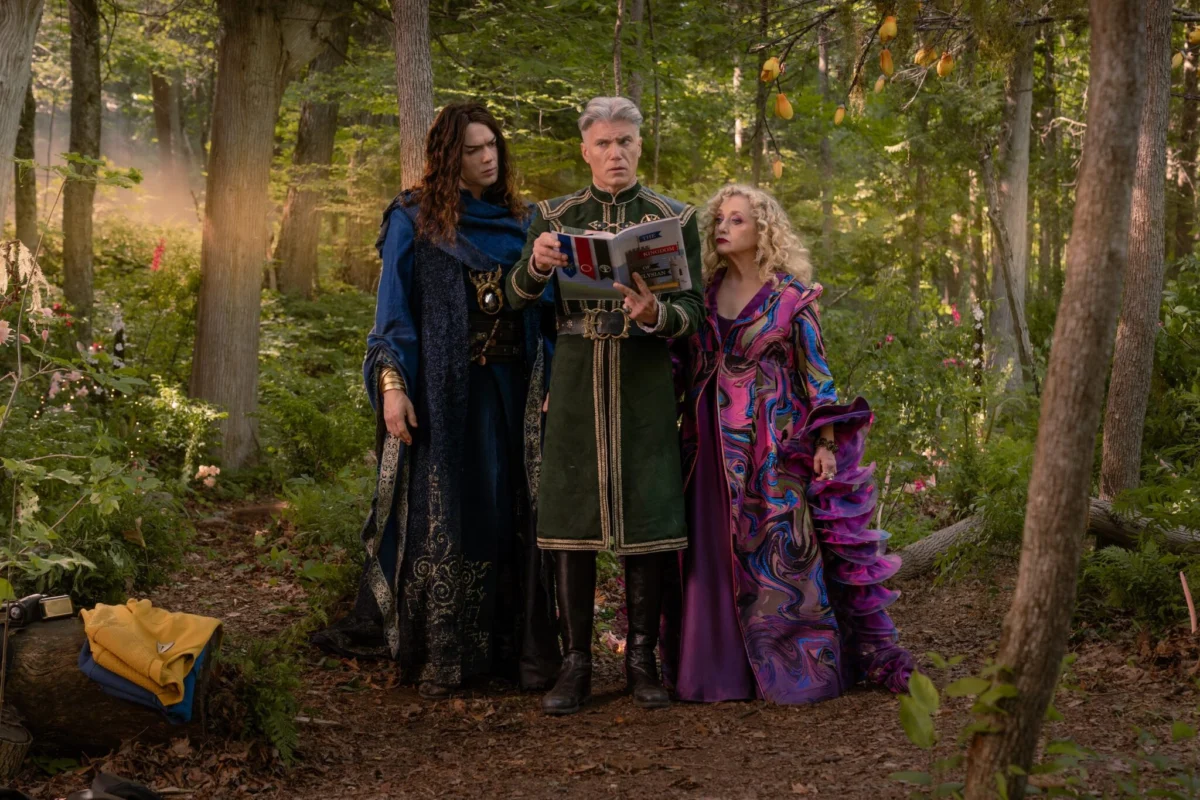
Main Facts: The Return to the Elysian Kingdom
The Star Trek: Strange New Worlds Season 4, Episode 9, titled "Once La’an a Time," marks a return to one of the most high-concept narrative devices in the series’ history: the reality-bending "Elysian Kingdom." The episode revisits the premise established in the first season, where an extra-dimensional entity residing within a nebula manifested the contents of a children’s fantasy book—The Kingdom of Elysian—aboard the USS Enterprise.
In the inaugural appearance of this phenomenon, the ship’s reality was rewritten to facilitate a recovery for Rukiya, the terminally ill daughter of Dr. M’Benga, who was being held in a transporter buffer. The brilliance of that first-season outing lay in its meta-textual layer: the crew were not merely acting out the book, but rather participating in a fan-fiction narrative Rukiya had constructed in her own mind, allowing for "ships" and character dynamics that did not exist in the source material.
"Once La’an a Time," however, finds itself struggling to replicate that magic. While the visual flair, costume design, and commitment to the "dress-up" trope remain, the narrative cohesion is notably absent. The episode sees the crew once again thrust into these roles, though this time the motivation appears to be a therapeutic intervention for La’an Noonien-Singh, who has struggled with profound emotional volatility throughout the season.
Chronology of the Disappointment
The narrative progression of the episode follows a familiar, yet increasingly strained, path.

- The Inciting Incident: Upon encountering a spatial anomaly, the crew begins to lose their memories, replaced by the roles of characters from the Elysian mythology. Dr. M’Benga is the sole individual who retains his true consciousness, acting as the bridge between the two realities.
- The "Planet" Reveal: The crew beams down to a planetary surface that is revealed to be a colossal, floating disk drifting through the vacuum of space. The lack of a "turtles and elephants" cosmological nod was a missed opportunity for the writers to lean into the absurdity.
- The Conflict: Queen Neve (played by Celia Rose Gooding) imprisons Captain Pike and Spock, demanding that Pelia (the engineer) write a sequel to the book that grants the Queen absolute power.
- The Climax: The plot descends into a chaotic confrontation featuring a red dragon, a "Swamp of Infinite Death" homage to The Princess Bride, and a subplot involving Pike and Spock disguising themselves to infiltrate their own ship.
- The Resolution: The episode concludes with the return to normalcy, but with an open-ended ambiguity regarding whether the entity behind the simulation is the now-transcended Rukiya or a separate cosmic force, leaving viewers with more frustration than closure.
Supporting Data: Character Dynamics and Cast Departures
One of the most glaring issues in the episode is the absence of certain key players. Rong Fu’s character, the stalwart bodyguard Mitchell, is absent due to the actor’s commitments to other projects like Dying Seconds and The Miniature Wife. This leaves a hole in the ensemble that is awkwardly filled by Paul Wesley’s "Prince Dashing."
While Wesley’s performance is energetic, the character is written as an intentionally inept, werewolf-cursed romantic lead. His presence serves as a vehicle for various Princess Bride Easter eggs, including a clunky "As you wish" line that highlights the central problem of the episode: it is consistently drawing comparisons to superior stories rather than establishing its own.
The "Benny Russell" Connection
A highlight for long-time franchise devotees is the nod to the Star Trek: Deep Space Nine classic, "Far Beyond the Stars." Captain Pike refers to Pelia as "Benny Russell," the visionary writer who, in the DS9 universe, hallucinated the existence of the Emissary. This creates a fascinating, albeit brief, piece of internal lore suggesting that Russell was a prolific author of various genres—including children’s fantasy—perhaps during his periods of institutionalization.
Official Responses and Creative Implications
The reception to "Once La’an a Time" has been polarized, reflecting a growing sentiment among the audience that the series has become "choked with goofy episodes." While the Strange New Worlds format thrives on its ability to pivot from the hard-hitting gravitas of episodes like "Orders of Magnitude" to lighthearted romp, the sheer frequency of these "silly" episodes has diluted their impact.

When placed alongside other experimental episodes this season—specifically "Human Best Friend," "Level-Five Transporter Accident," and "Like Chronitons Through the Hourglass"—the "Elysian" sequel feels like a repetitive exercise in style over substance.
The "Wolf" in the Room
A significant critique of the episode’s production quality is the visual execution of the werewolf transformation. Despite decades of technological advancement in CGI, animatronics, and practical effects, the creature design for Prince Dashing remains underwhelming. The "doofy" appearance of the werewolf distracts from the stakes of the scene, illustrating a disconnect between the show’s high-fantasy ambition and its practical realization.
Implications for the Future of the Franchise
The most important takeaway from this episode is the focus on La’an Noonien-Singh. For much of the fourth season, her character arc has been defined by a deep-seated, often disruptive, anger. The episode attempts to use the "Elysian" construct as a psychological crucible for her to process this frustration.
If this episode is intended to be a watershed moment for La’an’s character development, the execution is hampered by the episode’s overall lack of focus. We are left with the implication that the entity behind the simulation is trying to "help" her, but the narrative refuses to confirm the entity’s identity. This choice feels less like a clever mystery and more like an evasion of narrative responsibility.

Is the "Strange New World" Losing Its Way?
The reliance on meta-narrative sequels suggests a potential exhaustion of ideas within the writers’ room. While the first season’s "Elysian Kingdom" felt fresh, inventive, and emotionally grounded in the relationship between a father and his daughter, the sequel feels like a "greatest hits" compilation that lacks the original’s emotional anchor.
When a show pivots this heavily toward pastiche—quoting The Princess Bride and relying on recycled tropes—it risks losing the very thing that made Strange New Worlds a critical darling: its ability to treat its characters’ growth with genuine, non-ironic sincerity. By making the Enterprise crew act "completely differently," the writers provide actors like Christina Chong and Ethan Peck an opportunity to showcase their range, but they do so at the cost of the characters the audience has spent four years getting to know.
Final Assessment
The production values, as expected, are top-tier. The costumes are spectacular, and the chemistry between the cast remains the strongest element of the series. Celia Rose Gooding, in particular, demonstrates a masterful grasp of villainy that far exceeds her earlier, more tentative performances. However, these individual bright spots cannot save the episode from its fundamental flaw: it is a sequel to a story that didn’t need one, and it is a comedy that too often forgets to be funny.
As Strange New Worlds moves forward, it must balance its commitment to experimental, genre-bending storytelling with the necessity of keeping the audience grounded in the core reality of the Enterprise. If the show continues to prioritize "hijinks" over character-driven stakes, it risks alienating the very fans who embraced the show for its return to the classic Trek ethos. For now, "Once La’an a Time" stands as a cautionary tale: sometimes, the most dangerous thing an interstellar vessel can encounter is a story that has already been told.

 Siti Muinah
 Ammar Sabilarrohman