Nana
Nana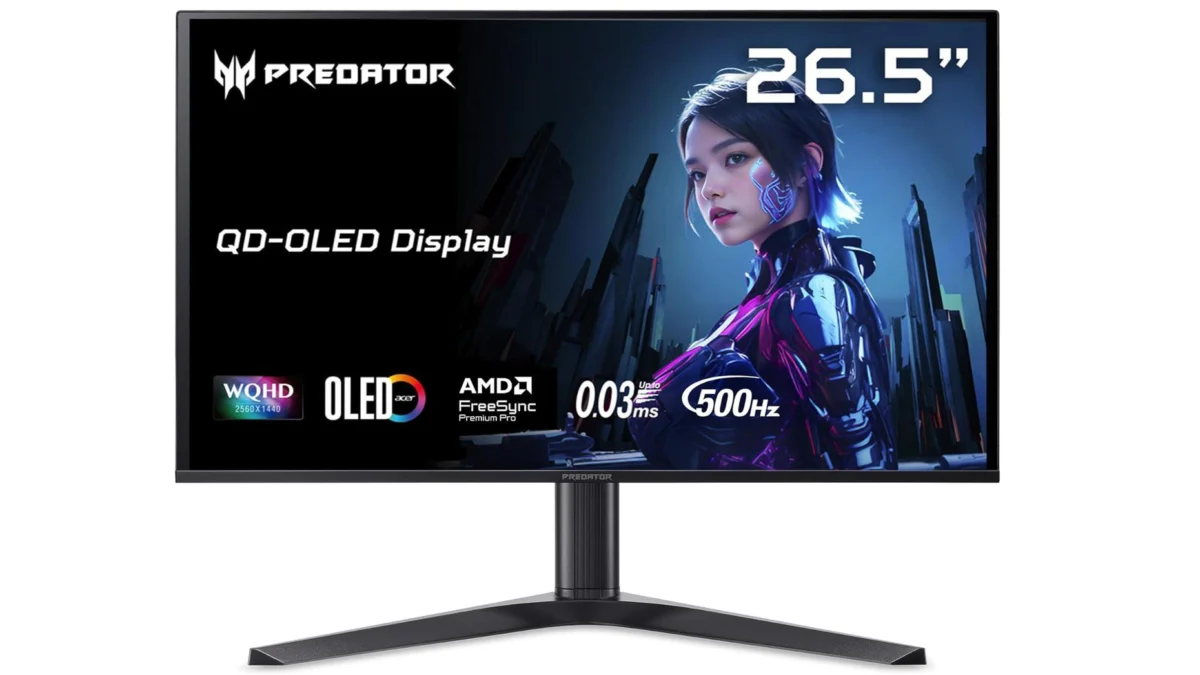
In an era defined by fluctuating memory costs and the relentless upward pressure on component pricing, PC enthusiasts have grown accustomed to a barrage of negative fiscal news. Whether it is the soaring cost of DDR5 RAM or the volatility of the NAND flash market affecting SSD pricing, the path to a high-end gaming rig has become increasingly expensive. However, today offers a rare, significant reprieve. Newegg has slashed the price of the Acer Predator X27U (model F5bmiippruzx)—a premium, enthusiast-grade QD-OLED display—down to just $509.99, marking one of the most aggressive discounts for this tier of monitor technology to date.
The State of the Market: A Rare Break in the Clouds
The current hardware landscape is characterized by a "price-hike fatigue." Consumers have spent the last eighteen months navigating supply chain inconsistencies and artificial constraints that have pushed the entry point for enthusiast-level gaming components into the stratosphere. While graphics card prices have stabilized to some extent, the peripheral market—specifically high-refresh-rate, OLED-panel displays—has remained largely insulated from price drops due to the complexity of manufacturing these cutting-edge panels.
The Acer Predator X27U represents a departure from this trend. By positioning a 27-inch, 1440p, 500Hz QD-OLED monitor at the $500 threshold, Acer and its retail partners are effectively challenging the pricing architecture of the premium display segment. This move is particularly significant for gamers who have been waiting for the "OLED transition" to become financially accessible.
Chronology of the Predator X27U’s Market Presence
The journey of the Predator X27U from a premium flagship to a value-oriented powerhouse did not happen overnight. To understand why this sale is significant, one must look at the timeline of the product’s release and its subsequent market positioning.
1. The Launch Phase (Early 2024)
When the Predator X27U was first introduced to the market, it arrived with a premium MSRP, often hovering well above the $800 to $900 range. At launch, it was marketed as a "pro-sumer" tool—a display designed for competitive eSports professionals who demanded the absolute ceiling of refresh rates. During this period, the technology was largely relegated to enthusiasts willing to pay the "early adopter tax."
2. The Competitive Plateau (Mid-2024)
As competing panels from brands like ASUS, Alienware, and MSI began to saturate the market, the X27U found itself in a crowded arena. Manufacturers began to iterate on the QD-OLED (Quantum Dot Organic Light Emitting Diode) technology, leading to minor refreshes in firmware and cooling solutions. During this phase, the X27U began to see intermittent sales, usually dipping into the $700 range.
3. The Current Price Correction (Late 2024)
The current sale at Newegg, which brings the unit to $509.99, represents a fundamental shift. Analysts suggest this is a combination of inventory clearing ahead of potential next-gen panel releases and a broader strategy by Acer to capture market share in the mid-range segment. By bringing a 500Hz panel into the price bracket previously reserved for entry-level 144Hz monitors, Acer is effectively signaling a new standard for value.
Supporting Data: The Technical Edge of the X27U
The allure of the Predator X27U is not merely its price; it is the sheer technical capability packed into its chassis. For the uninitiated, the specifications of this display read like a wish list for a modern gamer.
The QD-OLED Advantage
Quantum Dot OLED technology is the current gold standard for display panels. Unlike traditional IPS or VA panels, OLED pixels are self-emissive. This means each individual pixel can turn off completely, resulting in "infinite" contrast ratios and true blacks. The "QD" (Quantum Dot) layer adds a layer of vibrancy and color volume that standard OLEDs struggle to match, resulting in high-dynamic-range (HDR) performance that is genuinely transformative.
The 500Hz Refresh Rate: Is It Overkill?
Perhaps the most polarizing feature of the X27U is its 500Hz refresh rate. In the world of display technology, 500Hz is a staggering figure. For the average user, the jump from 144Hz to 240Hz is noticeable, but the leap to 500Hz is often debated.
However, for the target demographic—competitive eSports players in titles like Valorant, Counter-Strike 2, or Overwatch 2—the benefit is tangible. A 500Hz refresh rate reduces the interval between frames to a mere 2 milliseconds. When combined with the near-instantaneous response time of an OLED panel (typically 0.03ms GtG), the result is motion clarity that is virtually indistinguishable from real-world movement.
DisplayHDR True Black 500
The monitor carries the VESA DisplayHDR True Black 500 certification. This ensures that the monitor meets strict standards for luminance and black levels. While 500 nits might sound lower than the 1000-nit peaks seen on some mini-LED monitors, the "True Black" certification ensures that the local contrast is so high that the perceived image quality is often superior to brighter, less precise displays.
Official Responses and Industry Outlook
Acer has been relatively quiet regarding the specific duration of this sale, which is a hallmark of "flash" inventory movements. However, the move is indicative of a broader industry shift. As manufacturing yields for QD-OLED panels have improved, the overhead costs for manufacturers have decreased.
Industry analysts at major tech firms have noted that the "OLED-for-all" movement is gaining momentum. Companies are moving away from traditional gaming monitors and aggressively subsidizing OLED transitions to ensure that consumers remain within their ecosystem. "We are seeing a commoditization of high-end panel tech," says one industry consultant. "What was once a luxury is now being used as a loss-leader to drive brand loyalty in a highly competitive peripherals market."
Implications: What This Means for Your Next Upgrade
If you are currently sitting on an aging 1080p or 1440p IPS monitor, the implications of this sale are profound. Here is what this shift means for the broader PC gaming ecosystem:
1. The Death of the "Mid-Range" IPS
With OLED technology approaching the $500 mark, the justification for purchasing a high-end IPS monitor becomes increasingly difficult. While IPS panels still hold an advantage in terms of static text clarity (due to sub-pixel layout differences) and longevity (due to the lack of burn-in risk), the visual fidelity of OLED is simply in a different class.
2. Diminishing Returns on Refresh Rates
The 500Hz milestone suggests that the industry is approaching a plateau. Once motion clarity is near-perfect, manufacturers will likely shift their focus toward resolution (4K) and size (ultrawide) rather than pushing refresh rates higher. This is a win for the consumer, as the "arms race" for frames per second is reaching a point of diminishing returns.
3. The Need for GPU Synergy
It is important to note that a 500Hz display is only as good as the hardware driving it. To take advantage of the Acer Predator X27U’s capabilities, a user requires a modern GPU capable of outputting high frame rates at 1440p. This sale may indirectly drive sales of high-end graphics cards, as users realize their current hardware cannot push enough frames to justify the display’s capabilities.
Conclusion
The Acer Predator X27U, priced at $509.99, is more than just a bargain; it is a signal of a changing market. For those who have been waiting for the perfect moment to transition to OLED, the combination of a 500Hz refresh rate and the rich, infinite-contrast picture quality of QD-OLED represents the best value-per-dollar currently available in the display market.
While the volatility of the broader tech market continues to cause headaches for those looking to upgrade their RAM or SSD storage, the monitor market has finally provided a clear, objective win for the consumer. As we move into the final quarter of the year, it remains to be seen if this price point will become the new "normal" or if it is merely a temporary correction. For now, however, those in the market for a display upgrade have a clear path forward. If you have been waiting to see the world of gaming through an OLED lens, the barrier to entry has never been lower.


 Azzam Bilal Chamdy
 Iffa Jayyana