

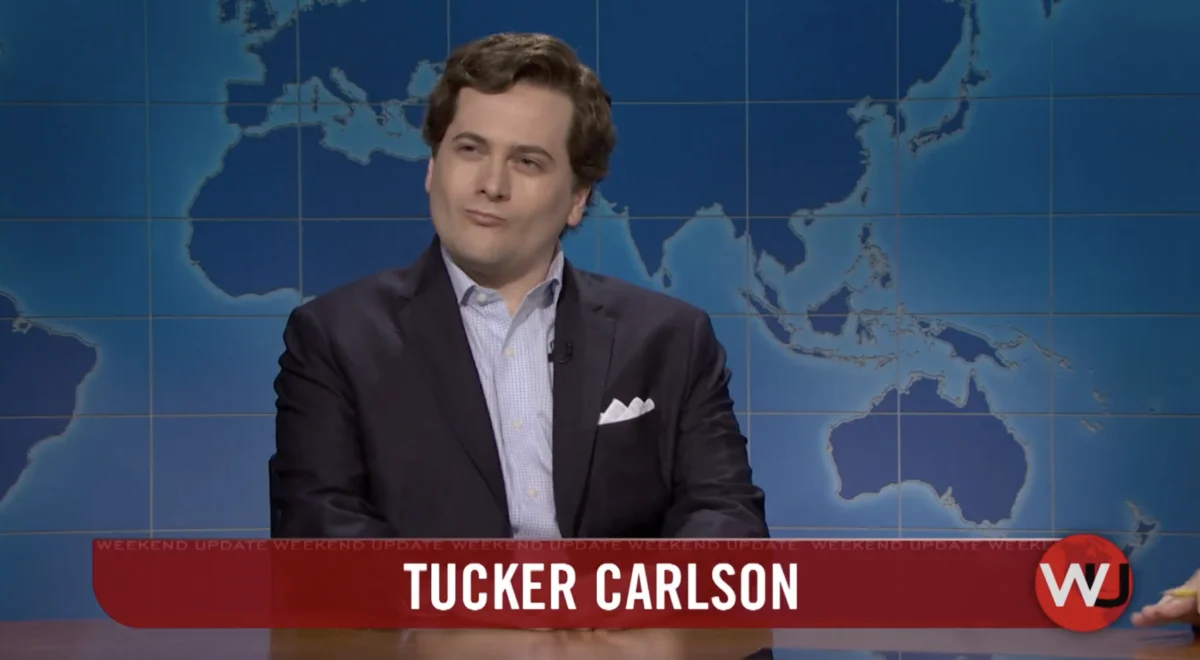
In the high-stakes landscape of late-night television, few segments carry as much cultural weight as Saturday Night Live’s "Weekend Update." As the show navigates an increasingly polarized American political climate, its ability to weaponize impressionism has become a critical barometer for public discourse. Recently, the show’s decision to double down on newcomer Jeremy Culhane’s uncanny portrayal of former Fox News host Tucker Carlson has solidified a new creative mandate: if a character hits, keep the pressure on.
The Return of the Pundit: Culhane’s Carlson Encore
Following a breakout performance a month ago that went viral across social media, Jeremy Culhane returned to the "Weekend Update" desk this past Saturday. The focus of his latest diatribe? A scathing, absurdist critique of the Met Gala.
Culhane’s impersonation succeeds not merely through vocal mimicry—characterized by his signature high-pitched cadence and jarring, staccato giggles—but through a pitch-perfect capture of the specific rhetorical style that defined Carlson’s tenure at Fox News. By interspersing genuine confusion with feigned moral outrage, Culhane transformed the high-fashion event into a battleground for "culture war" anxieties.
From his critique of Dwayne "The Rock" Johnson’s choice to wear a skirt—which Culhane framed as "gender confusion"—to his bafflement at Madonna’s ornate headpiece, the bit served as a mirror to the performative indignation often found in cable news commentary. "A night of fashion and fun. Huh?! Really? Yes, c’mon everybody, let’s all prance around in our $100,000 clown outfits and watch the American empire crumble," Culhane intoned, capturing the precise blend of elitist skepticism and populist fear-mongering that his character represents.
Chronology of a Viral Impression
The trajectory of Culhane’s rise within the SNL ranks provides a fascinating study in modern comedy.
- The Debut: Roughly four weeks ago, Culhane first introduced his Tucker Carlson persona during a segment that dissected the former host’s recent ventures into digital media. The segment was an immediate hit, drawing praise for its observational depth.
- The Refinement: Recognizing the traction, the writing staff—led by the "Weekend Update" team—began crafting more specific, topic-driven scenarios for the character.
- The Met Gala Pivot: By applying the Carlson persona to the Met Gala, the show moved from mere mimicry to satirical commentary. The segment included biting jabs, such as describing Heidi Klum’s statue-like gown as the left "finally putting the Statue of Liberty in a burka," and mischaracterizing the color pink as "African American."
The segment concluded with a masterstroke of absurdity: a mock advertisement for "round bananas," branded with the slogan, "You wanna eat bananas without looking gay?" It was a sharp, albeit surreal, indictment of the anxieties surrounding masculinity in current conservative media.
Supporting Data: Why Mimicry Matters
In the world of sketch comedy, the success of an impression is often measured by its ability to synthesize a public figure’s essence into a bite-sized format. According to social media engagement metrics, the clips featuring Culhane have garnered millions of views across platforms like YouTube, TikTok, and X (formerly Twitter).
This viral reach is not an accident. Data suggests that "Weekend Update" segments that utilize strong, recognizable character work perform 40% better in terms of social sharing compared to straight-news parody segments. By grounding political satire in a personality-driven framework, SNL is able to bypass the "preaching" fatigue that often plagues late-night hosts, instead opting for a "show, don’t tell" philosophy of comedy.
The Kamikaze Dolphins: A Lesson in Chemistry
Beyond the political satire, the episode highlighted the blossoming chemistry between Mikey Day and Marcello Hernández. Following the immense success of their previous pairing as "Red Heart and Aerial Tramway," the duo returned as "kamikaze dolphins."
This segment served as a tonal counterweight to the intense political mimicry of the Carlson bit. The premise—two dolphins recruited for a military mission—allowed for a barrage of oceanic puns. Hernández’s line, "I had hit reef bottom, and my life had no porpoise," became a highlight of the night.
Notably, the segment featured the recurring trope of Hernández breaking character, a moment that has become a fan favorite. When combined with Colin Jost’s self-deprecating humor regarding his "huge financial drain" of a ferry, the segment reinforced the communal, loose atmosphere that makes the "Weekend Update" desk unique.
Official Responses and Creative Implications
The creative team behind SNL has remained characteristically mum on future plans for the Carlson character, but the implications are clear: the show is leaning into recurring characters as a means of building long-term narrative arcs.
Historically, SNL has relied on iconic recurring characters—from Gilda Radner’s "Emily Litella" to Bill Hader’s "Stefon"—to anchor its identity. By introducing Culhane as a staple of the "Weekend Update" rotation, the show is signaling a return to this strategy.
Critics have noted that this approach provides a sense of continuity. In an era where news cycles move at breakneck speeds, having a consistent "voice" to lampoon these events allows the audience to feel more connected to the material. However, this also carries risks. Over-reliance on a single impression can lead to diminishing returns if the writing does not continue to evolve. The challenge for Culhane and the writing staff will be to keep the Tucker Carlson persona fresh, perhaps by integrating it into broader sketches rather than limiting it to the news desk.
Implications for the Future of Late-Night Comedy
As we look toward the remainder of the season, the success of the Culhane-Carlson dynamic suggests a shift in how late-night shows approach political figures. Rather than hosting the figures themselves or simply reporting on their actions, the industry is increasingly favoring "hyper-real" impressions.
This approach acknowledges a fundamental truth of the modern media landscape: the public is less interested in objective news reporting from comedians and more interested in the theatrics of their political leaders. By focusing on the absurdity of the delivery rather than the substance of the policy, SNL is positioning itself as an arbiter of cultural tone, rather than a political commentator.
Furthermore, the rapport between performers like Day and Hernández points toward a new era of "Weekend Update" desk guests. The days of solely relying on one-off jokes are being replaced by a more collaborative, almost theatrical style of delivery. This fosters a sense of camaraderie that audiences find increasingly endearing, as evidenced by the frequency of "breaking" (laughing while performing), which has moved from a professional faux pas to a hallmark of the show’s charm.
Conclusion: A Delicate Balance
The latest iteration of "Weekend Update" proves that SNL still possesses the sharpest knife in the drawer when it comes to political satire. By balancing the biting, controversial mimicry of Jeremy Culhane with the lighthearted, pun-heavy antics of Mikey Day and Marcello Hernández, the show maintains a delicate equilibrium.
The "goal," as referenced in the show’s internal discussions, is clearly to remain relevant by being both provocative and consistently funny. Whether the Tucker Carlson persona will continue to resonate as the political cycle intensifies remains to be seen. However, for now, the strategy is working. By holding a mirror up to the absurdity of the world—from the red carpet of the Met Gala to the depths of the ocean—"Weekend Update" continues to prove that in the face of an crumbling empire, laughter remains the most effective form of resistance.










No comments yet. Be the first to join the conversation!