

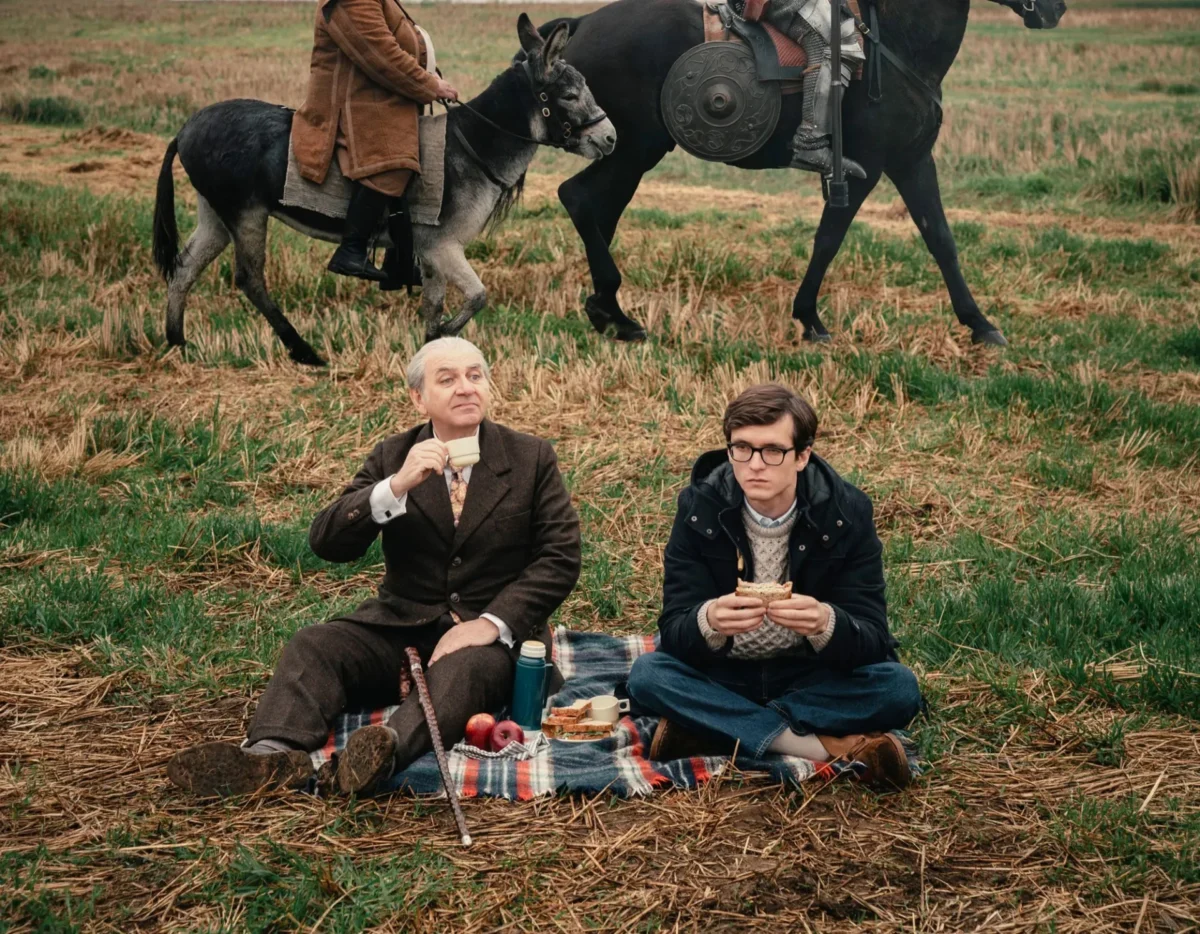
The literary world is often built upon the currency of the anecdote—stories traded over wine or at academic conferences that grow in stature with every retelling. Few, however, possess the improbable charm of Jay Parini’s 2020 memoir, Borges and Me: An Encounter. It chronicles the serendipitous, surreal, and life-altering road trip taken by a young American doctoral student in the 1970s and his unexpected companion: the venerable, sightless Argentine literary giant Jorge Luis Borges.
Now, director Marc Turtletaub has brought this unlikely journey to the screen in a feature film adaptation that captures the spirit of the memoir while navigating the delicate line between historical homage and whimsical fiction. Premiering to a warm reception at the Edinburgh Film Festival, the film serves as a mellow, sentimental exploration of youth, genius, and the transformative power of travel.
The Genesis of an Improbable Journey
In the early 1970s, Jay Parini, then a PhD candidate at Scotland’s St. Andrews University, found his academic trajectory irrevocably altered by a series of coincidences. Parini was a native Pennsylvanian—a quintessential “fish out of water” navigating the hallowed, rain-swept halls of Scottish academia. His supervisor, the poet Alastair Reid, was a noted translator of Borges and a man of bohemian inclinations.
When Reid hosted the legendary, septuagenarian Borges at his coastal cottage, the young, earnest, and somewhat naive Parini was drawn into the orbit of the man who had redefined 20th-century literature. The “me” of the title refers to Parini’s involuntary promotion from observer to caretaker. When Reid was called away to London on an emergency, he left the sightless, eccentric Borges in the care of his student. Parini, who had already planned a journey into the Highlands to interview the elusive poet George Mackay Brown, found himself saddled with the responsibility of transporting one of the world’s most brilliant minds across the rugged Scottish landscape.
Chronology of a Cross-Generational Odyssey
The film structures itself around this road trip, a series of episodic detours that serve as a crucible for the young Parini. The narrative follows a deliberate, rhythmic pace:
- The Introduction: Parini, played with wide-eyed, bespectacled sincerity by Fionn Whitehead, is established as an academic drowning in the theoretical, struggling to reconcile his intellectual pursuits with the messy realities of the world.
- The Handover: The departure of Alan Cumming’s charismatic, breezily bohemian Alastair Reid serves as the inciting incident, forcing the mismatched pair together.
- The Highlands Traverse: As the two navigate the Scottish countryside, the contrast between the youthful, anxious American and the impish, philosophical, and sightless Argentine provides both the comedic heartbeat and the emotional weight of the film.
- The Sightseeing Slog: A recurring source of tension—and humor—is the requirement that Parini act as Borges’ eyes, describing the sweeping vistas of the Highlands in language that the master of metaphors finds wanting.
- The Climax: A series of adventures, including a bumbling, almost slapstick excursion on Loch Ness and a meditative, hallucinatory visit to an ancient battlefield, brings the pair to a point of mutual understanding.
- The Resolution: The journey concludes not with a grand academic epiphany, but with a quiet, humanizing recognition of their shared, yet vastly different, experiences of the world.
The Craft Behind the Lens: A Transatlantic Production
Director Marc Turtletaub has leaned into the “tall story” quality of the source material. By casting Chilean veteran Luis Gnecco—renowned for his titular role in Neruda—as Borges, the production bridges the gap between South American literary gravitas and the film’s North American/British sensibilities. Gnecco delivers a performance that is equal parts impish wisdom and childlike wonder, imbuing the historical figure with a buoyancy that defies his years.
The visual identity of the film is owed in no small part to cinematographer Christopher Norr, whose work captures the Scottish Highlands with a dewy, autumnal crispness. The tawny, textured landscapes serve as more than just a backdrop; they act as a silent character, grounding the film’s more ethereal, philosophical dialogues in the tangible, tactile reality of the Scottish wilderness.
Supporting Data: Character Dynamics and Thematic Depth
The film’s efficacy lies in the dynamic between its leads. Fionn Whitehead, known for his stoic turn in Dunkirk, utilizes his natural, upright English sensibility to play the American Parini as a man constantly teetering on the edge of exhaustion. His Parini is an academic who has read extensively about life but has lived very little of it.
In contrast, Gnecco’s Borges is a man who has lived through the breadth of the human experience—or at least, the breadth of the human imagination—and now seeks to consume the world through the senses of others. The inclusion of Freya Mavor as Ailith, a local pub worker who provides a romantic catalyst for Parini, introduces a necessary friction. Her presence allows the audience to see a side of Parini that is not defined by his proximity to greatness, but by his own burgeoning sense of self.
Peter Mullan’s mischievous cameo as George Mackay Brown provides a narrative anchor, representing the very goal of Parini’s original, solitary journey. Mullan’s performance reminds the audience that the “Borges and Me” road trip was never the destination—it was a series of unplanned deviations that eventually led to a more profound understanding of the world.
Critical Implications: Fiction vs. Historical Biography
One of the most interesting aspects of the film is its relationship to historical truth. Screenwriter Oren Moverman, working from earlier drafts by Parini and Ross Clarke, makes no pretense that this is a documentary. The film is a “character” study—in the literary sense—of a man who was already a legend by the 1970s.
Some critics have pointed out that the film engages very little with the actual bibliography of Borges. For those seeking a deep dive into the labyrinthine metafiction of The Garden of Forking Paths or The Aleph, the film may feel thin. However, the production team clearly aimed for something else: an exploration of memory and the way we mythologize the people who influence our formative years.
By treating Borges as a “buoyant, heavily imagined spirit” rather than a rigid historical subject, the film avoids the pitfalls of the typical “Great Man” biopic. It suggests that the value of the encounter lies not in the lessons taught, but in the humanity revealed during the silence between the words.
A Mellow, Sentimental Legacy
As a feature, Borges and Me is an exercise in mood and atmosphere. It is a film for the festival circuit—the kind of project that thrives on word-of-mouth recommendations and arthouse-crossover appeal. It does not aim to revolutionize the genre, but rather to occupy a space of quiet, reflective nostalgia.
The final product feels like an extension of the very anecdote it seeks to adapt: a story that is perhaps slightly embellished, occasionally uneven, but ultimately enchanting. It speaks to the “porous, knowledge-gathering naivety of youth,” a period in one’s life where the prospect of spending a week in a car with a literary titan feels like both a catastrophe and a miraculous opportunity.
In a cinematic landscape often dominated by high-octane blockbusters, the simple, lyrical, and good-natured journey of Borges and Me offers a rare, meditative pause. It invites the audience to consider their own "Borges"—the unexpected mentors and chance encounters that have, in some small or large way, defined the trajectory of their own lives. Whether or not the events transpired exactly as Parini recalls them is, in the end, irrelevant; the story has been elevated to the realm of myth, and as the film proves, that is where it belongs.










