Evan Lee Salim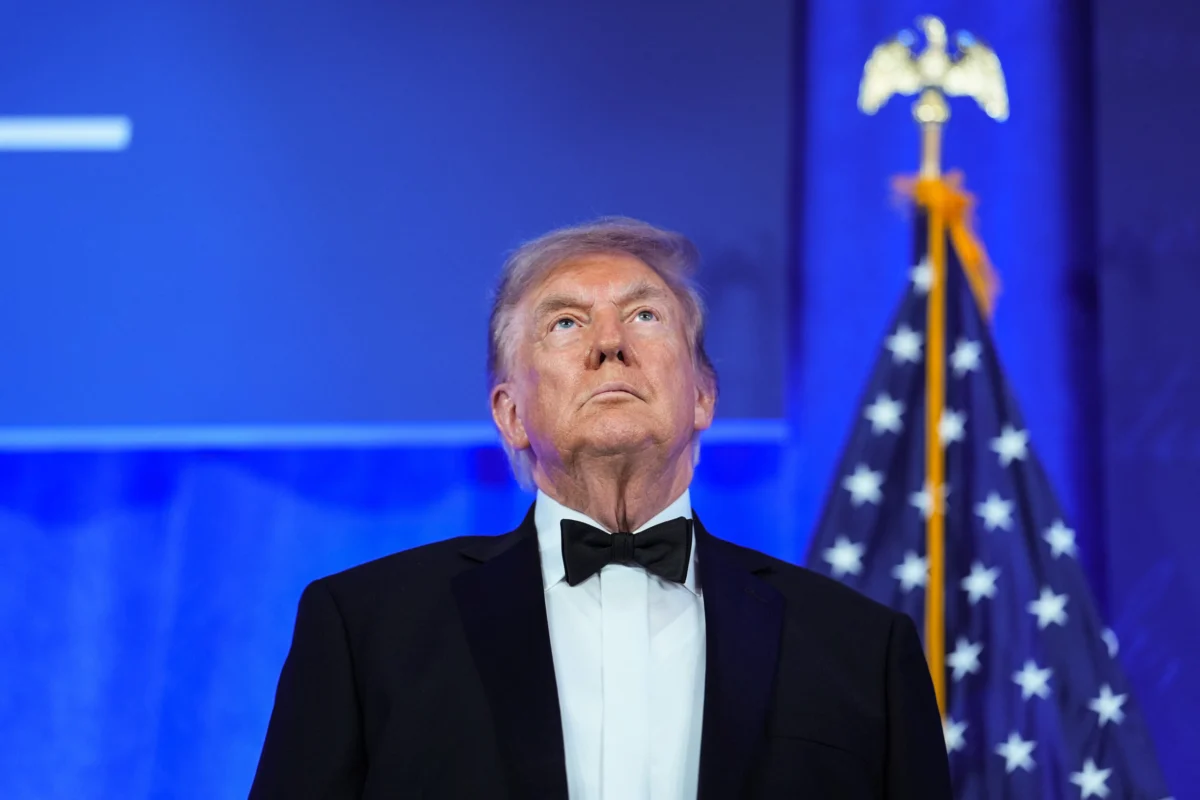
In a political landscape defined by perpetual antagonism between the executive branch and the press, Friday night’s rescheduled White House Correspondents’ Association (WHCA) gala stood as a surreal, high-tension milestone. President Donald Trump, making his first-ever appearance at the traditional black-tie dinner, transformed what is typically a night of lighthearted bipartisan roasts into a 64-minute, wide-ranging grievance session that oscillated between sharp insults, bizarre tangents, and direct confrontations with the reporters assembled before him.
The gala, held at the Waldorf Astoria in Washington, D.C., was a delayed affair, pushed back from its original April 25 date following a harrowing security breach in which an armed attacker attempted to target the president at the Washington Hilton. While the mood in the room remained tense given the backdrop of recent violence, the president’s address ensured the atmosphere was defined more by ideological warfare than by the ceremonial unity often associated with the event.
A Chronology of the Evening: From Civility to Conflict
The evening commenced with opening remarks from outgoing WHCA president Weijia Jiang of CBS News, who shared hosting duties with Fox News’ Jacqui Heinrich. Following a performance by mentalist Oz Pearlman—a notable departure from the traditional selection of a comedian to roast the president—Trump took the stage at 9:33 p.m.
The president began with a veneer of protocol, acknowledging the audience with a mix of practiced courtesy and palpable disdain. “I am delighted to be here at the White House Correspondents’ Dinner,” he stated. “Amazing people, a lot of people that I like. Some I don’t like at all, but I respect most of them.”
However, the tone quickly shifted. Reflecting on his internal debate regarding the nature of the speech, Trump noted, “I said, ‘What do we do here? Is this supposed to be fun? Am I supposed to be serious? Am I supposed to be a comedian?’ So I guess you said, maybe a little bit of everything.”
The subsequent hour saw the president abandon any pretense of presidential decorum, launching a series of attacks on media outlets, individual journalists, political rivals, and pop-culture icons. By the time he concluded, the speech had served as a comprehensive manifesto of the president’s long-standing hostility toward the "fake news" media.
The Media Under Siege: Ratings, Revenue, and "Fake News"
Central to the president’s address was the argument that the mainstream media is an industry in decline, sustained only by the existence of his own political persona.
“This evening it’s really all about the fake news media and your handling of prizes—writing and performing made-up stories like the Academy Awards,” Trump remarked. He pivoted from this to a critique of the entertainment industry, specifically the declining ratings of the Oscars, which he attributed directly to the industry’s opposition to him.
Perhaps most provocatively, the president warned the journalists in attendance of their impending obsolescence. “When I’m gone, you’re all going to be broke. Your business model is going to be finished. No, it’s true. When I’m not around, you’re going to be broke. There’s not going to be anybody to report on. Nobody gives a damn about anybody else.”
He framed his own media strategy as a triumph over traditional journalism, boasting about his dominance on platforms like TikTok—which he claimed to have successfully navigated during his administration—and asserting that he had abandoned the press entirely, a move he credited for his electoral success.
Targeted Attacks: Personal Vendettas at the Podium
The president’s remarks were not confined to the industry as a whole; he singled out several prominent journalists for harsh criticism. CNN anchors were a particular focus of his ire.
Addressing Kaitlan Collins, who received the 2026 WHCA award for her coverage of the president’s 2025 Oval Office confrontation with Ukrainian President Volodymyr Zelensky, Trump dismissed the honor as a “fake” achievement. He went on to criticize her demeanor, repeatedly urging her to “smile,” and launched into an odd, derogatory tangent regarding a past marketing campaign involving Dylan Mulvaney and Bud Light.
Don Lemon was similarly targeted, with the president labeling him the “dumbest man on television” and claiming he held the lowest ratings in the industry. Anderson Cooper, conversely, received a backhanded acknowledgment, with Trump noting he “liked” him for past interviews but felt the journalist had “gone bad” upon entering the political fray.
The president’s disdain also extended to the broader cultural and political sphere. California Governor Gavin Newsom, Senators Elizabeth Warren and Chuck Schumer, and representative Ilhan Omar were all subjected to rhetorical jabs. Even musical icon Bruce Springsteen did not escape the president’s gaze; Trump mocked the artist’s appearance and suggested his current tour be renamed "Bored in the USA."
The Legal and Ethical Friction
The dinner served as a physical manifestation of the ongoing legal battles between the Trump administration and the press. The Katharine Graham Award for Courage and Accountability was presented to reporters from The Wall Street Journal for their investigation into a controversial letter allegedly written by Trump to Jeffrey Epstein—a report the president has vehemently denied and which led to a $20 billion defamation lawsuit against the publication.
In an awkward moment of forced cordiality, Trump shook the hands of the Journal reporters as they accepted their award, only to immediately throw his hands up in mock exasperation and retreat to his seat. The legal implications of this tension remain significant, as the Journal’s legal team has labeled the president’s continued litigation an “affront to the First Amendment,” a sentiment that defines the current precarious relationship between the White House and the press corps.
Official Responses and Defensive Posture
While the president was still on stage, CNN’s leadership issued a swift defense of their reporting. Mark Thompson, CEO of CNN Worldwide, issued a formal statement affirming the network’s commitment to its staff and the principles of journalism.
“We stand by our journalists and the integrity and fair-mindedness with which the CNN team reports the news,” Thompson stated. “Honest, accurate journalism may sometimes irritate politicians, but our right to report and present that reporting to the public without government interference is fully protected by the U.S. Constitution. CNN will continue to exercise this right.”
The White House, meanwhile, appeared to be in damage-control mode regarding the president’s rhetoric. Press Secretary Karoline Leavitt, who was praised by Trump as having “one of the hardest jobs in the White House,” remained at his side throughout the event, navigating the fallout of his comments regarding the "Trump Derangement Syndrome"—which the president continues to treat as a formal, diagnosable medical condition.
Implications for the Future of the Press
The 2026 WHCA dinner will likely be remembered not for its celebration of the First Amendment, but as a stark demonstration of the total erosion of norms between the executive branch and the press. By utilizing the platform to mock journalists, insult political rivals, and propagate the idea of a "Trump-branded" press dinner, the president has signaled that he views the media not as an institution to be engaged with, but as an entity to be dismantled or subsumed.
As the evening drew to a close, the president offered a final, characteristic sign-off: he donned a "Trump 2028" hat, repeated his unsubstantiated claims regarding the 2020 election results, and declared his intention to return to the dinner next year.
For the White House Correspondents’ Association, the challenge is clear. The organization is now tasked with reconciling its mission to facilitate a free and open press with an executive who views that same press as his primary adversary. The events of Friday night suggest that as long as the current administration remains in power, the dinner will remain a theater of conflict rather than a celebration of democratic transparency.

 Jia Lissa
 Lina Hope