Asro
Asro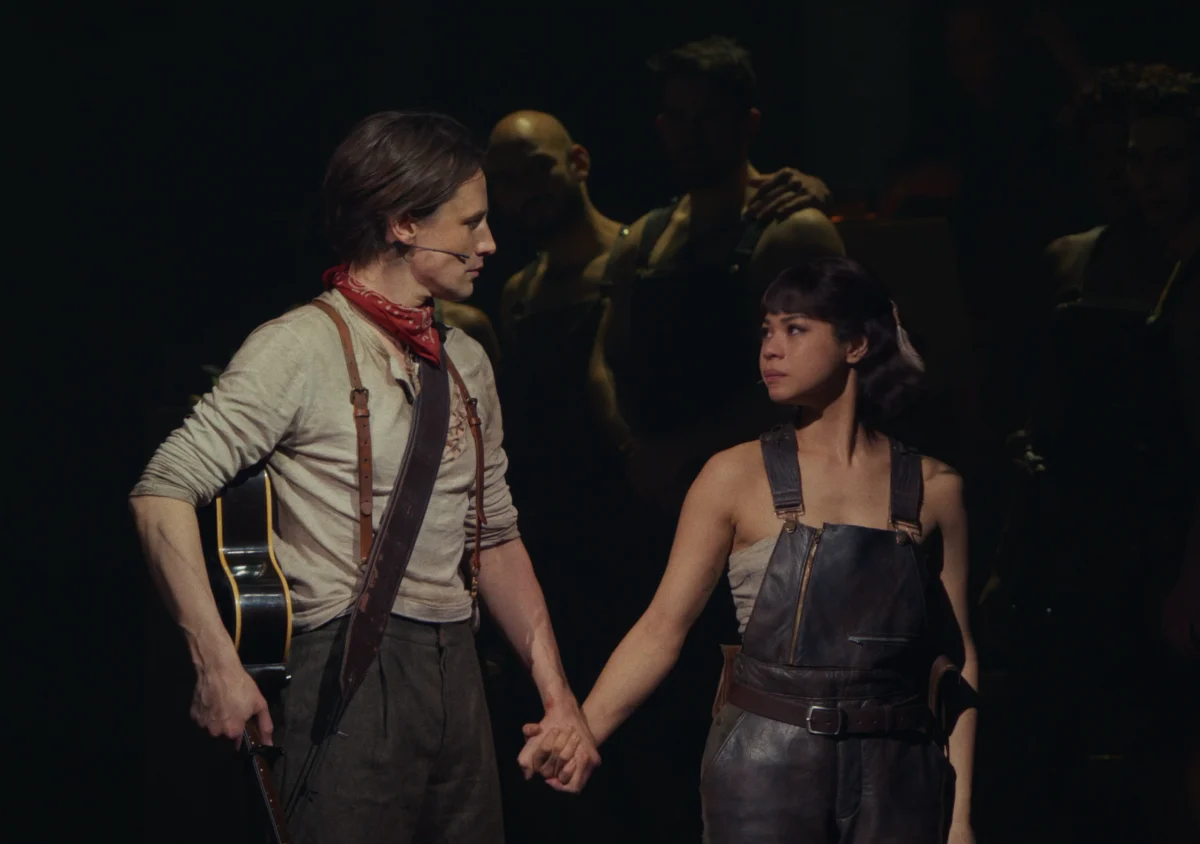
While the gods of Olympus have been notably absent from recent big-budget mythological adaptations—often relegated to the periphery or left as subjects of distant lore—the Underworld has finally claimed its due. Currently lighting up theaters, Hadestown: The Musical has arrived as a masterclass in stage-to-screen translation, offering a visceral, intimate look at the interplay between mortal yearning and immortal indifference.
The filmed production of this Tony-winning Broadway juggernaut is projected to rake in an impressive $9 million at the U.S. box office this weekend. This figure positions it as the second-highest grossing "direct capture" of a stage production in history, trailing only the monumental success of the Hamilton film. As the summer movie season searches for distinct counterprogramming, this "folk opera"—a term favored by Tony winner André De Shields—has proven that a tragic, jazz-infused descent into the afterlife is exactly what modern audiences are craving.
A Legacy of Myth: The Chronology of ‘Hadestown’
The journey of Hadestown is as storied as the myth of Orpheus and Eurydice it recounts. Conceived by Americana musician Anaïs Mitchell, the project began its life in 2006 as a collection of songs performed in intimate folk clubs, such as McCabe’s in Santa Monica. What started as a labor of love for Mitchell and her circle of musician friends has, over two decades, evolved into a cultural touchstone.
Following its 2016 off-Broadway premiere, the show moved to Broadway in 2019, where it became a runaway hit. Now, in 2026, the film serves as a dual milestone, marking both the 10th anniversary of its off-Broadway debut and the 20th anniversary of its inception. The film was captured during a brief window in London’s Lyric Theatre, where the original Broadway principals—Reeve Carney, Eva Noblezada, Patrick Page, and André De Shields—reunited to commit their performances to celluloid before the cast cycled through its next iteration.

Cinematic Craft: The "Live Capture" Revolution
Director Brett Sullivan, a veteran of the "capture" genre with over a dozen credits including Miss Saigon, Waitress, and Kinky Boots, approached Hadestown with a specific philosophy: bridge the gap between theatrical spectacle and intimate cinema.
"I always studied Stop Making Sense," Sullivan says, referring to the legendary Talking Heads concert film. "That became the template for me. We need to see the actor’s eyes, and we also need to see the spectacle. It’s a dance."
The technical logistics of the filming were, by all accounts, a Herculean effort. Because the production wanted to preserve the raw, authentic energy of a live show, the cast performed for three live audiences over the course of a weekend. With four to six cameras moving to different vantage points for every performance, the final film was synthesized from what was essentially a 30-camera shoot.
"Every shot you see in the film, we only had one take at it," explains Reeve Carney, who stars as Orpheus. "The planning that went into it was intense. Because we were in the Lyric Theatre, which is smaller than our original Broadway home, it lent itself perfectly to a cinematic experience."

The Human Element: Performances Under the Microscope
For the performers, the transition from stage to screen brought an unexpected intimacy. In a theater, the audience’s eye is free to roam; on screen, the camera dictates the focus.
Patrick Page, whose deep, baritone portrayal of Hades has become iconic, notes that the close-ups reveal layers of subtext that might have been lost in the back rows of a theater. "A close-up comes right in and reads the actor’s thoughts," Page says. "We always knew that was there, and for us, those things were as real as the music."
However, the process was not without its hurdles. During the rehearsal process, Page suffered a significant foot injury, requiring him to perform with a boot and a cane. Rather than hiding the injury, director Brett Sullivan incorporated it into the blocking, adding a new layer of vulnerability to the character of Hades.
"Patrick had a wild ride," says Mitchell. "But I feel like you feel them all authentically in their selves at the time of the taping. They are taking on these characters again with the added experience of six years of life that happened in between."

Eva Noblezada, who plays Eurydice, views the return to the role after a hiatus as a physical and emotional necessity. "You just have to know how to drop into your character’s body," she says. "It’s like getting on a rollercoaster. You know you’re going to have that almost vertical drop at a high speed, and you just have to strap down and lock in."
Societal Echoes: Why ‘Hadestown’ Resonates Now
Beyond the music and the performances, Hadestown has struck a nerve with contemporary audiences. The show’s themes—the divide between the dream of a better world and the reality of the present, the struggle against authoritarian power, and the desperate need for human empathy—feel prophetically aligned with the current political climate.
"The tension between ‘the world we dream about and the one we live in now’ is what keeps people in it," Page observes. "That tension isn’t someone’s fault. But it’s a real conflict."
This sentiment is echoed by the show’s massive, fervent fan base, particularly among younger viewers. For them, the tragedy of Orpheus and Eurydice is not a hopeless ending, but a rallying cry. "I don’t view Hadestown as a tragedy," Carney asserts. "I view it as a piece designed to empower and embolden people to make a different decision and to choose a different ending."

André De Shields, the show’s legendary Hermes, keeps his assessment simple yet profound: "To speak in the current vernacular, I think the audience feels, ‘I’m finally being seen.’ Simply that."
Implications for the Future of Event Cinema
The success of the Hadestown film serves as a validation for "event cinema." For years, there was fear within the industry that filming a musical would cannibalize the live stage production. However, history has proven otherwise.
"We tried it out with Newsies with Disney quite a while ago," says Sullivan. "As it turns out, when the film did its event cinema thing, they got another couple of tours booked off the back of it. It proved that these things can co-exist."
The film has also sparked a new wave of engagement in educational settings. Mitchell notes that they have released the rights for high schools to produce the show, and the creative interpretations—from gender-blind casting to experimental staging—have been overwhelming.

"It’s very cool to see what they’re doing," Mitchell says. "It’s got its own life. It’s moving around the world on its own legs."
Conclusion: A Living Myth
As the film continues its theatrical run, the creators are left to marvel at how their work has evolved. For Anaïs Mitchell, the story has shifted from a personal project of her youth to a timeless piece that she now views with a sense of wonder.
"I have no idea what this thing is or what it means to people," Mitchell reflects. "It’s got its own life."
Whether through the lens of a camera or the perspective of a stage, Hadestown remains a mirror held up to the human condition. It reminds us that even when the outcome is known, the act of singing, the act of dreaming, and the act of choosing to move forward are, in themselves, the greatest victories. In the end, the myth of Hadestown is not about how the story ends—it is about the courage it takes to tell it again and again.

 Jia Lissa
 Iffa Jayyana