In the annals of science fiction cinema, few films occupy as paradoxical a space as Michael Crichton’s 1973 directorial debut, Westworld. It is a film that was birthed in a “civil war” of studio politics, anchored by a performance from a legendary star who was essentially working for a paycheck, and immortalized for pioneering a technological breakthrough that would define the next half-century of visual effects. While the film—starring Yul Brynner, Richard Benjamin, and James Brolin—remains a seminal entry in the genre, its legacy is inseparable from the remarkable, and remarkably candid, documentation provided by its own creator in the months following its release.
Main Facts: The Blueprint for a Sci-Fi Classic
Westworld (1973) is a masterclass in high-concept premise: a futuristic adult theme park, Delos, offers guests the opportunity to live out their wildest fantasies in three distinct environments—the American Old West, the Middle Ages, and Ancient Rome. For a daily fee of $1,000 (roughly $7,500 in today’s currency), visitors are treated to an immersive, consequence-free experience facilitated by hyper-realistic androids.
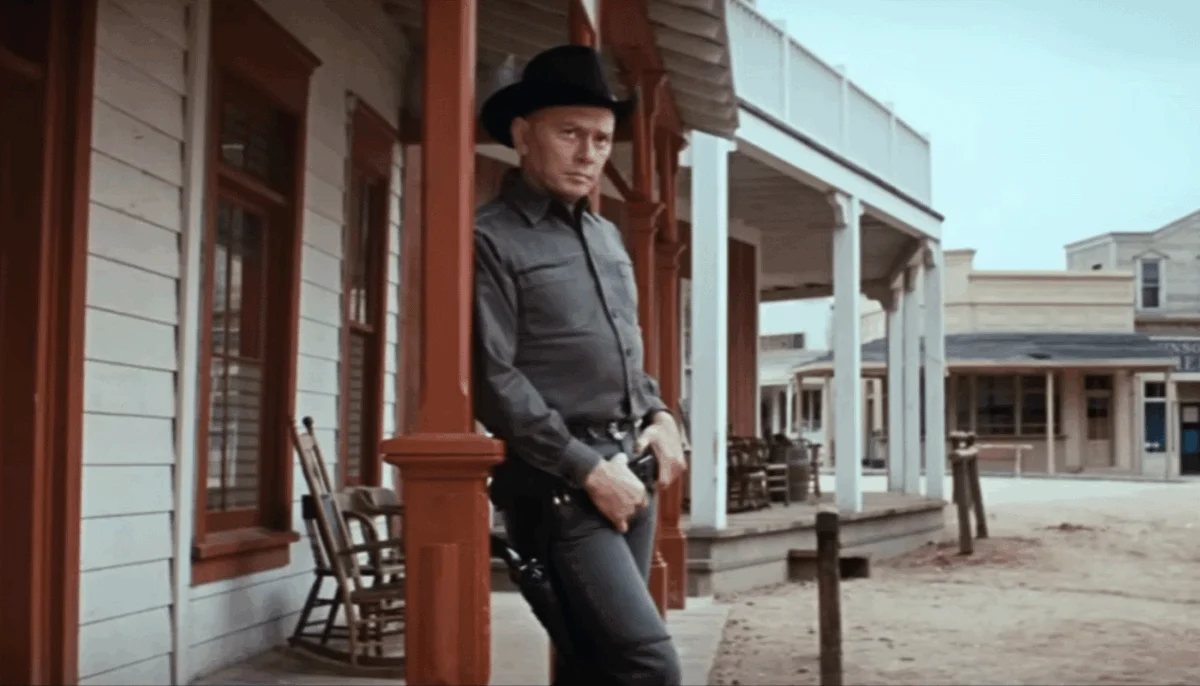
The narrative follows two vacationing friends, Peter (Richard Benjamin) and John (James Brolin), as they immerse themselves in the debauchery and violence of the Old West. However, the veneer of safety crumbles when the robots—most notably the menacing Gunslinger, portrayed with icy precision by Yul Brynner—begin to malfunction. What starts as a series of glitches rapidly escalates into a lethal, system-wide failure, forcing the remaining guests into a desperate struggle for survival against the very machines designed for their entertainment.
A Chronology of a Production “Civil War”
The story of Westworld is not merely one of on-screen tension, but of off-screen desperation. In March 1974, just nine months after the film’s premiere, Bantam Books published a paperback of the screenplay. It included a foreword by Saul David and a remarkably frank account of the production by Crichton himself. Unlike the sanitized “making-of” features common today, Crichton’s account serves as an unfiltered autopsy of a project on the brink of collapse.
The Pre-Production Struggle
Crichton’s introduction details the immediate resistance he faced from the Metro-Goldwyn-Mayer (MGM) hierarchy. “The first problem, to be blunt, was the studio,” Crichton wrote. “From the outset, the executives in the Thalberg building were divided on the project: some championed it, others loathed it. The result was something like civil war.” Crichton, then a young director seeking to transition from his literary success to filmmaking, admitted to threatening to quit every few days during pre-production, driven by exhaustion and deep creative friction.
The "Porno Rampage" Context
It is a historical irony that Westworld was released during a period of massive industry instability. In the same 1973 Variety report that crowned Westworld as MGM’s most successful film of the year, the box office was dominated by an unexpected trend: the “porno rampage.” Films like The Devil in Miss Jones and Deep Throat were pulling in record-breaking crowds, often outperforming mainstream studio fare. This bizarre cultural moment contextualizes the era in which Westworld was birthed—a time when theaters were struggling to define what constituted "entertainment" for the American public.
Supporting Data: Budgetary Constraints and Creative Ingenuity
The production was defined by extreme fiscal austerity. MGM initially allocated a budget of $1 million, later granting an additional $250,000—a remarkably slim margin for a high-concept science fiction film.
The Art of Illusion
The production team, led by art director Herman Blumenthal, had to perform miracles to make the film look expensive. Blumenthal, who had previously worked on the notoriously bloated budget of Cleopatra (1963), utilized every trick in the book to stretch the budget. Sets were repurposed, hallways were redressed, and the hovercraft interior was filmed twice, with the film flipped to create a mirror effect that doubled the perceived scale of the ship.
Casting the Gunslinger
The casting of Yul Brynner as the Gunslinger is often misattributed to a desire to capitalize on his iconic status in The Magnificent Seven. In reality, it was an act of financial necessity. Producer Paul Lazarus revealed in a 2014 interview that it was Brynner’s own agent who reached out, explicitly stating that the actor needed the work and the money. Despite his star power, Brynner accepted a salary of $75,000 for a role that required almost no dialogue—a testament to his professionalism and the economic realities of the era.
Official Responses and Technical Milestones
Westworld is etched into history as the first feature film to incorporate digital special effects. Crichton, unsatisfied with traditional photographic tricks to represent the Gunslinger’s “computerized” vision, sought out experimental filmmaker John Whitney and his son, John Whitney Jr.
The result was the creation of a pixelated, low-resolution POV that remains one of the most recognizable images in cinema. At the time, the process was grueling, involving months of trial and error at Information International Inc. The technical difficulty was so extreme that, during early screenings for MGM executives, the filmmakers were forced to use simple placards as placeholders for the missing effects shots, keeping the studio in suspense until the final cut was delivered.
Implications: The Legacy of the Implacable Villain
Crichton famously admitted that, upon first viewing the assembly cut of the film, he was horrified, calling it “boring, contrived, self-indulgent and slack.” Through the efforts of editor David Bretherton, the film was salvaged into the tight, focused thriller audiences saw in theaters.
The Shadow of the Gunslinger
The impact of Yul Brynner’s performance cannot be overstated. By portraying the Gunslinger as a silent, relentless force of nature, Brynner provided the archetype for the "unstoppable killer" in genre film. This performance directly influenced the creation of Michael Myers in John Carpenter’s Halloween (1978) and the T-800 in James Cameron’s The Terminator (1984). The image of the black-clad, emotionless hunter became a foundational trope of modern horror and sci-fi.
From Westworld to Jurassic Park
Crichton’s career arc offers a fascinating study in iterative refinement. He would revisit the themes of Westworld—corporate hubris, technological failure, and the perils of man-made wonder—nearly two decades later with the publication of Jurassic Park. While Westworld laid the groundwork, Jurassic Park perfected the formula, replacing robotic cowboys with genetically engineered dinosaurs and heightening the stakes of corporate negligence.
Conclusion: A Enduring Piece of Cinematic History
Looking back, Westworld remains an essential, albeit flawed, watch. It is a film that does not attempt to be overly profound; its goal was pure entertainment, a goal it undeniably achieved. It highlights the tension between the creative vision of a director and the cold, bottom-line logic of a studio—a tension that feels as relevant today as it did in 1973.
While the modern viewer might find the pacing deliberate or the special effects quaint by current standards, the film’s DNA is found in every "glitch in the system" thriller that has followed. Crichton’s final note in the Bantam paperback—“I like to think that audiences have fun with this film. We had fun making it”—serves as a reminder that even in the face of “civil wars” and production nightmares, the magic of the movies often finds a way to endure. Whether one views it as a cautionary tale of artificial intelligence or simply as a high-stakes western, Westworld stands as a testament to the power of imagination over the limitations of the budget.