


For over a decade, the humble corporate blog has been a cornerstone of digital marketing. From SEO optimization and thought leadership to providing genuine value to potential customers, the business blog has remained a constant in an ever-shifting landscape. However, as any seasoned content strategist knows, the digital ecosystem is rarely static. Relying on outdated tactics is a recipe for diminishing returns.
To understand how to navigate this evolving terrain, industry professionals consistently turn to Orbit Media’s Annual Blogger Survey. Now in its 11th year, this report has become the gold standard for benchmarking content performance. Recently, I sat down with Andy Crestodina, CMO and Co-Founder of Orbit Media, to unpack the latest findings and determine what they mean for the future of content marketing in 2025 and beyond.
The Myth of AI Speed: Why Blogging Still Takes Time
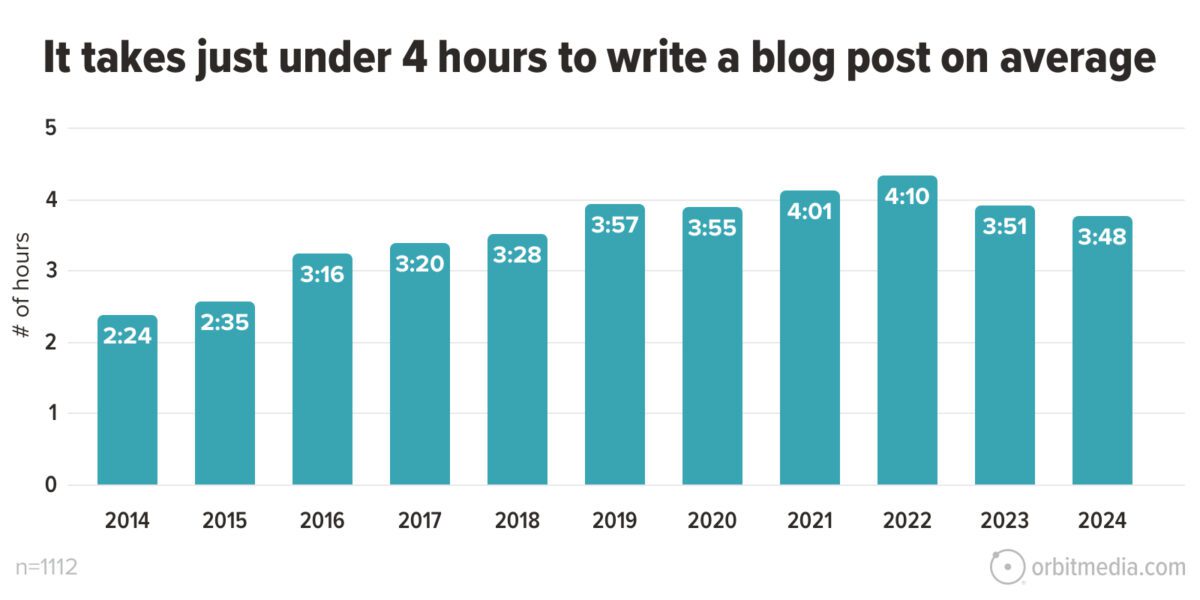
One of the most pressing questions leading into this year’s research was the impact of generative AI. With a plethora of tools promising to automate content creation and slash production times, many expected to see a significant drop in the time required to draft a blog post.

The results, however, were strikingly defiant of this expectation. According to the 11th Annual Blogger Survey, the average blog post takes three hours and forty-eight minutes to write—a mere three-minute decrease from the previous year.
Despite 80% of bloggers now reporting the use of AI tools, there is no strong correlation between widespread AI adoption and improved performance metrics. While AI is excellent for brainstorming, drafting, or visual generation, it cannot replace the strategic direction, rigorous fact-checking, and human creativity required to make content truly stand out in a saturated market. The human element remains the primary driver of quality, and quality remains the primary driver of results.
Key Performance Indicators: What Drives Success?
The survey highlights a clear divide between "low-effort" and "high-effort" content programs. For content leaders, the data offers a roadmap for moving away from mediocrity.
1. The Power of Depth and Frequency
The research confirms that high-effort content—specifically articles exceeding 2,000 words—is far more likely to produce "strong results." However, this depth cannot come at the expense of consistency. Data suggests that a bi-weekly publishing cadence is the absolute minimum threshold for sustained performance. Audiences today have high expectations; they are not willing to settle for thin, repetitive content, nor are they willing to wait months for high-quality insights.
2. Treating the Blog Like a Social Feed
Perhaps the most significant takeaway is the need to treat your blog feed with the same rigor as a social media stream. Top-performing blogs and social feeds share common DNA: high engagement, consistent pacing, and a deep understanding of user intent. Social platforms have spent billions on user testing to optimize for engagement; marketers who ignore these lessons in their blog design and distribution strategy do so at their own peril.
The Shrinking Traffic Problem
One of the most sobering insights from the report is the trend in overall blogging performance. The number of marketers reporting "strong results" has seen a steady decline over the last five years.

This drop is largely attributed to the shifting nature of search. As search traffic—a once reliable pillar of content growth—becomes more volatile and "zero-click" searches become the norm, many marketers are feeling the squeeze. When traffic is your primary metric of success, you are vulnerable to the whims of search engine algorithms.
Expert Q&A: Insights from Andy Crestodina
To bridge the gap between data and practice, I spoke with Andy Crestodina about his personal takeaways from the research and his outlook for the coming year.
Q: What research findings were the most surprising to you personally?

Andy Crestodina: "The data tells us, year after year, that big efforts drive big outcomes. That isn’t surprising in theory, but when you see the differences side-by-side between low-effort and high-effort programs, it’s stark. What is surprising is seeing so many content programs sticking to the same low-effort model—the same short-form posts, the same monthly cadence, no research, no collaboration, no video. What do these marketers expect? If you put in low effort, you should expect low results. The data is telling us clearly: if you want to win, you have to do the work."
Q: The data suggests that podcasters are the most likely to report strong results. Why is that?
Andy Crestodina: "It’s a powerful correlation. While our sample size for podcasters was smaller, the performance tracks perfectly with other successful behaviors. Podcasters aren’t just sitting behind a keyboard in isolation. They are collaborating, they are interviewing, and they are using multiple formats. The act of hitting ‘record’ and engaging with guests forces a level of rigor that often bleeds into the rest of their content strategy. They are doing the hard things that others avoid."

Q: How should bloggers be measuring success if traffic is becoming a less reliable metric?
Andy Crestodina: "Traffic is the most visible metric, but it is often the least important. We need to stop obsessing over vanity metrics and start looking at the bottom of the funnel. The most important outcomes—word-of-mouth, top-of-mind awareness, and actual conversions—are the hardest to measure, but they are the ones that actually pay the bills. As search traffic becomes more difficult to capture, we need to focus on those deeper, more qualitative impacts."
Strategic Implications: How to Pivot for 2025
If the data proves that traditional, traffic-only models are underperforming, what should leadership teams do next?

1. Diversify Your Distribution
Crestodina’s #1 tip for B2B brands is to embrace "rented land" strategically. While the old rule was to avoid building on platforms you don’t own, the current reality is that platforms like LinkedIn are prioritizing their own newsletters. By publishing high-value content directly to platforms where your audience already spends their time, you can reach them without relying solely on search traffic.
2. Focus on Repurposing and Internal Linking
Every piece of content should be a hub, not a silo. Treat every article as an opportunity to support others through internal linking and as a source for repurposing into videos, social posts, or audio clips.
3. Redefine the "Result"
Content marketers must shift their focus from "How many people clicked?" to "How did this content move the needle?" Whether that means tracking lead quality, nurturing existing prospects, or building brand authority, the shift from vanity metrics to business-impact metrics is no longer optional.

The Bottom Line
The 11th Annual Blogger Survey is not just a report on the state of the industry; it is a wake-up call. The era of "content for the sake of content" is effectively over. In 2025, the brands that win will be the ones that prioritize depth over speed, collaboration over isolation, and business outcomes over traffic volume.
As Andy Crestodina noted, the data is all right there. The roadmap for a high-performing content program exists—the only variable left is the willingness of your team to put in the effort required to execute it. Don’t settle for the low-effort status quo. Start building a strategy that treats your audience with the respect they deserve, and the results will follow.












No comments yet. Be the first to join the conversation!