

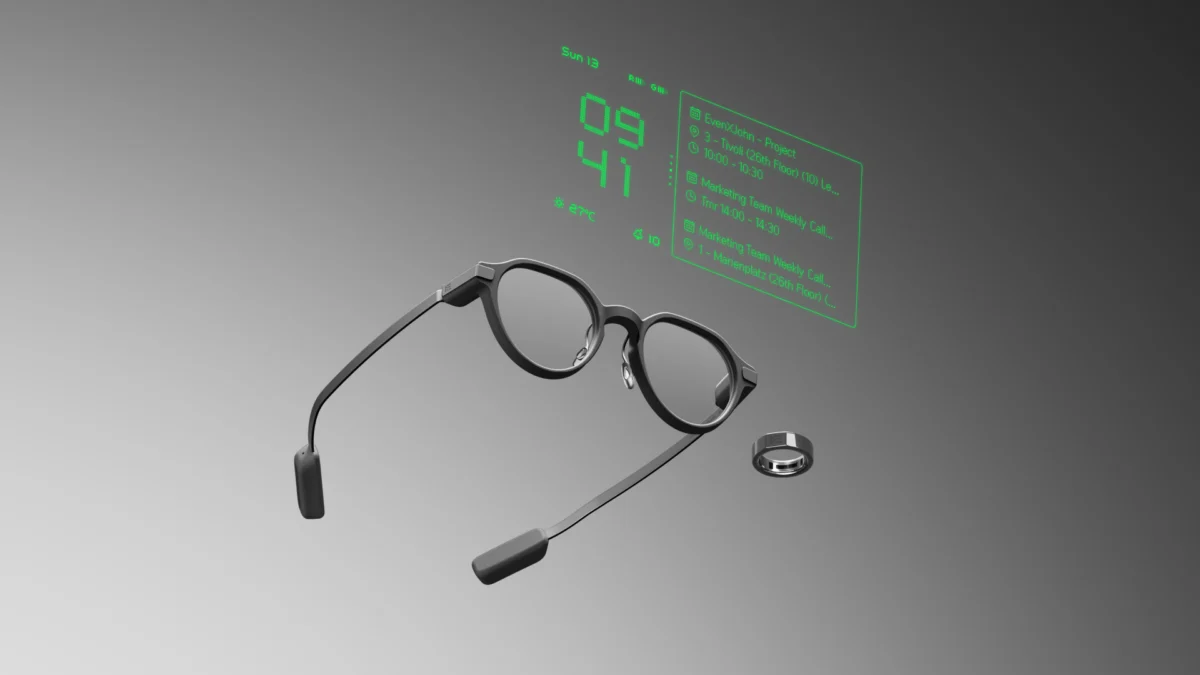
In the high-stakes arena of wearable technology, the battle for the human face is intensifying. With industry titans like Meta and Snap recently debuting new iterations of smart glasses—each vying to integrate cameras and AI into the daily lives of consumers—the market has reached a fever pitch. However, amidst the clamor of these tech giants, a Shenzhen-based upstart is quietly carving out a formidable niche. Even Realities, a three-year-old company founded by veterans of Apple and the luxury eyewear industry, has emerged as a disruptive force, betting that the future of augmented reality (AR) lies not in content capture, but in a display-first philosophy that prioritizes utility and user privacy.
The startup’s meteoric rise was underscored this month by a massive $150 million pre-Series B funding round. Led by Chinese tech conglomerate Meituan and supported by returning backer Tencent, the round has catapulted Even Realities to a $1 billion valuation, effectively cementing its status as a "unicorn" in the competitive wearable sector.
A Chronology of Innovation: From Concept to Unicorn
The genesis of Even Realities dates back to 2023, a pivotal year for the wearable industry. Founded by a team of ex-Apple engineers—including CEO Will Wang, who contributed to the development of the iPhone and Apple Watch—the company was built on the premise that smart glasses should function as an extension of the human experience rather than an intrusive recording device. Recognizing that the industry was trending toward bulky, camera-heavy hardware, the founders sought to marry high-end optical engineering with the aesthetic sensibilities of luxury eyewear designers, including those from the renowned brand Lindberg.
The company’s growth trajectory has been blistering:
- 2023: Foundation of Even Realities in Shenzhen, establishing a hybrid team of hardware experts and fashion-forward designers.
- 2024: The debut of the Even G1, which Wang claims was the lightest waveguide-based smart glasses available at the time. The product defied market expectations, surpassing a 10,000-unit sales milestone—a first for a startup in this specific form factor.
- Late 2024: The launch of the Even G2, the current flagship. This iteration solidified the company’s "no-camera" design philosophy, focusing instead on a heads-up display (HUD) controlled by a proprietary smart ring, the Even R1.
- 2025–2026: The company undergoes a massive operational expansion, ballooning from a lean team of 30–40 employees to a workforce of 300–400. The recent $150 million funding round marks the arrival of the company as a global player.
The Privacy-First Philosophy: Why No Camera?
While Meta and Snap are leaning into cameras to facilitate video recording and visual AI analysis, Will Wang has steered Even Realities in the opposite direction. For the Even G2, the camera was omitted entirely. This is not merely a technical limitation; it is a core design pillar.
"Smart glasses are likely the most personal computing device a human will ever wear," Wang noted in an interview with TechCrunch. "Because they are worn on the face throughout the day, they must feel socially acceptable to both the wearer and those around them. Privacy is not a feature you add on; it is a design constraint that must be baked into the hardware and software from the start."
This philosophy extends to the user’s data. Features such as the "Conversate" copilot—which provides real-time transcriptions and contextual explanations of jargon during meetings—process audio locally or via encrypted channels. Instead of storing massive databases of recordings, the device focuses on transient utility, ensuring that user data meets stringent European privacy standards. By avoiding the stigma associated with "always-on" recording devices, Even Realities is positioning itself as a professional tool rather than a social media accessory.
Technical Architecture: The "Even HAO" Advantage
The primary challenge for smart glasses has always been the "optical stack." As Wang explains, most consumer electronics, such as smartphones, rely on conventional OLED or LCD screens. Smart glasses, however, require a fundamental shift in engineering.
"You cannot simply bolt a screen onto a pair of frames," Wang says. "Smart glasses are the first product category to rely on true optical displays. You have to design the microchip, the optics, and the waveguide together. That is where we have invested the most."
To address this, the company developed Even HAO (Holistic Adaptive Optics). Unlike competitors who often source off-the-shelf components and attempt to integrate them, Even Realities designs the entire optical path as a unified ecosystem. This end-to-end approach allows for better integration of prescription lenses, a thinner waveguide profile, and superior light efficiency, ensuring that the display remains visible in bright sunlight without the glasses becoming excessively heavy.
Market Positioning and Supporting Data
Even Realities has successfully captured a premium demographic. Despite pricing its hardware at the top of the category—retailing at $599, with total packages including the R1 ring and prescription lenses often reaching $1,000—the startup is already a profitable entity.
The user profile is distinct: a significant portion of the customer base consists of male professionals aged 30 to 50. According to the company’s internal surveys, roughly one-third of their users are company executives, suggesting that the product is viewed as a productivity tool rather than a toy.
Geographically, the company is an anomaly. Despite being headquartered in China and utilizing local manufacturing hubs, the majority of its sales originate in the United States, followed by Japan, South Korea, the Middle East, and Europe. Interestingly, the company has not yet launched in the Chinese market, citing a desire to ensure their infrastructure and service levels are perfectly tuned before opening up to such a high-demand, high-complexity region.
The Implications: A New Era of Wearable Productivity
The emergence of Even Realities signals a fragmentation in the smart glasses market. For years, the industry was obsessed with "the next smartphone," pushing complex AR experiences that required bulky batteries and high-powered cameras. The success of the Even G2 suggests that a large subset of users does not want a camera on their face; they want a subtle, reliable digital assistant that helps them navigate information in the physical world.
The implications for the broader tech industry are profound:
- Productivity vs. Presence: The industry is splitting. One branch, led by Meta, focuses on "Presence"—connecting people through shared visual experiences. The other, led by Even Realities, focuses on "Augmented Intelligence"—giving the user an edge in their professional and personal tasks without the social friction of cameras.
- The Rise of Input Methods: The reliance on the Even R1 smart ring demonstrates that voice control is not the only, nor necessarily the best, way to interact with glasses. By utilizing tactile, haptic input via a ring, users can navigate their heads-up display without drawing attention to themselves in public.
- Optical Sovereignty: The investment into proprietary optics like Even HAO suggests that, in the future, the "brand" of the glasses will matter less than the "optical stack" behind them. Companies that control their optical supply chain from end to end will likely dominate the market, while those reliant on third-party display components may struggle to differentiate their products.
Conclusion: The Path Ahead
As Even Realities scales to meet global demand, the company faces the classic "scaling pains" of a unicorn startup. Growing from a small, agile team to an organization of several hundred requires a shift in management culture and supply chain management. Furthermore, as they eventually eye the Chinese market, they will need to navigate one of the most competitive consumer tech environments on the planet.
However, with $150 million in fresh capital and a proven track record of shipping hardware that people actually want to wear, Even Realities has moved beyond the "hype" phase. By focusing on optics, privacy, and professional utility, they have proven that the most successful way to put technology on a user’s face might just be to make it disappear. For the giants in the West, the message is clear: the race for the face is not just about who has the best camera, but about who understands the delicate balance between high-tech utility and human comfort.











