The 1980s represent a distinct, fever-dream epoch for the fantasy genre. It was a decade where the barriers between high-concept imagination and low-budget practical effects were porous, resulting in a lineage of films that were often weirder, more unpolished, and arguably more daring than the digital-slick blockbusters of the 2000s. While franchises like The Lord of the Rings would eventually bring a level of prestige and coherent world-building to cinematic fantasy, the Eighties were defined by a "kitchen-sink" approach to myth-making.
Within this landscape, the 1982 film The Sword and the Sorcerer stands as a quintessential artifact. As we continue our retrospective exploration of the decade’s most canonical, if occasionally maligned, fantasy entries, we turn our attention to this specific slice of sword-and-sorcery pulp—a movie that remains as puzzling as it is memorable.
The Architecture of a Cult Classic: Core Narrative Facts
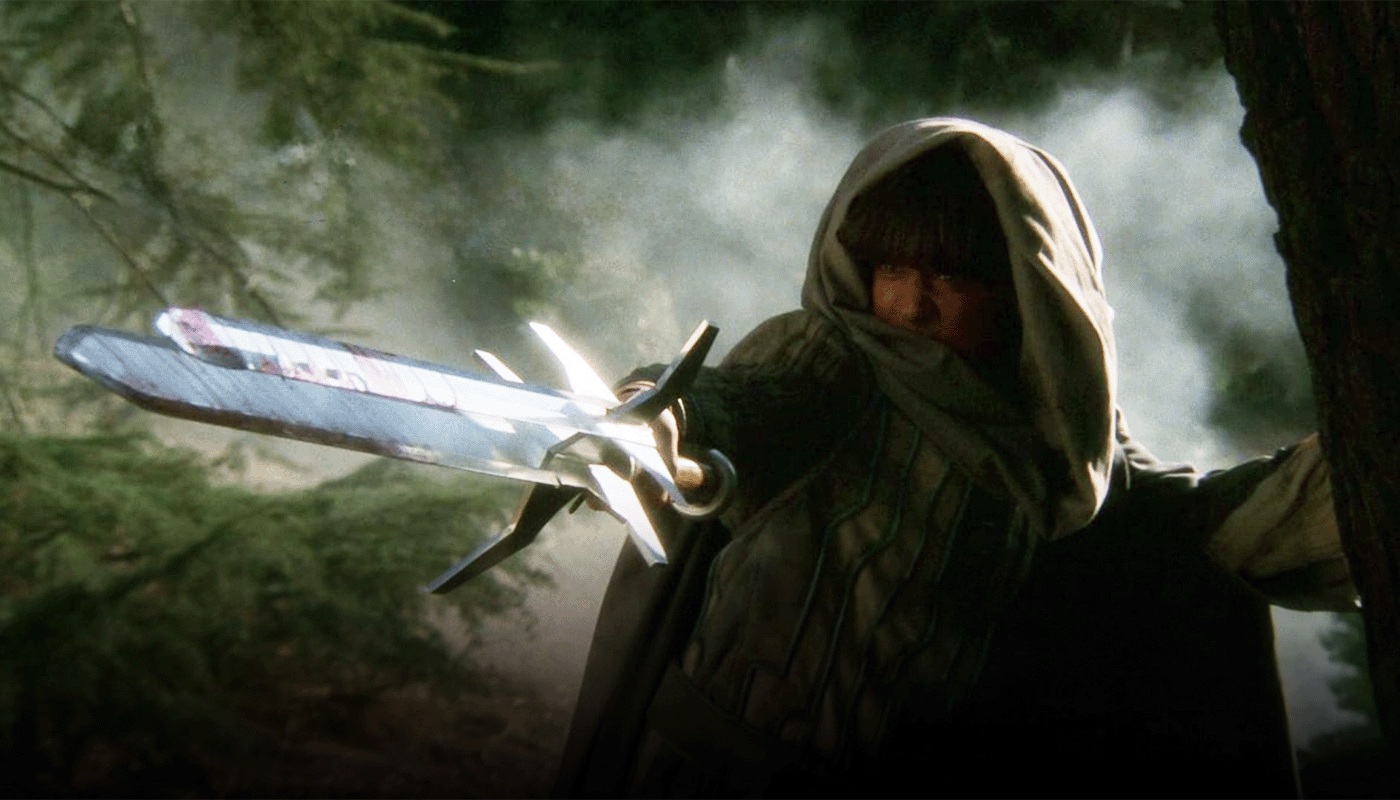
Directed by Albert Pyun, The Sword and the Sorcerer is a film that wears its ambition on its sleeve, despite the limitations of its production. The story follows Prince Talon (played by Lee Horsley), a mercenary who wields a signature triple-bladed sword—a weapon capable of firing its secondary blades like crossbow bolts.
The plot is a dense, often convoluted web of palace intrigue. The antagonist, King Titus Cromwell (Richard Lynch), a man whose screen presence mirrors the cold intensity of a Rutger Hauer performance, resurrects the ancient sorcerer Xusia of Delos (Richard Moll) to facilitate his conquest of the kingdom of Ehdan. The betrayal is swift and predictable: Cromwell uses the sorcerer to win his war and then attempts to discard him. Eleven years later, a matured Talon returns to the political fray, clashing with Cromwell’s forces, navigating an ill-conceived romantic entanglement with his cousin Alana (Kathleen Beller), and ultimately facing off against both the sorcerer and the king in a climax that features more "skin-plopping" Foley effects than one might expect from a standard fantasy romp.
A Chronology of Chaos: The Narrative Arc
The film’s structure is notably front-loaded with exposition, setting a tone of epic significance that the screenplay struggles to maintain.
- The Resurrections: The film opens with the dark ritual of Xusia’s return. This segment serves as the most effective portion of the film, utilizing grotesque practical effects that remain genuinely unsettling decades later.
- The Exile: Prince Talon is sent into hiding, inheriting the iconic three-pronged blade that would become the film’s singular claim to fame.
- The Rebellion: Over a decade later, Talon finds himself caught in the middle of a resistance movement led by his estranged relatives, Mikah and Alana. The film’s romantic subplot—which, upon retrospective viewing, takes on an unintentionally uncomfortable, incestuous tone—drives Talon toward the final confrontation.
- The Wedding Feast: The final act takes place at Cromwell’s castle. Talon, having survived a crucifixion, storms the castle alongside a motley crew of prisoners and concubines. The resolution involves a multi-layered fight sequence where the "sword" and the "sorcerer" finally meet their respective fates.
Supporting Data: Production and Economic Impact
By almost any standard metric of the time, The Sword and the Sorcerer was an outlier. Produced on a lean budget of approximately $4 million, the film defied critical consensus to become the most profitable independent feature of 1982. It raked in $39.1 million at the box office, a testament to the insatiable appetite audiences had for fantasy content in the immediate wake of the Star Wars phenomenon and the burgeoning interest in Dungeons & Dragons-style aesthetics.
Despite this commercial success, the film was largely panned by critics. It was viewed as a chaotic, derivative exercise in violence and skimpy costumes. Yet, the data suggests that the film’s "cultural footprint" was surprisingly durable. Beyond the brief run of plastic triple-bladed toys that flooded the market, the movie became a staple of cable television rotation, eventually finding a second life via the comedic lens of the Rifftrax crew in 2014.
Official Responses and Creative Retrospection
The reception of the film has always been bifurcated. To the uninitiated, The Sword and the Sorcerer is a textbook example of "so-bad-it’s-good" cinema. However, closer analysis reveals that the film’s failure to achieve a "canonical" status equivalent to Conan the Barbarian is not necessarily due to a lack of effort.
The film feels as though it is desperately trying to adapt a massive, pre-existing literary epic, despite being an original screenplay. The names of the kings, the historical polities mentioned, and the sheer volume of lore stuffed into the runtime all suggest that the writers—including Pyun—were operating under the assumption that they were building a massive franchise. The dialogue, particularly the opening monologue—"Know you now of days long past, the time when the world was young…"—is an attempt at grandiosity that falls flat when delivered by actors with distinctly modern, often urban, American accents.
When asked about the film’s legacy, critics have often pointed to the "whimsical nonsense" of the weapon design as its greatest strength. It is a film that understands the cool factor of fantasy, even if it lacks the narrative connective tissue to make that coolness matter. The sequel, Tales from an Ancient Empire (2010), attempted to recapture this magic nearly three decades later with Kevin Sorbo in the lead, but it was met with near-universal critical derision, serving as a cautionary tale about the difficulties of reviving lightning in a bottle.
Implications: The Legacy of "Wrong-Part" Filmmaking
The ultimate implication of The Sword and the Sorcerer is that a film’s legacy is rarely determined by its plot coherence. The movie is arguably a failure of storytelling, yet it is a triumph of visual imagination. It represents a time when fantasy was still being figured out on the fly.
The film’s legacy is found in the "bottle-rocket" sword—a weapon that, while nonsensical from a physics standpoint, captures the raw, unbridled enthusiasm of a child playing in the backyard. It represents the "Summer of Sword and Sorcery" in its purest form: high-octane, low-brow, and entirely unapologetic.
Why It Matters Today
In the modern era, where CGI allows for seamless world-building and every frame of a fantasy film is meticulously color-graded and focus-grouped, The Sword and the Sorcerer serves as a necessary reminder of the value of the "weird." The practical, visceral quality of the Xusia scenes and the tactile, if ridiculous, nature of the props offer a level of charm that modern audiences are increasingly starving for.
While it may not be a masterpiece of screenwriting, the film remains a landmark for those who value the experimental spirit of the 1980s. It was a project that put immense effort into the "wrong" parts—the lore, the complex family trees, the high-minded narration—but in doing so, it created a unique atmosphere that has kept it in the conversation for over forty years. As we move toward our next installment, focusing on the quintessential Robert E. Howard universe, it is worth remembering that even the "failures" of the Eighties contributed to the foundation upon which today’s fantasy landscape rests.
The Sword and the Sorcerer may have been a false bill of goods in terms of its narrative, but as a piece of pure, distilled fantasy spectacle, it remains a rare, three-bladed gem of the era.