

Executive Summary: Bridging Academic Rigor and Virtual Identity
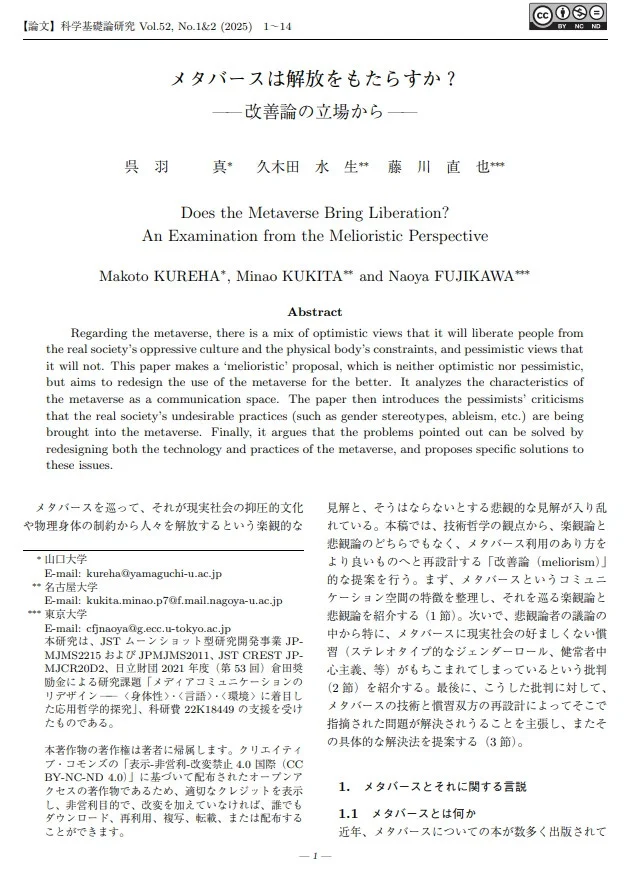
The emergence of Virtual YouTubers (VTubers) has transcended the boundaries of niche entertainment, establishing itself as a significant cultural and technological phenomenon. A recent academic paper, published in the journal Kisoron (Volume 52, Issues 1-2, April 2025), provides a comprehensive analysis of the VTuber movement. The study explores how these digital performers—ranging from independent creators to those backed by major production agencies—are redefining concepts of identity, performance, and social interaction within the Metaverse.
The article highlights that VTubers are not merely avatars but complex, interactive entities that rely on sophisticated motion-capture technology and real-time streaming to foster deep, parasocial bonds with global audiences. As the line between physical and virtual existence blurs, the academic community has begun to treat the VTuber phenomenon as a critical case study for the future of digital labor, gender performance, and virtual reality infrastructure.
Chronology of a Digital Revolution
The rise of the VTuber is not an overnight success story but the culmination of years of rapid technological advancement and cultural shifts in Japan and beyond.
- 2016–2017: The Genesis: The term "VTuber" gained prominence with the debut of Kizuna AI, who popularized the concept of a 3D-modeled avatar performing on YouTube. During this phase, the novelty of the medium served as a catalyst for growth, drawing in early adopters from the gaming and anime communities.
- 2018–2020: Industrialization: Following the success of early pioneers, specialized talent agencies such as Hololive Production and NIJISANJI emerged. This period marked the transition from individual hobbyists to a structured industry, complete with auditions, character design, and professional management.
- 2021–2022: The Metaverse Convergence: As platforms like VRChat gained traction, the integration of VTubers into the "Metaverse" became a focal point. Academic studies, including those by Liudmila Bredikhina and other researchers, began to document how VTubers utilize Virtual Reality (VR) to host live events, concerts, and social gatherings, effectively turning their performances into immersive experiences.
- 2023–2025: Institutional Recognition: The publication of the Kisoron study signifies that the academic world now views VTubers as a legitimate subject of sociological and technological inquiry. The focus has shifted from "what is a VTuber?" to "how are VTubers shaping the future of human-computer interaction?"
Supporting Data: The Scale of the Phenomenon
The data supporting the growth of the VTuber industry is staggering. Research indicates that the top-tier VTubers—many of whom are managed by major agencies—regularly command concurrent viewer counts (CCV) ranging from 3,000 to over 9,000 during standard streams, with peak events attracting hundreds of thousands of live viewers.

Key Performance Indicators:
- Viewer Engagement: Unlike traditional content creators, VTubers foster a "melioristic" relationship with their audience, where the constant evolution of the character’s narrative and appearance encourages long-term retention.
- Technological Barriers to Entry: While professional VTubers utilize high-end hardware (e.g., iPhone X facial recognition, custom motion-capture suits), the democratization of software like FaceRig and VTube Studio has allowed independent creators to lower the barrier to entry, resulting in a diverse, decentralized ecosystem.
- Cross-Platform Integration: The study notes that the most successful VTubers effectively utilize a multi-platform strategy, leveraging YouTube for long-form content, Twitter (X) for daily engagement, and VRChat for immersive, real-time social interaction.
Official Perspectives and Academic Analysis
The academic community has focused heavily on the concept of the "Virtual Body." As noted in the Kisoron article, the agency behind a VTuber is often a complex interplay between the performer, the rigger, the modeler, and the community.
Key Academic Themes:
- Performance of Identity: Researchers argue that VTubers allow for a "liberation of self." By separating the human performer from the visual avatar, creators can explore gender, personality, and aesthetic expressions that might be constrained in the physical world.
- The "Uncanny Valley" and Beyond: Initial resistance to the "uncanny" nature of digital avatars has largely been replaced by aesthetic acceptance. Audiences now view the stylized, anime-inspired avatars as a distinct form of artistic representation, distinct from photo-realistic CGI.
- Labor and Digital Economics: The study highlights the precarious nature of VTuber labor. While the top 1% achieve celebrity status, the vast majority of independent creators face the same challenges as any other digital creator: monetization, platform algorithm shifts, and the psychological toll of maintaining a "persona" for an audience.
Implications for the Future of the Metaverse
The implications of the VTuber phenomenon for the broader Metaverse are profound. As the industry matures, we are seeing the following trends:
1. The Normalization of Digital Avatars
We are moving toward a future where a significant portion of our digital interactions will occur via avatars. The VTuber model provides a blueprint for how to maintain charisma and personal brand in a virtual space, a skill that will be essential for future professionals in virtual meetings, remote education, and digital social spaces.
2. The Decentralization of Content
With the rise of platforms like VRChat and the use of the VRM (Virtual Reality Model) format, content creation is becoming more interoperable. A performer is no longer tied to one platform; their avatar can travel across different virtual worlds, retaining their identity and brand. This interoperability is the backbone of a functional Metaverse.

3. Ethical and Sociological Challenges
As we move forward, the academic community warns of several challenges. These include the protection of the digital performer’s identity (doxing risks), the potential for deep-fake exploitation, and the ethical implications of AI-driven or "automated" VTubers. The Kisoron study emphasizes the need for robust ethical frameworks that protect both the human behind the avatar and the audience interacting with them.
Conclusion: A New Cultural Standard
The research presented in Kisoron underscores that the VTuber phenomenon is not a transient trend but a fundamental shift in how we conceive of digital presence. By merging the performative arts with cutting-edge digital infrastructure, VTubers have created a new category of celebrity—one that is built on interactivity, accessibility, and the limitless potential of the virtual world.
As we look toward 2025 and beyond, the integration of VTuber technology into the wider Metaverse seems inevitable. Whether through professional agencies or independent grassroots creators, the "Virtual YouTuber" has set a new standard for human expression in the digital age. This evolution challenges us to reconsider the boundaries of the "real" and the "virtual," suggesting that in the near future, the most authentic way to represent oneself may be through the very avatars that were once dismissed as mere cartoons.
For further reading on the academic study, please refer to the latest volume of the Kisoron Journal (Vol. 52, 1-2) or visit the J-STAGE repository for the full article and supplementary research papers regarding digital identity.









No comments yet. Be the first to join the conversation!