Ali Ikhwan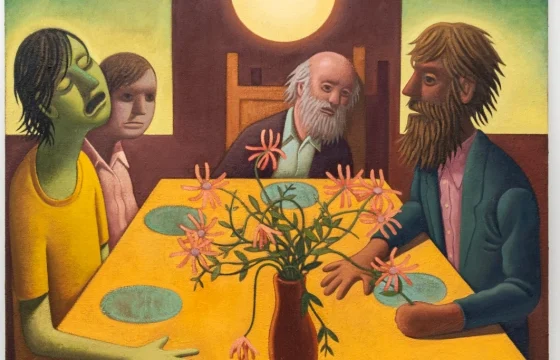
HESSE FLATOW is pleased to announce the opening of Franklin, an evocative exhibition of paintings and works on paper by artist Nat Meade. Marking his third solo presentation with the gallery, the exhibition invites viewers into a complex psychological landscape where the struggles and triumphs of the human condition are distilled into archetypal figures. On view through April 18, 2026, the collection serves as a poignant meditation on the roles of fatherhood, sonship, and the enduring weight of legacy.
Main Facts: The Intersection of Myth and Domesticity
At the heart of Franklin lies a departure from traditional portraiture. Meade does not seek to capture the likenesses of specific individuals; rather, he constructs protagonists that mirror timeless, universal archetypes. These figures inhabit a liminal space where personal history intersects with the broader, often absurd, theater of human existence.
Through a blend of somber introspection and wry humor, Meade navigates the complexities of his own life—as a father, a son, a partner, and an academic—to probe the depths of the human psyche. The paintings function as allegorical mirrors, allowing both the artist and the audience to confront existential questions through a lens that is at once deeply intimate and structurally detached. By abstracting these experiences, Meade creates a "realm of resonance," where the viewer is invited to project their own narratives onto his painted characters.
Chronology: A Trajectory of Growth and Grief
The genesis of Franklin can be traced back to a period of profound personal transition for the artist. Following the recent passing of his father, Meade found himself in a state of deep reflection, forced to re-evaluate his own identity through the lens of his new role as a parent. This chronological evolution is evident throughout the exhibition, which tracks a shift from the turbulent, often violent, nature of his earlier works to a more nuanced, hopeful exploration of reconciliation.
Early Inspirations and Artistic Evolution
Historically, Meade’s figures were often depicted as victims of the natural world—buffeted by relentless winds or submerged by crashing waves. These works captured the struggle of the individual against an indifferent or hostile environment. However, Franklin represents a decisive turning point in the artist’s trajectory. The tempestuous seas of his past works have given way to tranquil, shallow waters, signaling a transition from survival to healing. This progression suggests that by acknowledging the "rocky histories" that have come before, one can actively work to release future generations from the cycles of trauma that defined the past.
Supporting Data: Symbols, Subtext, and Cinematic Allusions
Meade’s visual language is rich with symbolism, drawing from art history, mythology, and pop culture to articulate his themes.
The Anatomy of the Spirit
In the work titled Poise, Meade presents a pair of legs dangling from a cloud. This image challenges the viewer to determine whether the figure is ascending toward the heavens or descending into the mortal realm. It serves as a visual metaphor for the thin, often blurred, boundary between birth and death. In other pieces, ghostly specters hover over figures—a direct reference to the haunting presence of inherited trauma and the ongoing process of finding release. The visual shorthand of a soul peeling away from an expiring body, reminiscent of classic animation, adds a layer of surrealism that manages to be both melancholy and curiously detached.
The "Franklin" Connection
The exhibition’s title, Franklin, acts as a subtle, layered nod to the 1974 horror film The Texas Chainsaw Massacre. In the film, the character Franklin is a manifestation of the deranged, patriarchal family structure. By invoking this cinematic reference, Meade leans into the discomfort of confronting one’s own internal "monsters"—the violent, antagonistic impulses that are often passed down through generations.
Classical Allusions
Meade’s engagement with history is further evidenced by his use of mythological and historical motifs:
- The Vulture and the Corpse: Evoking the eternal punishment of Prometheus, this imagery speaks to the cyclical nature of suffering and the feeling of being perpetually "eaten" by one’s own past actions or failures.
- The Nebuchadnezzar Figure: Echoing William Blake’s famous portrayal of the Babylonian king, a bearded figure on his hands and knees serves as a stark warning against the hubris of power and the madness that follows the loss of one’s moral center.
Official Perspectives: The Dichotomy of Age
A critical aspect of the exhibition is the visual contrast between the older and younger figures. Meade positions these generations in distinct environments, underscoring the shift in perspective that comes with age.
The Burden of the Adult
The adult figures in Franklin are frequently depicted in states of introspection or struggle. They are often burdened by the weight of their own histories, caught in the act of sublimating their darker impulses. They exist within a world of echoes, where the past is never quite finished and the "ghosts" of ancestors are visible, lingering over their shoulders.
The Hope of the Youth
In stark contrast, the younger figures in the exhibition appear unencumbered. Meade portrays a young boy steering a boat with a radiant, golden torch, charting a path that is entirely his own, free from the clouds of familial expectation or societal pressure. In another scene, an adolescent stands ankle-deep in a secluded cove, his focus entirely on the marvels of the tide pool—starfish, anemones, and mussels. This scene is one of pure, unadulterated wonder.
Perhaps most poignant is the image of a father and son standing together in the same pool, with the father tenderly guiding the child. This imagery highlights the transition Meade is navigating: the role of the father is no longer one of dominance or struggle, but of stewardship. It is an acknowledgment that while we cannot erase the past, we can guide the next generation with a gentler hand.
Implications: The Resilience of Human Nature
The ultimate implication of Franklin is not one of despair, but of stubborn, resilient hope. By confronting the "heaviness" of mortality and the ghosts of our fathers, Meade argues that progress is not only possible but inevitable.
Healing the Intergenerational Wound
The exhibition suggests that the path to healing lies in the recognition of one’s own limitations and the "rocky histories" that form the bedrock of our identities. By externalizing these struggles through paint, Meade achieves a form of catharsis that is shared with the viewer. He posits that acknowledging the "specters" of trauma is the first step toward releasing them.
A Future-Oriented Perspective
The shift in Meade’s work—from the crashing waves of earlier exhibitions to the calm, shallow waters of the present—is a testament to the transformative power of art. Franklin serves as a reminder that even when faced with the "insurmountable heaviness" of life, human nature possesses a remarkable capacity for renewal. The exhibition invites the viewer to look back, not to be consumed by the past, but to understand the terrain well enough to navigate toward a brighter, more harmonious horizon.
As the exhibition continues its run at HESSE FLATOW through April 2026, it stands as a significant contribution to contemporary figurative painting. It is an invitation to sit with the uncomfortable, to acknowledge the ghosts we carry, and ultimately, to embrace the torch of the future with the wonder of a child exploring a hidden cove. In the quiet, deliberate strokes of Nat Meade’s brush, we find a mirror for our own lives—a reflection that is, at turns, painful, humorous, and deeply, undeniably human.



 Lina Irawan