

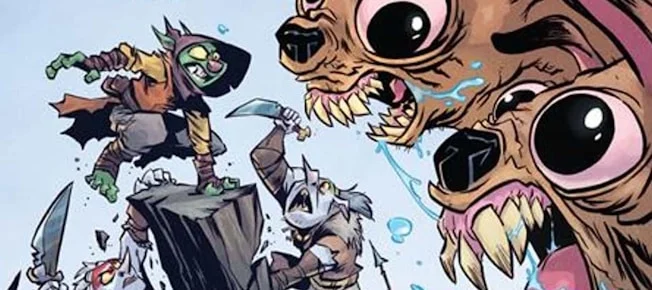
The landscape of modern fantasy comics is often dominated by polished heroes and epic quests for glory, but the latest installment of Brett Bean’s D’orc series offers a grit-filled, visceral departure from the norm. With the release of D’orc #4, readers are once again thrust into the chaotic life of the titular protagonist, a character defined not by his nobility, but by his desperate, messy struggle for survival. As the series progresses, it continues to carve out a unique space in the independent comic market, blending high-stakes action with a dark, sardonic wit that characterizes the brutal world Bean has constructed.
The Narrative Core: Caught Between Teeth and Spears
At the center of D’orc #4 is a scenario that perfectly encapsulates the series’ central ethos: nowhere is safe, and every encounter is a gamble with mortality. In this issue, D’orc finds himself in a precarious position, trapped in the crossfire between two rival goblin gangs. However, the conflict is not merely a skirmish between minor factions; it is complicated by the presence of a legendary, terrifying entity known as Thrawg—a colossal, three-headed beast that both gangs are desperately hunting.
The narrative tension in this issue is palpable. For D’orc, the situation is a grim lesson in the realities of his world. As the promotional materials for the issue succinctly put it, the protagonist is forced to accept that in his line of work, he is destined to become either a "shish kebab" or a "chew toy." This fatalistic worldview is not just flavor text; it is the driving force of the character’s development. Every choice D’orc makes is governed by the immediate need for self-preservation, turning his journey into a fragmented, bloody odyssey where progress is measured in limbs kept intact and distance covered toward an uncertain destination.
Chronology of Chaos: The Evolution of a Hard-Knock Fantasy
To understand the stakes of D’orc #4, one must look at the trajectory of the series thus far. Since its inception, D’orc has been a study in escalating peril.
- The Introduction: Initial issues established D’orc as an unlikely protagonist navigating a world that seems actively hostile to his existence. Unlike traditional fantasy leads, D’orc’s motivations are grounded in basic survival, setting a tone of grounded, albeit grotesque, realism.
- The Escalation: As the series progressed, the scope of the world expanded, introducing complex political dynamics between different monstrous factions, such as the goblin gangs seen in the current issue.
- The Current Conflict: D’orc #4 marks a turning point where the protagonist is no longer merely dodging danger but is forced to interact with the apex predators of his environment, namely the three-headed Thrawg. This marks a shift from passive avoidance to active, albeit reluctant, engagement with the power structures of his world.
The progression of the story suggests that Bean is interested in more than just a sequence of battles. He is mapping a world where the hierarchy of violence is the only law, and D’orc is a player—often a pawn—in a game far larger than himself.
Creative Synergy: The Team Behind the Terror
The visceral impact of D’orc #4 is a direct result of a highly collaborative creative process. Brett Bean, who serves as both writer and artist, provides the foundation for the series’ aesthetic. His style is characterized by dynamic, kinetic lines that emphasize the fluidity of combat and the grotesque nature of the creatures inhabiting this realm.
Supporting Bean is colorist Jean-Francois Beaulieu, whose work is instrumental in establishing the atmosphere of the book. Beaulieu’s palette choices—often favoring earthy, bruised tones punctuated by the sharp, metallic glint of weapons or the sickening vibrancy of blood—create a sensory experience that feels both lived-in and dangerous.
Completing the creative trifecta is letterer Nate Piekos. In a comic as action-heavy as D’orc, the lettering is not merely a functional element; it is a vital component of the pacing. Piekos’s ability to weave dialogue through the chaos of battle, ensuring that the reader never loses the thread of the story amidst the violence, demonstrates a mastery of comic book craft that keeps the narrative moving at a breakneck speed.
Industry Implications and the Indie Landscape
The release of D’orc #4 comes at a significant time for the independent comic industry. With the rise of digital platforms and decentralized distribution, creators like Brett Bean have more freedom than ever to push the boundaries of genre fiction.
- Market Positioning: D’orc occupies a niche that appeals to fans of dark fantasy, grimdark fiction, and character-driven action. By eschewing the tropes of "chosen one" narratives in favor of a protagonist who is constantly one step away from disaster, the series distinguishes itself from more conventional titles.
- Support Structures: The inclusion of links to local comic shop locators and digital platforms like Zeus Comics and Kindle highlights the modern hybrid model of comic distribution. Publishers and creators are increasingly reliant on a combination of physical retail and digital accessibility to sustain their projects.
- The "Affiliate" Model: The transparent disclosure regarding affiliate links serves as a reminder of the evolving economics of comic journalism. Websites that provide coverage of these titles, such as Graphic Policy, operate within an ecosystem where reader support—facilitated by these links—is essential for the continued viability of independent news and reviews.
The Psychological Dimension of the "Chew Toy"
What makes D’orc #4 particularly compelling is the underlying philosophy of the protagonist. D’orc is not a hero in the classical sense; he is a survivor who has internalized the violence of his environment. The "slobbering" mentioned in the promotional copy—the inevitable, sensory-heavy presence of the Thrawg—serves as a metaphor for the constant, encroaching threats that define D’orc’s life.
By focusing on the mundane aspects of survival—the need to keep moving, the need to avoid being eaten—Bean elevates the comic from a simple creature feature to a character study. D’orc’s journey is an existential one. Every piece of him that survives a skirmish represents a small victory against a world that demands his total destruction. The reader is invited to root for him not because he is "good," but because he is resilient.
Future Outlook: Where Does D’orc Go From Here?
As the series moves beyond the events of issue #4, the question remains: what is the ultimate destination? The narrative promises that at least "one piece" of D’orc will get closer to his goal. This phrasing is deliberately ambiguous, hinting at both physical mutilation and the potential for a larger, more abstract purpose behind his trek.
For fans of the series, D’orc #4 offers a perfect distillation of what has made the title a cult hit. It is unapologetically violent, creatively daring, and deeply committed to its own unique brand of fantasy. As the industry continues to evolve, the success of titles like D’orc suggests that readers are hungry for stories that do not pull their punches and that embrace the darker, more chaotic elements of the imagination.
How to Engage with the Series
For those looking to dive into the world of D’orc, the entry barrier is relatively low, provided one has the stomach for the content. The series is available through several channels:
- Local Comic Shops: Readers are encouraged to support their local economy by visiting a comic shop near them. Resources like the Comic Shop Locator or calling 1-888-comicbook remain the primary ways to ensure that local retailers can keep indie titles on the shelves.
- Digital Distribution: For those who prefer the convenience of digital media, platforms like Amazon/Kindle and specialist retailers like Zeus Comics provide immediate access to the latest issue.
- Community Engagement: Following the creative team and supporting the publications that cover their work ensures that the conversation around indie comics remains vibrant and that creators like Brett Bean continue to receive the recognition they deserve.
Ultimately, D’orc #4 is a testament to the power of independent storytelling. It is a reminder that even in a world filled with three-headed monsters and rival gangs, there is a space for stories that are as raw and unfiltered as the characters they depict. Whether D’orc survives to reach his destination remains to be seen, but the journey, as documented by this latest issue, is certainly one worth taking.









No comments yet. Be the first to join the conversation!