

SEO Keywords: Tumblepop Memories, Data East, Arcade Game, Platformer, Nintendo Switch, Daewon Media Game Lab, CRT Games, Playasia, Retro Gaming, Game Revival, Limited Edition, 2026 Release
Main Facts: A Beloved Classic Returns
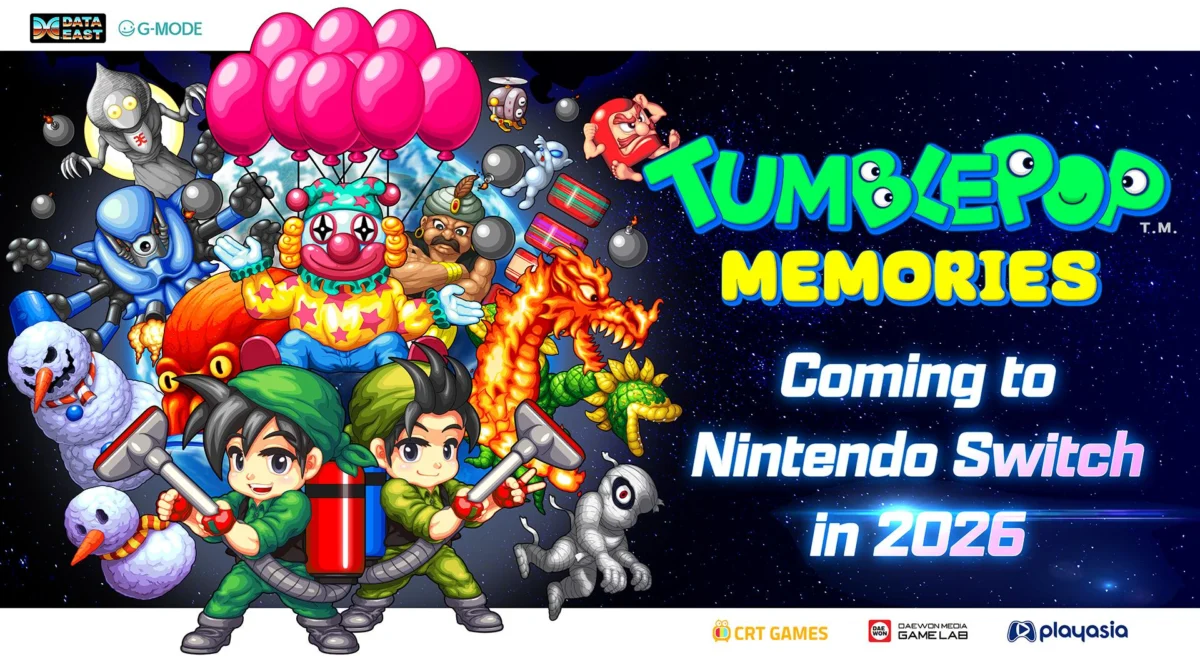
In a move set to ignite nostalgia among veteran gamers and introduce a charming piece of arcade history to a new audience, Daewon Media Game Lab, in collaboration with developer CRT Games, has officially announced Tumblepop: Memories. This eagerly anticipated title is a modern reimagining of Data East’s cult classic 1991 arcade platformer, Tumblepop, and is slated for release in 2026, primarily targeting the Nintendo Switch console. The announcement marks a significant moment for fans of the original and underscores a growing trend in the industry to revive and revitalize beloved intellectual properties from gaming’s golden age.
Tumblepop: Memories promises to deliver a meticulously crafted experience that honors its arcade roots while introducing contemporary elements designed to appeal to modern players. Key features highlighted in the initial announcement include updated visuals, modernized controls, and support for two-player cooperative play, mirroring the social fun of arcade cabinets. Crucially, the developers have confirmed the inclusion of both the original 1991 arcade version and the 1992 Game Boy port, offering a comprehensive package for purists and historians alike. Beyond the classic content, Tumblepop: Memories will also feature brand-new stages and modes, such as Survival Mode, Boss Rush, a mysterious "Tum Tum mode," an online Hi-Scoreboard, and extensive Gallery content, ensuring a robust and replayable experience.
The international publishing and distribution of Tumblepop: Memories will be handled by Playasia, a renowned specialist in bringing unique and niche titles to global audiences. Playasia will be responsible for publishing the game in North America and Europe, and will also oversee the distribution of both physical standard and highly collectible limited editions. The limited edition, designed to captivate dedicated collectors, is packed with exclusive merchandise: a physical copy of the game, the original soundtrack on CD, an A5-size mini art book, a replica A4-size arcade flyer, a comprehensive game manual, and a B5-size art card, all elegantly housed within a bespoke limited edition box. As an added incentive for early adopters, pre-orders will include an exclusive Tumblepop: Memories key ring. Pre-orders are expected to open soon via Playasia’s official website, with special offers available for savvy shoppers.
This announcement signifies more than just the release of a new game; it represents a commitment to preserving gaming heritage while evolving it for a contemporary landscape. The blend of faithful recreation and innovative expansion positions Tumblepop: Memories as a potential benchmark for how classic arcade experiences can be successfully brought into the 21st century.
Chronology: From Arcade Cabinets to Digital Revival
The journey of Tumblepop: Memories is deeply intertwined with the rich history of arcade gaming and the enduring legacy of Japanese developer Data East. Understanding this lineage is crucial to appreciating the significance of its modern revival.
The Legacy of Data East and the Original Tumblepop
Data East Corporation was a prolific Japanese video game developer and publisher established in 1976. Throughout the 1980s and early 1990s, they became a household name in arcades worldwide, responsible for a diverse catalog of memorable titles across various genres. Their output included iconic games like Karnov, BurgerTime, Joe & Mac, Midnight Resistance, and the pioneering fighting game Karate Champ. Data East was known for its innovative gameplay mechanics, distinctive art styles, and often quirky sense of humor, carving out a unique niche in a highly competitive market dominated by giants like Capcom, Konami, and Sega.
In 1991, Data East released Tumblepop into arcades, a charming and highly addictive platform-action game that quickly garnered a dedicated following. The game introduced players to a pair of ghost-busting characters, whose primary weapon was a powerful vacuum cleaner. Players would suck up various enemies, from mischievous ghosts to bizarre creatures, and then spit them back out as projectiles to clear the screen. This unique "suck-and-spit" mechanic, reminiscent of Bubble Bobble‘s bubble-trapping or Snow Bros.‘s snowball-rolling, offered a fresh take on the platformer genre. The game featured vibrant pixel art, catchy chiptune music, and intricate level designs that encouraged strategic thinking alongside quick reflexes. Its cooperative two-player mode amplified the fun, allowing friends to team up and tackle the game’s increasingly challenging stages together. Tumblepop was praised for its accessible gameplay, charming aesthetics, and high replayability, making it a standout title in the crowded arcade scene of the early 90s.
Following its arcade success, Tumblepop was ported to the Nintendo Game Boy in 1992. While the Game Boy version naturally featured monochrome graphics and adapted controls, it managed to retain much of the original’s core gameplay loop and charm, making it a popular title for portable gaming enthusiasts. The existence of both the arcade and Game Boy versions speaks to the game’s initial popularity and Data East’s efforts to broaden its reach beyond the arcade.
However, despite its creative output, Data East faced increasing financial difficulties in the late 1990s and early 2000s, eventually filing for bankruptcy in 2003. While the company ceased operations, its rich catalog of intellectual properties remained, often changing hands or lying dormant, leaving many beloved titles inaccessible to modern audiences. This dormancy fueled a desire among fans and preservationists for these games to be brought back into the spotlight.
The Reimagining Process: Breathing New Life into a Classic
The decision to revive Tumblepop for the modern era is part of a broader industry trend that recognizes the immense value of gaming heritage. Many classic titles, particularly those from the arcade era, possess timeless gameplay mechanics and artistic charm that resonate with players across generations. The challenge lies in updating these experiences without sacrificing their original essence.
The emergence of Tumblepop: Memories can be seen as a culmination of this trend, facilitated by new partnerships and a renewed appreciation for Data East’s catalog. Daewon Media Game Lab, a publisher with a keen interest in both original titles and the revitalization of established franchises, has partnered with CRT Games, a developer specializing in modern interpretations of classic gaming experiences. While specific details about the genesis of this project are yet to be fully disclosed, it is plausible that the teams identified Tumblepop as a prime candidate for a revival due to its unique mechanics, cooperative potential, and enduring fan base, albeit a niche one. The "Memories" in the title itself signifies a profound respect for the game’s past, suggesting a commitment to preserving the cherished aspects while building upon them.
The development process for such a reimagining typically involves a delicate balance. Developers must meticulously analyze the original game’s design, identify its core strengths, and determine how best to translate those strengths into a contemporary context. This often includes modernizing controls for current gamepads, enhancing visual fidelity to meet modern expectations, and expanding content to provide value beyond a simple port. The involvement of Playasia as an international publisher and distributor is also a critical piece of the puzzle, indicating a strategy to reach a global audience, particularly those who appreciate physical releases and collector’s editions of niche titles. The 2026 release date suggests a thorough development cycle, allowing CRT Games ample time to craft an experience that lives up to both its legacy and modern gaming standards.
Supporting Data: Deep Dive into Gameplay, Features, and Editions
Tumblepop: Memories is shaping up to be a comprehensive package, blending nostalgic elements with fresh content and catering to both casual players and dedicated collectors. The details provided by CRT Games offer a tantalizing glimpse into what players can expect.
Gameplay Evolution: Bridging Eras
The core promise of Tumblepop: Memories lies in its ability to bridge the gap between classic and contemporary gaming. The developers state their goal is to deliver "updated visuals and modernized controls while preserving the fun and charm of the original release."

- Updated Visuals: While the original Tumblepop boasted charming pixel art, modern technology allows for significant enhancements. Players can anticipate sharper character models, more dynamic backgrounds, enhanced special effects for vacuuming and spitting enemies, and potentially more detailed environmental elements. The art direction will likely aim for a vibrant, expressive style that respects the original’s aesthetic while leveraging higher resolutions and modern rendering techniques. This ensures the game looks appealing on modern displays without losing its identity.
- Modernized Controls: Arcade games often featured simple, direct control schemes. For Tumblepop: Memories, modernized controls would likely translate to smoother character movement, more precise aiming for the vacuum mechanic, and perhaps remappable buttons to suit individual player preferences. This ensures that the game feels responsive and intuitive on contemporary controllers, removing any potential friction that might arise from strictly adhering to decades-old input methods.
- Two-Player Co-op: A cornerstone of the original arcade experience was its cooperative multiplayer. Tumblepop: Memories fully embraces this, supporting up to two-player co-op. This feature is vital for recapturing the social enjoyment of arcade gaming, allowing friends to strategize, coordinate attacks, and share in the excitement of clearing stages. The co-op mode often introduces unique gameplay dynamics, such as reviving fallen teammates or combining attacks for greater efficiency, enhancing replayability and fostering a sense of camaraderie.
- Included Classic Versions: A significant boon for fans and preservationists is the inclusion of both the original 1991 Arcade version and the 1992 Game Boy version. This demonstrates a deep respect for the game’s history. Players can directly compare the modern reimagining with its source material, experience the different nuances of each classic iteration (e.g., the arcade’s vibrant visuals versus the Game Boy’s portable charm and unique level designs), and appreciate the evolution of the title. This feature alone adds immense value, transforming the package into a virtual museum of Tumblepop‘s history.
New Content and Features: Expanding the Universe
Beyond the faithful recreation of the original, Tumblepop: Memories aims to provide substantial new content, significantly extending the game’s longevity and appeal.
- Brand-New Stages and Modes: The promise of new stages suggests an expansion of the game’s narrative or simply more environments to explore, each likely introducing unique enemies, hazards, and boss encounters.
- Survival Mode: This mode typically challenges players to withstand endless waves of enemies, testing their endurance, resource management, and mastery of the vacuuming mechanics. It’s often a high-score chase, encouraging players to push their limits and compete for the top spot on leaderboards.
- Boss Rush: A classic challenge mode, Boss Rush pits players against all of the game’s bosses in rapid succession, often with limited health or resources. This mode focuses purely on combat proficiency and pattern recognition, offering a distinct and intense gameplay experience separate from the main campaign.
- Tum Tum Mode: As a new, uniquely named mode, "Tum Tum Mode" could offer a variety of innovative gameplay twists. It might be a series of specific challenges (e.g., clear a stage using only enemies of a certain color, or complete a level within a strict time limit), a puzzle-oriented mode utilizing the vacuum mechanics, or perhaps a distinct competitive multiplayer mode. Its enigmatic name sparks curiosity and hints at creative new ways to play.
- Online Hi-Scoreboard: Essential for any arcade-inspired game in the modern era, an online Hi-Scoreboard will allow players globally to compete for bragging rights. This feature fosters a competitive community, encourages repeated play to optimize scores, and provides a tangible measure of skill and dedication.
- Gallery Content: This typically includes unlockable extras such as concept art, character designs, historical development documents, promotional materials, and perhaps even developer commentary or interviews. Gallery content offers a fascinating behind-the-scenes look at the game’s creation and its legacy, enriching the overall experience for curious players.
The Collector’s Appeal: Physical Editions and Exclusive Bonuses
Playasia’s role in distributing physical standard and limited editions highlights the game’s appeal to collectors and enthusiasts who value tangible media.
- Limited Edition Box Contents: The limited edition is a treasure trove for fans:
- Game Copy: The physical cartridge or disc, a prized possession in an increasingly digital world.
- Original Soundtrack CD: Allows players to enjoy the game’s memorable tunes outside of gameplay, preserving the auditory experience.
- A5-size Mini Art Book: Offers a glimpse into the game’s visual development, featuring character designs, environmental concepts, and possibly early sketches, providing insight into the artistic process.
- A4-size Arcade Flyer: A faithful replica of the original arcade cabinet’s promotional material, offering a piece of gaming history and a nostalgic connection to the game’s origins.
- Game Manual: A tactile item increasingly rare in modern gaming, providing lore, gameplay tips, and a nostalgic throwback to the days when manuals were integral to the game experience.
- B5-size Art Card: A high-quality print suitable for display, showcasing key art or character illustrations.
- Limited Edition Box: A premium container that elegantly houses all these collectibles, making it a display piece in itself.
- Pre-order Bonus Key Ring: A small but significant incentive for early purchases, adding to the collectible nature of the release.
- Playasia’s Role: Playasia’s expertise in handling niche and import titles, particularly physical collector’s editions, makes them an ideal partner for Tumblepop: Memories. Their global reach ensures that fans across North America and Europe will have access to these coveted physical releases.
Official Responses: Voices Behind the Revival
While specific direct quotes from Daewon Media Game Lab, CRT Games, or Playasia executives have not been widely disseminated beyond the initial announcement text, the overarching message from CRT Games’ "About" section provides a clear articulation of their vision and goals for Tumblepop: Memories.
The development team at CRT Games clearly emphasizes a dual objective: "reimagining the iconic arcade experience with updated visuals and modernized controls while preserving the fun and charm of the original release." This statement is foundational to the project, demonstrating a deep understanding of the delicate balance required when reviving a classic. It speaks to a commitment to respecting the source material’s integrity—its "fun and charm"—while simultaneously ensuring it meets the expectations of a contemporary audience through "updated visuals and modernized controls." This approach is crucial for satisfying both long-time fans who cherish the original and new players who may be encountering Tumblepop for the first time.
The inclusion of two-player cooperative play is a deliberate choice to maintain the social aspect that defined arcade gaming. Furthermore, the decision to bundle the original 1991 Arcade and 1992 Game Boy versions within Tumblepop: Memories is a powerful testament to the developers’ dedication to nostalgia and historical preservation. It transforms the reimagining from a mere remake into a definitive historical package, allowing players to contextualize the new content within its rich legacy.
The addition of "brand-new stages and modes, including Survival Mode, Boss Rush, Tum Tum mode, online Hi-Scoreboard, Gallery content, and more" signals an ambition to go beyond simple recreation. It conveys a desire to expand the Tumblepop universe, offering substantial new gameplay experiences that justify a modern release. These new features aim to enhance replayability, introduce new challenges, and foster community engagement through competitive scoreboards and behind-the-scenes content.
The partnership itself speaks volumes. Daewon Media Game Lab, as the publisher, brings financial backing and strategic oversight. CRT Games, as the developer, contributes the creative and technical expertise required to execute the vision. Playasia, as the international publisher and distributor, ensures the game reaches a global audience, particularly those who appreciate specialized physical releases. This collaboration underscores a shared belief in the enduring appeal of Tumblepop and a concerted effort to deliver a high-quality product to its eagerly awaiting fanbase. While detailed statements from specific individuals are pending, the collective message from these entities is one of thoughtful revival, quality craftsmanship, and a commitment to player satisfaction.
Implications: Reshaping the Retro Landscape and Future Prospects
The announcement of Tumblepop: Memories carries significant implications, not just for the game itself, but for the broader retro gaming market, the future of Data East’s intellectual properties, and player expectations for such revivals.
Impact on the Retro Gaming Market
Tumblepop: Memories joins a thriving ecosystem of retro game revivals and remakes that have seen considerable success in recent years. Titles like Wonder Boy: The Dragon’s Trap, Streets of Rage 4, Alex Kidd in Miracle World DX, and Teenage Mutant Ninja Turtles: Shredder’s Revenge have demonstrated that there is a substantial and hungry market for modern takes on classic arcade and console experiences. This trend is driven by several factors:
- Nostalgia: Older gamers are eager to revisit the games of their youth, often with improved visuals and quality-of-life features.
- Accessibility: Many classic games are difficult to play on modern hardware due to compatibility issues or simply being unavailable. Revivals make these experiences accessible to a new generation.
- Timeless Gameplay: Many retro games possess fundamental gameplay loops that remain engaging and fun, proving that good game design transcends technological limitations.
Tumblepop: Memories stands to reinforce this trend, proving that even lesser-known but equally charming titles from the arcade era can find new life. Its success could encourage other publishers and developers to delve deeper into the archives of dormant IPs, particularly those from Data East, to identify other candidates for similar treatment.
Future of Data East IPs
The revival of Tumblepop is particularly significant for the legacy of Data East. Since the company’s dissolution, its vast library of games has been in a state of limbo, with various IPs being acquired by different entities. The success of Tumblepop: Memories could serve as a catalyst for the revival of other beloved Data East titles. Imagine modernized versions of Karnov, with its unique grappling mechanics, or a reimagined Joe & Mac with enhanced prehistoric platforming. A fresh take on BurgerTime or Midnight Resistance could also find an eager audience.
Daewon Media Game Lab and CRT Games, by taking on Tumblepop, position themselves as key players in the preservation and modernization of Data East’s heritage. If Tumblepop: Memories performs well, it could pave the way for them to acquire or license additional Data East IPs, potentially establishing a dedicated pipeline for bringing these classics back into the public eye. This would be a tremendous boon for retro gaming enthusiasts and a fitting tribute to Data East’s contributions to the industry.
Player Expectations and Anticipation
The announcement sets a high bar for Tumblepop: Memories. Players expect a delicate balance between fidelity and innovation. While updated visuals and modernized controls are welcome, there’s an inherent demand for the game to feel like the original. The core "suck-and-spit" mechanic, the enemy behaviors, and the overall charm must remain intact. Any deviation that fundamentally alters the original’s spirit could lead to disappointment.
The inclusion of the original arcade and Game Boy versions is a smart move, as it provides a safety net and a point of comparison, demonstrating the developers’ confidence in their reimagining. However, the new modes and stages will also be scrutinized. Players will be looking for well-designed content that expands on the Tumblepop universe in meaningful ways, rather than feeling tacked on. The online Hi-Scoreboard will fuel competitive play, but the game’s fundamental stability and online functionality will be paramount for its success in this aspect.
The anticipation for Tumblepop: Memories will steadily build towards its 2026 release. The physical limited edition, with its wealth of collector’s items, is likely to generate significant interest, tapping into the growing market for premium physical media. Ultimately, Tumblepop: Memories stands as a testament to the enduring power of classic game design and the industry’s increasing willingness to celebrate and evolve its own rich history. Its success will not only bring joy to countless players but could also unlock the potential for many more forgotten gems to shine brightly once again.











No comments yet. Be the first to join the conversation!