

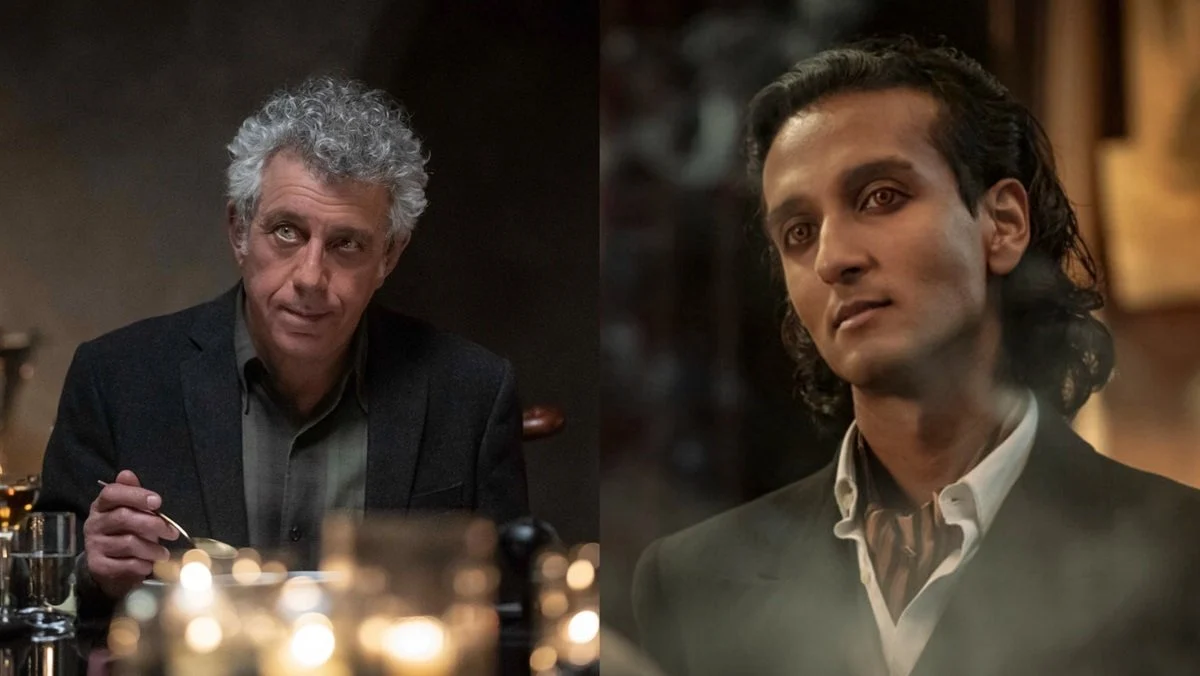
The season two finale of AMC’s Interview with the Vampire delivered a narrative bombshell that sent ripples through the Immortal Universe fandom: the reveal that the veteran reporter Daniel Molloy (Eric Bogosian) had been turned into a vampire by his enigmatic subject, Armand (Assad Zaman). This transformation, depicted in a chilling flash-forward, serves as the ultimate culmination of a decades-long power struggle between the mortal journalist and the centuries-old immortal.
While the show leaves the exact mechanics and timeline of this transition shrouded in mystery, the act appears less an expression of romantic devotion and more a calculated, perhaps spiteful, maneuver. To understand the gravity of this development, one must look beyond the screen and into the foundational lore established by Anne Rice in The Vampire Chronicles.
The Evolution of "The Boy"
In the original 1976 novel Interview with the Vampire, the character who would eventually become Daniel Molloy was a mere cipher, referred to only as "the Boy." At the time, he was a nameless, ambitious journalist who, upon interviewing Louis de Pointe du Lac in a San Francisco apartment, became obsessed with the vampiric condition. He ran off with Louis’s audio tapes, eventually transcribing them into the titular book.
It was not until the third novel in the series, 1988’s The Queen of the Damned, that Rice provided the character with a name, a history, and a definitive role in the grander tapestry of the Vampire Chronicles. The chapter titled "The Story of Daniel, the Devil’s Minion, or the Boy from Interview with the Vampire" bridges the gap between his initial encounter with Louis and his eventual entanglement with the Vampire Armand. In the literary canon, Daniel’s search for the legendary Lestat de Lioncourt led him not to his quarry, but to the domain of the formidable Armand, who had claimed New Orleans as his exclusive, blood-drenched territory.

A Chronology of Obsession: From Novel to Screen
The literary history of Daniel and Armand is a dense, century-spanning chronicle of psychological attrition. Upon discovering that the young mortal knew the secrets of his kind, Armand began a predatory game of cat-and-mouse. For years, he stalked Daniel across continents, appearing in his life at whim, threatening his existence, and then, inexplicably, allowing him to live for the sake of entertainment.
The Night Island Era
A pivotal chapter in their relationship occurred with the creation of the "Night Island," a private sanctuary off the coast of Florida. Armand, utilizing his immense age and knowledge of sunken treasures, coerced Daniel—who began to view himself as the "Devil’s Minion"—into helping him acquire unimaginable wealth. With this fortune, they established a hedonistic, nocturnal paradise that existed solely for the benefit of the undead.
During this period, Daniel enjoyed the trappings of wealth and access to the vampire’s inner circle, yet he remained fundamentally an outsider—a mortal trapped in the orbit of a god-like being. His persistent demand to be turned into a vampire was met with consistent refusal by Armand, who found a peculiar, possessive joy in keeping his companion mortal. It was only when Daniel’s life was imperiled during a failed attempt to escape his captor that Armand finally bestowed the Dark Gift, a move that fundamentally altered, and eventually fractured, their already volatile dynamic.
The AMC Interpretation
AMC’s adaptation has taken significant liberties with this timeline, particularly regarding the 1973 encounter. In the series, Armand is revealed to have intervened during Louis’s attempt to kill Daniel, wiping the reporter’s memory of the event and setting the stage for a decades-long manipulation. The show suggests a more modern, sinister framing for their relationship. While the books paint a picture of long-term codependency on Night Island, the show implies a more immediate and aggressive reclamation of Daniel by Armand following the revelation of Armand’s betrayal regarding Claudia.

Supporting Data and Narrative Implications
The implications of this shift are profound for the upcoming third season. If the show intends to incorporate the Night Island arc, it may do so as a series of fragmented flashbacks or a new, expanded narrative path for the now-vampiric Daniel.
The existence of a dedicated series titled The Night Island—announced by AMC as part of the expanded Immortal Universe—suggests that the network views this specific location and the associated history as a cornerstone of its storytelling strategy. Whether this series will focus on the literary past of Armand and Daniel or a post-season two reality remains a subject of intense speculation. The ambiguity of the "when" regarding Daniel’s turning allows the showrunners the flexibility to jump between time periods, potentially exploring the "missing years" where their bond evolved from curiosity to something far more toxic.
Official Responses and Actor Perspectives
The actors behind these iconic roles have offered tantalizing, albeit cryptic, insights into the nature of the bond between their characters. Eric Bogosian, discussing the internal logic of the relationship, provided a metaphor that highlights the dark, possessive nature of Armand’s love. "I feel that Armand’s love for Daniel is like when a kid has a stuffed animal, and he drags it around with him for years until it has one button and a hole for an eye," Bogosian remarked. "He loves that little stuffed animal. So, it’s as romantic as that can be."
This perspective shifts the audience’s perception of the pairing. It frames Armand’s actions not as a romantic gesture, but as an act of profound objectification. When paired with the teaser from Assad Zaman—who noted that "Love between vampires can be one thing… Or it can be many things"—the audience is invited to question the morality of an immortal who treats a human life as a collectible toy.

The Future of the Immortal Universe
The decision to turn Daniel Molloy is not merely a plot twist; it is a fundamental shift in the show’s power dynamics. Daniel, once the inquisitive, vulnerable observer, is now a permanent, undead participant in the world of the vampires. This transition invites a host of new questions:
- Memory and Trauma: How will the memories of his long life as a mortal affect Daniel’s transition into immortality?
- The Power Balance: Can a newly turned vampire, even one as cynical as Daniel, hope to outmaneuver a 500-year-old master like Armand?
- The Narrative Frame: Will the show continue to rely on the "interview" format, or will the new vampiric status of the interviewer force a total reconstruction of the show’s frame narrative?
As we look toward the future of Interview with the Vampire, the inclusion of the Night Island lore and the psychological weight of the "Devil’s Minion" arc suggest that the series is leaning heavily into the darker, more exploitative aspects of Anne Rice’s world. The chemistry between Zaman and Bogosian has become the gravitational center of the series, pulling in secondary characters and forcing them to confront the reality that, in the world of the undead, love is often indistinguishable from possession.
Ultimately, the audience is left with the haunting realization that Daniel Molloy’s quest for the truth—his lifelong pursuit of the "real" story—has resulted in the most final, irreversible story of all. He is now part of the history he once only documented. Whether he becomes a partner, a prisoner, or a rival to Armand remains the most compelling question in a series that continues to redefine the modern gothic horror genre. As production for the next installment moves forward, fans can expect the interplay between these two characters to serve as the definitive exploration of what happens when a mortal life is swallowed whole by the weight of eternity.










No comments yet. Be the first to join the conversation!