

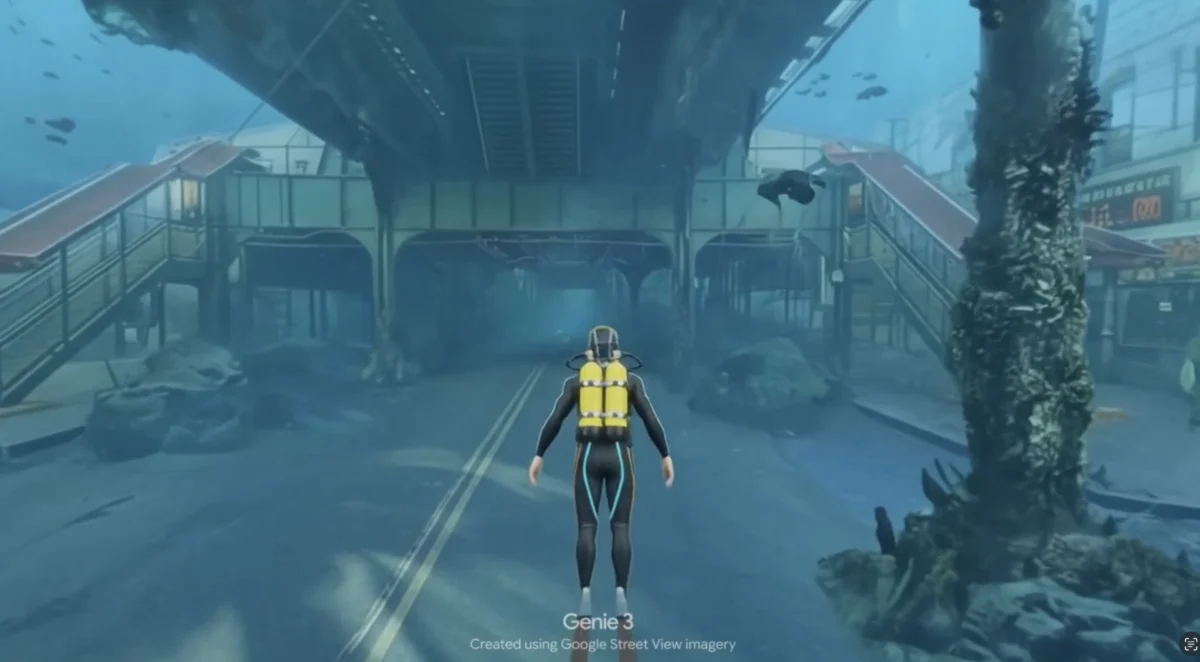
For two decades, Google Street View has served as the world’s digital window, offering a static, panoramic perspective of our neighborhoods, childhood homes, and far-flung travel destinations. But the era of simply "looking" at the world through a screen is drawing to a close. At this year’s Google I/O developer conference, Google DeepMind unveiled a transformative integration that promises to turn our static maps into dynamic, interactive simulations. By marrying 280 billion Street View images with "Project Genie"—the company’s sophisticated generative world model—Google is enabling users to step inside the map and reshape reality itself.
The Convergence of Geography and Generative AI
The core innovation lies in the marriage of Google’s vast geographic repository with the "Genie" architecture. Project Genie, a general-purpose world model, is designed to generate diverse, interactive environments that respond to user input. Previously, Genie was largely focused on synthesizing game-like worlds from text prompts or static imagery. By anchoring this capability to the real-world data of Street View, Google has created a bridge between the physical world and the latent space of generative AI.
This integration allows users to move beyond the "click-to-pan" functionality of traditional Maps. Imagine pulling up a street corner in Paris, then using an AI interface to toggle the weather to a blizzard, shift the time of day to a twilight glow, or even simulate the catastrophic environmental changes of a science-fiction "Day After Tomorrow" scenario. This is no longer just a map; it is a sandbox of the real world.
Chronology of a World-Building Vision
The path to this integration is rooted in Google’s long-standing obsession with digitizing the planet. Since the launch of Street View 20 years ago, Google has utilized a complex fleet of specialized vehicles and "tracker backpacks" to map 110 countries across all seven continents.
- 2005–2020: The foundational era. Google builds the world’s most comprehensive visual database, collecting over 280 billion images.
- August 2025: Google DeepMind releases "Genie 3" for research preview, marking a significant leap in world-model capabilities.
- January 2026: Access to the Genie tool is expanded to Google AI Ultra subscribers in the United States, allowing for the generation of interactive game worlds.
- May 2026 (Google I/O): The official announcement of the Street View-to-Genie integration. The company initiates a rollout to U.S. Ultra users, with global availability promised in the coming weeks.
The Data Powerhouse: Why Street View Matters
The sheer scale of Street View data is what distinguishes Google’s approach from other generative AI projects. According to Jack Parker-Holder, a research scientist on DeepMind’s open-endedness team, the combination of rich, real-world information with the procedural generation capabilities of Genie creates a synergy that was previously impossible.
"With Street View, we have imagery from a large quantity of the world," Parker-Holder explains. "You can imagine how potentially powerful it is to combine this rich source of real-world information and data with an ability to simulate worlds."
The spatial continuity provided by the model is the technical breakthrough here. When a user turns 360 degrees in a Genie-generated environment, the model does not simply "guess" what is behind them; it recalls the visual context of the original Street View data, maintaining a coherent and persistent space. This consistency is what separates a high-end simulation from a mere visual hallucination.
Official Perspectives: From Research to Real-World Application
Google’s leadership views this as a multi-pronged evolution. For Jonathan Herbert, director of Google Maps, the project represents a long-gestating ambition. Having started as a Street View intern 12 years ago, Herbert sees the integration as the logical conclusion of years of mapping efforts. "We have long thought about how we can build out the best and richest model of the world on top of Street View data," Herbert noted.
However, the team remains tempered by caution. Diego Rivas, a product manager at DeepMind, emphasizes that this is an experimental phase. While the demos—which include underwater simulations of residential neighborhoods—are impressive, the technology is still in its infancy. "The goal is to put this into as many hands as possible," Rivas said, while noting that the team is acutely aware of the need to improve spatial accuracy and physics-based interactions.
The Robotics and Autonomous Driving Frontier
Beyond consumer curiosity, the implications for robotics and autonomous driving are profound. The current iteration of Genie 3 is already being used to power simulators for Waymo, Google’s autonomous driving subsidiary. By feeding Street View data into the model, Waymo can train its vehicles on "exceedingly rare events"—such as sudden weather shifts or unexpected obstacles—without needing to encounter them in the physical world.
The distinction between traditional simulators and Genie lies in the "agent" perspective. Traditional simulators are often tethered to the "driver’s seat" (the car’s point of view). Genie, conversely, can simulate a world from the perspective of a human pedestrian or a delivery robot.
Parker-Holder provides a practical use case: "If a new robot is being deployed in London, which rarely sees the sun, Genie could simulate those scarce occasions when the sun glints off the Victorian housing. This ensures the robot isn’t ‘shocked’ by sudden light changes, making it more resilient in real-world deployment."
Current Limitations: Physics and Fidelity
Despite the excitement, Google is transparent about the "video game" quality of the current output. The models are not yet fully physics-aware. In early samples, a character running through a snowy landscape might pass directly through solid objects like cacti or bushes. This is a far cry from Google’s other AI products, such as the video generator "Veo," which demonstrates a sophisticated understanding of how paper boats drift on water or how smoke disperses in air.
DeepMind researchers argue that physics is not "hard-coded" into these models; rather, it is learned through passive observation, much like a human child learns to navigate the world. Parker-Holder remains optimistic about the timeline for improvement: "I think for this kind of model, it’s maybe six to 12 months behind video in terms of the accuracy and quality. It’s something we will solve."
Broader Implications and Future Outlook
The integration of Street View into Genie points to a future where maps are no longer just reference tools but predictive engines.
1. Urban Planning and Simulation
City planners could use these tools to visualize the impact of new construction projects, traffic patterns, or climate change on specific neighborhoods. By simulating how a street looks under different weather conditions or at different times of the year, authorities can better prepare for infrastructure resilience.
2. Immersive Education
The potential for education is immense. History students could "walk" through a digitally reconstructed 19th-century version of their town, or geography students could explore remote regions of the globe with a level of interactivity that exceeds simple 360-degree photography.
3. The Future of Gaming
As Genie matures, it could democratize game development. If a model can generate an interactive, spatially accurate environment from a few text prompts or Street View coordinates, the barrier to entry for building complex, hyper-realistic simulations will collapse, shifting the focus from manual coding to creative intent.
Conclusion: The Road Ahead
As Google rolls out access to U.S. Ultra users, the tech giant is effectively inviting the public to help refine the model. The experiment represents a bold step toward the goal of "General Artificial Intelligence" (AGI), where machines don’t just process data but understand the fundamental structure of the world we live in.
While we are not yet at the stage of photorealistic, physics-perfect simulations, the "spatial continuity" breakthrough ensures that Google’s world-building ambitions are built on a solid foundation. Whether it is training the next generation of autonomous robots or allowing a user to walk through their childhood home in a simulated winter storm, the line between reality and representation is becoming increasingly thin. As Google continues to iterate, the world—quite literally—is becoming a sandbox for our collective imagination.












No comments yet. Be the first to join the conversation!