

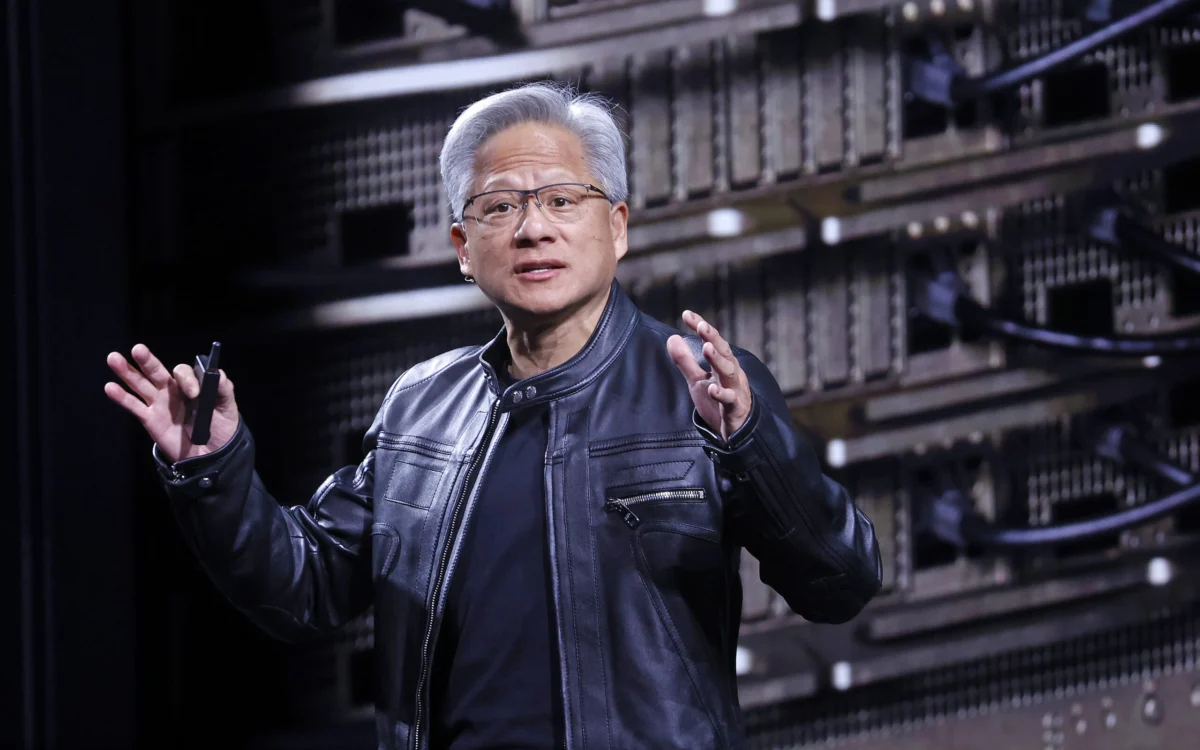
In the high-stakes theater of Silicon Valley, few executives command a stage with the magnetism of Jensen Huang. The Nvidia founder and CEO has long been regarded as the ultimate corporate evangelist, a leader whose relentless optimism regarding his company’s trajectory is matched only by his ability to deliver astronomical financial results. While skeptics often dismiss executive fervor as mere “hype,” Huang’s track record of consistent, quarter-over-quarter dominance has earned him a rare commodity in the tech industry: the benefit of the doubt.
As Nvidia navigates a post-GPU-monopoly landscape, Huang has unveiled his next strategic masterstroke: the Vera CPU. By positioning this new silicon as the foundational architecture for “agentic AI,” Huang is not merely expanding his product catalog; he is claiming a massive, previously untapped $200 billion Total Addressable Market (TAM).
The Main Event: A New Era of Compute
During Nvidia’s latest earnings call—a session that saw the company report a staggering $81.6 billion in revenue with a bullish forecast of $91 billion for the upcoming period—Huang articulated a fundamental shift in how the world handles artificial intelligence.
For years, the industry narrative has been defined by the GPU’s supremacy in training large language models. However, Huang argues that the next evolution of AI—specifically agentic AI, where software entities perform autonomous, multi-step tasks—requires a departure from traditional cloud architecture. Enter Vera, a CPU purpose-built for the unique demands of agents.
Unlike legacy CPUs designed for general-purpose computing or high-frequency core execution, Vera is optimized specifically for token throughput. By moving away from the classic “core-heavy” design that dominates the Intel and AMD-led landscape, Nvidia is pivoting to satisfy the hunger of autonomous agents that require low-latency tool usage, effectively creating a new class of "AI-native" computing.
A Chronology of Strategic Expansion
To understand the weight of the Vera announcement, one must look at the recent evolution of Nvidia’s hardware roadmap.
- March 2026: Nvidia officially launches the Vera CPU. Initial market reactions were measured, as investors questioned whether a GPU-centric company could successfully disrupt the entrenched CPU market.
- Early April 2026: Amazon CEO Andy Jassy makes waves in his annual shareholder letter, signaling Amazon’s intent to dominate the AI chip space with homegrown CPUs, taking direct aim at the traditional incumbents and Nvidia.
- Late April 2026: Amazon Web Services (AWS) announces a massive partnership with Meta for millions of proprietary Amazon AI CPUs, intensifying the competitive pressure on Nvidia.
- May 2026: Following a record-breaking earnings report, Huang doubles down on Vera, revealing that Nvidia has already secured $20 billion in standalone sales for the new chip in its first months of availability.
This timeline reflects a rapid escalation in the "Chip Wars." While AWS and other hyperscalers are racing to verticalize their hardware stacks, Nvidia is countering by shifting from being a component supplier to an end-to-end infrastructure provider, bundling Vera CPUs with its flagship Rubin GPUs.
Supporting Data: The Arithmetic of Agents
Huang’s assertion of a $200 billion TAM for Vera is rooted in a specific vision of the future: the transition from human-led computing to agent-led computing.
"The world has a billion human users," Huang noted during the earnings call. "My sense is that the world is going to have billions of agents. Those billions of agents will all use tools, and those tools are going to be like PCs, just like us humans using PCs today."
The current market architecture is built for human interaction. The next, according to Nvidia, will be built for machine interaction. By decoupling the “thinking” aspect of AI—handled by the GPU—from the “task-execution” aspect—handled by the Vera CPU—Nvidia is creating a symbiotic hardware ecosystem.
The $20 billion in sales recorded to date serves as a powerful validation of this thesis. It suggests that hyperscalers and system makers are not waiting for the market to mature; they are actively retooling their data centers to accommodate the specific, token-heavy workloads that Vera excels at.
Official Responses and Industry Skepticism
The reception to Vera has been a study in contrasts. On one side, Wall Street analysts have expressed persistent anxiety regarding Nvidia’s vulnerability. The concern is that while Nvidia is the undisputed king of the GPU, the CPU market is a historical fortress guarded by giants.
Amazon’s move to supply Meta with custom silicon is the most tangible evidence of this threat. If hyperscalers like Amazon, Google, and Microsoft continue to develop their own internal chips, the potential for Nvidia to be "commoditized" remains a primary risk factor for investors.
However, Huang’s response to this anxiety is data-driven. By highlighting the partnership with every major hyperscaler and system maker, he suggests that even those developing their own silicon recognize the necessity of integrating Nvidia’s specialized architecture. The argument is that while a cloud provider might build a general-purpose CPU, they lack the specialized, agentic-first optimization that Vera offers.
Implications for the Future of Computing
The emergence of the Vera CPU signals a fundamental shift in the definition of "computing." If the last decade was defined by the transition from CPUs to GPUs for training, the next decade will be defined by the synthesis of the two for deployment.
1. The Death of General-Purpose Dominance
The shift toward Vera implies that general-purpose computing is reaching its limit in the age of AI. As workloads become more specialized, hardware must follow suit. The industry is moving toward a "domain-specific" future where CPUs are no longer the "brain" of the computer but rather the "hands and feet" of the agent.
2. The Hyperscaler Paradox
Nvidia is currently in a complex position with the major cloud providers. These companies are both Nvidia’s largest customers and its most significant long-term competitors. The success of Vera suggests that for the time being, Nvidia remains the indispensable engine of the AI revolution, even as those same customers attempt to build their own alternatives.
3. The "Agentic" PC Economy
Huang’s vision of a future with "billions of agents" acting as independent users of digital tools suggests a massive upgrade cycle for global infrastructure. If every agent requires a CPU-driven environment to function, the demand for high-throughput, agent-native silicon could easily dwarf the current demand for GPU-based training clusters.
Conclusion: The Hype-Man’s Gamble
Jensen Huang is undeniably a master of the narrative, but to dismiss his claims as mere hype ignores the engineering reality he is orchestrating. By launching Vera, he has essentially forced the industry to reconsider the limitations of the classic CPU architecture.
Whether Nvidia can maintain its market-leading position while facing off against the massive internal R&D budgets of AWS and Google remains to be seen. However, with $20 billion in early sales and a clear, logical roadmap for the era of agentic AI, Huang has provided a compelling argument that Nvidia’s growth story is far from finished.
As the world prepares for an economy populated by billions of autonomous agents, the competition to provide the "brain" and "tools" for these entities will likely be the defining tech story of the next decade. For now, Nvidia sits at the center of this transition, successfully selling not just hardware, but a vision of the future that the rest of the industry is scrambling to build alongside them.












No comments yet. Be the first to join the conversation!