

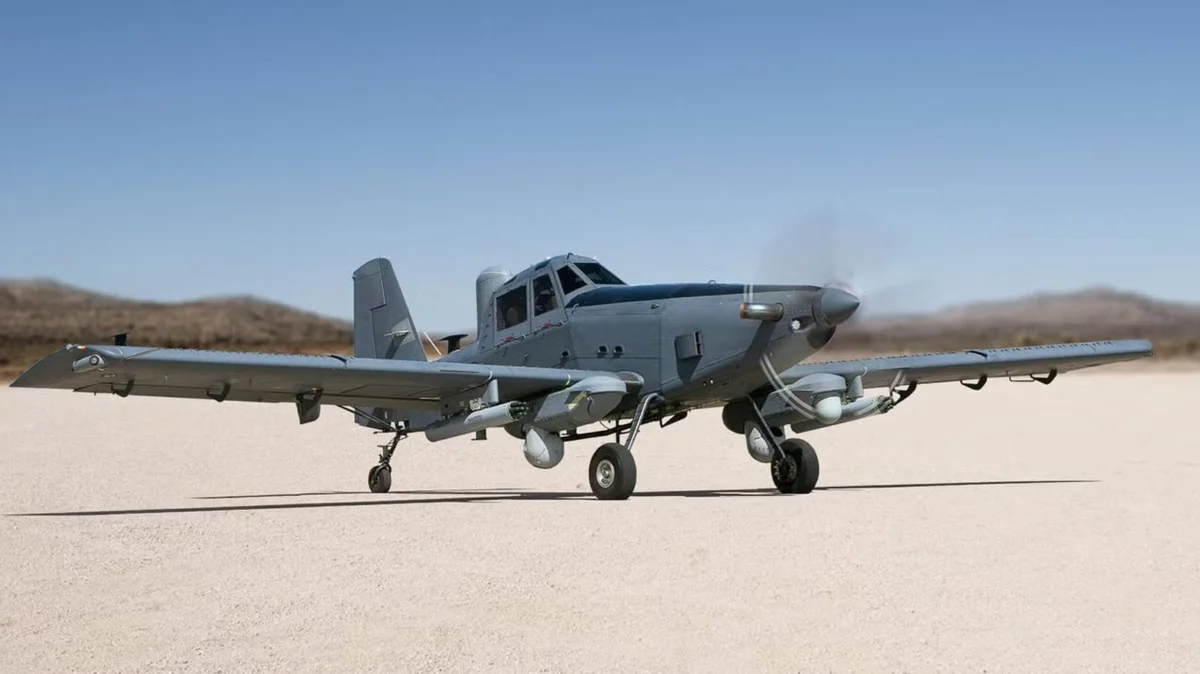
The United States Air Force Special Operations Command (AFSOC) has officially begun the integration of its newest, and perhaps most unconventional, aerial asset. As reported by Task and Purpose, the first 18 of a planned fleet of 75 OA-1K Skyraider II aircraft have been delivered. While the designation pays homage to the legendary Vietnam War-era A-1 Skyraider—a piston-engine juggernaut known for its durability and massive payload—the modern iteration is a radical departure from traditional jet-powered combat aviation.
To the casual observer, the OA-1K looks less like a fighter jet and more like an agricultural aircraft. This aesthetic is no coincidence; the OA-1K is derived from the AT-802U airframe, produced by Air Tractor, a company globally recognized for manufacturing heavy-duty cropdusters. Modified for the rigors of modern combat by L3Harris, the Skyraider II represents a pragmatic, cost-effective shift in how the U.S. military approaches the "Swiss Army Knife" of aerial warfare.
Main Facts: The Anatomy of the OA-1K
The OA-1K Skyraider II is designed to fill a specific gap in the AFSOC operational portfolio. Unlike the high-speed, high-altitude stealth platforms that dominate headlines, the OA-1K is built for the "low and slow" environment.
At its core, the aircraft is powered by the Pratt & Whitney PT6A-67F turboprop engine, a workhorse in the aviation industry known for its extreme reliability. Capable of generating 1,600 horsepower, the engine propels the Skyraider II to a maximum speed of approximately 245 miles per hour. While these metrics may seem modest compared to supersonic jets, they are optimized for the aircraft’s primary missions: close air support (CAS), precision strike, and armed intelligence, surveillance, and reconnaissance (ISR).
The aircraft’s utility is best expressed through its payload capacity. It features 10 external hardpoints capable of carrying up to 6,000 pounds of ordnance, sensors, or specialized surveillance equipment. This allows AFSOC commanders to configure the aircraft for a diverse range of sorties, from counter-insurgency operations to maritime patrol or humanitarian support, often in austere environments where sophisticated logistics chains do not exist.
A Chronological Perspective: From Farm to Frontline
The journey of the OA-1K is a case study in modern military procurement efficiency. For years, the Air Force debated the merits of a "Light Attack" aircraft. The conversation gained significant traction as the U.S. transitioned away from large-scale conflicts in the Middle East toward a more flexible, decentralized force structure.
- 2017-2018: The Air Force initiated the "Light Attack Experiment" (OA-X), testing various platforms to see which could provide cost-effective support without burning through the flight hours of expensive F-35 or F-15 fleets.
- 2022: L3Harris and Air Tractor were selected to refine the AT-802U for the specific needs of Special Operations Command.
- 2023: Initial fleet testing began, focusing on the integration of military-grade communications suites and defensive systems that separate the OA-1K from its civilian agricultural siblings.
- 2024: The delivery of the first 18 aircraft marks the transition from testing to operational fielding. The program aims to reach its full procurement goal of 75 units, ensuring that AFSOC has a persistent, ready-to-deploy force capable of operating globally.
Supporting Data: Why the "Cropduster" Approach Works
The decision to adopt a turboprop platform is driven by economics as much as it is by performance. In modern asymmetric warfare, the cost-per-flight-hour of a fifth-generation jet is often prohibitive for routine patrols or low-intensity engagements.
Economic and Logistical Efficiency
The PT6A engine is perhaps the most widely serviced turboprop engine in the world. Maintenance crews can find parts, technical support, and experienced mechanics in almost every corner of the globe. This reduces the logistical tail significantly. If an OA-1K needs maintenance in a remote region, it does not require a massive cargo plane filled with specialized proprietary tools; it requires common aviation parts and standard tools.
Portability and Rapid Deployment
A defining demonstration occurred this week, when AFSOC officials showcased the OA-1K’s ability to be loaded into the cargo bays of the C-17 Globemaster III and the C-5 Galaxy. The ability to break down the aircraft and transport it to a remote airstrip means that the U.S. can establish a combat-ready air presence within hours, not weeks. The OA-1K is specifically designed to take off and land on short, unimproved runways—often dirt or gravel—where traditional jet aircraft would suffer severe engine damage from debris ingestion.
Official Responses and Strategic Rationale
AFSOC leadership has been vocal about the "Swiss Army Knife" nature of the OA-1K. While some critics argue that the platform lacks the survivability of a jet, AFSOC planners emphasize that the aircraft is not intended for contested airspace where advanced anti-aircraft missiles are prevalent. Instead, the OA-1K is designed for environments where the U.S. holds air superiority but requires a persistent presence.
"The OA-1K is about providing the ground commander with options," says one defense analyst familiar with the procurement. "You don’t need a multi-million dollar missile to neutralize a small insurgent cell or provide overhead cover for a convoy. You need an aircraft that can loiter for hours, communicate with ground forces, and deliver precision fire when necessary. The Skyraider II is the most cost-effective solution we’ve seen in decades."
Furthermore, Air Tractor has been careful to distinguish the Skyraider II from the Embraer A-29 Super Tucano. While the A-29 is a purpose-built military trainer and light attack aircraft, the OA-1K’s heritage in agricultural aviation provides it with a level of ruggedness and short-field performance that is unmatched in its class.
Strategic Implications: The Future of Irregular Warfare
The deployment of the OA-1K sends a clear message about the trajectory of U.S. Special Operations. By investing in a fleet of 75 dedicated turboprop aircraft, the Air Force is acknowledging that the future of combat is not always about speed or stealth.
Decentralized Operations
The OA-1K is ideally suited for the "Great Power Competition" era, where the U.S. needs to maintain influence in partner nations through security cooperation and training. By operating an aircraft that is relatively inexpensive and easy to maintain, the U.S. can better train and assist allied air forces, building capacity while keeping its own combat-ready fleets available for higher-end conflicts.
Persistent ISR
One of the most critical roles for the OA-1K will be the "armed overwatch" mission. In regions where drone coverage is stretched thin, the OA-1K provides a manned platform that can loiter above a target area, providing real-time intelligence to commanders on the ground. The human element—a pilot who can make split-second decisions and communicate directly with infantry—remains a tactical advantage that unmanned platforms struggle to replicate.
A Legacy Reimagined
Naming the aircraft "Skyraider" is a nod to a philosophy that the military seems to be rediscovering. The original A-1 was revered for its ability to absorb ground fire and keep flying, its massive payload, and its ability to operate in the mud and rain of the Vietnam theater. By reviving this name, AFSOC is signaling that the OA-1K is not a toy; it is a serious, combat-hardened tool intended to perform in the dirtiest, most difficult environments on Earth.
Conclusion
As the U.S. Air Force integrates the remaining units of the OA-1K fleet, the aviation world will be watching to see how this "cropduster-turned-warfighter" performs in the field. With 18 aircraft already in the hands of operators, the program is moving out of the theoretical phase and into the reality of operational use.
Whether it is providing cover for special forces, conducting surveillance over disputed borders, or acting as a deterrent in regions where high-tech jets are either unavailable or overkill, the OA-1K Skyraider II is poised to become a staple of AFSOC’s inventory. It is a reminder that in the complex theater of modern war, sometimes the best solution is the one that is the most durable, the most maintainable, and the most reliable. The Skyraider is back—and it looks ready for the long haul.












No comments yet. Be the first to join the conversation!