Nila Kartika Wati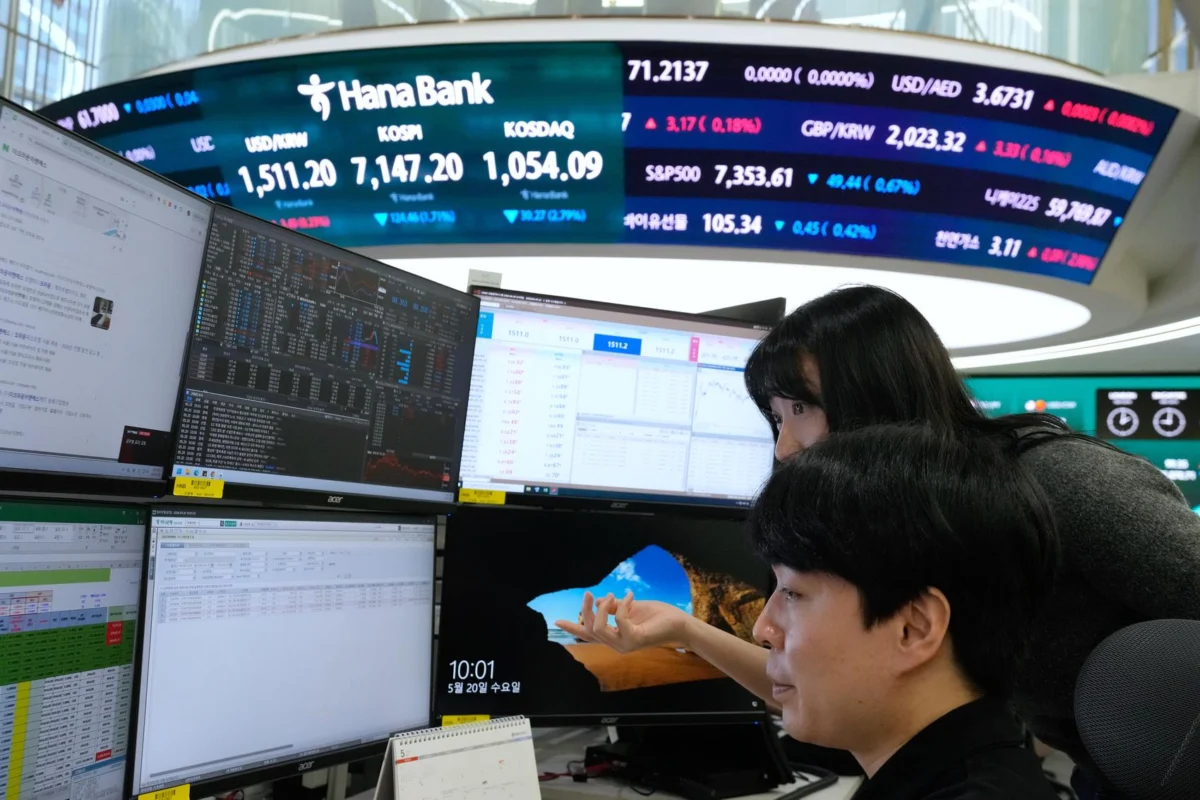
By Financial News Desk
May 2026
Asian markets surged on Friday, mirroring a positive sentiment that rippled across Wall Street in the previous session. As investors recalibrate their portfolios in the face of ongoing geopolitical instability—specifically the war involving Iran—the cooling of U.S. Treasury yields provided a much-needed reprieve for equities. Despite the lingering threat of energy price volatility, the global financial landscape appears to be finding a fragile equilibrium.
The State of Global Markets: A Broad Advance
The trading session on Friday saw a widespread rally across the Asia-Pacific region. Tokyo’s Nikkei 225 led the charge, surging 2.7% to close at 63,339.07. This bullish performance in Japan came alongside encouraging macroeconomic data, with reports indicating that inflation in the region hit a four-year low of 1.4% in April. This development is particularly significant given that Japan, like much of the world, has faced mounting pressure from elevated energy costs since the onset of the conflict in late February.
Elsewhere, investor sentiment remained buoyant. South Korea’s Kospi climbed 0.4% to reach 7,847.71, while Hong Kong’s Hang Seng Index and the Shanghai Composite both posted gains of 0.9%, closing at 25,612.40 and 4,112.90, respectively. Australia’s S&P/ASX 200 followed suit with a 0.4% increase to 8,657.00. Taiwan’s Taiex outperformed many of its peers with a 2.2% gain, and India’s Sensex added 0.6% as regional investors brushed off concerns regarding supply chain bottlenecks in the Middle East.
This positive movement follows a steady session on Wall Street. On Thursday, the S&P 500 managed a 0.2% gain to reach 7,445.72, while the Dow Jones Industrial Average climbed 0.6% to 50,285.66. The technology-heavy Nasdaq Composite saw a more modest rise of 0.1%, closing at 26,293.10.
Chronology of the Conflict and Energy Volatility
The volatility in equity markets is inextricably linked to the ongoing war in Iran, which has served as a catalyst for a global energy supply crisis. The conflict, which began in late February, has severely disrupted shipping through the Strait of Hormuz, a critical artery for global oil and gas transit.
In the weeks leading up to this Friday, markets were gripped by fear as U.S. Treasury yields climbed to multi-year highs. The spike in yields—driven by inflationary fears—threatened to stifle economic growth and undercut valuations for stocks, Bitcoin, and other risk-sensitive assets. However, as oil prices eased slightly during Thursday’s U.S. trading session, the pressure on the bond market began to dissipate.
By Friday, the yield on the U.S. 10-year Treasury had retreated to 4.57%, a marked decline from the 4.67% levels observed earlier in the week. This stabilization in the bond market provided the "breathing room" necessary for the equity rally. However, oil prices remain highly sensitive to diplomatic news. Brent crude, the international benchmark, rose 2.3% on Friday to reach $104.97 a barrel. To put this in perspective, prices were hovering around $70 per barrel in February, before the outbreak of hostilities. Benchmark U.S. crude similarly ticked up 1.8% to trade at $98.10.
Official Responses and Political Gridlock
The geopolitical landscape remains fraught with uncertainty, particularly regarding the U.S. legislative response to the conflict. The war powers resolution, intended to limit President Donald Trump’s military campaign, has become a focal point of domestic political friction.
On Thursday, the U.S. House of Representatives had scheduled a vote on a resolution introduced by Democrats that would have compelled the administration to withdraw military assets from the region. However, in a strategic maneuver, Republican leadership opted to delay the vote—and other related legislation—until June. Analysts suggest this was a tactical move to avoid a potential defeat, as it became clear that the GOP lacked the necessary consensus to block the bill.
This legislative delay has only added to the "wait-and-see" approach currently adopted by institutional investors. "Markets are still searching for signs of progress in a potential deal between the U.S. and Iran," noted Warren Patterson and Ewa Manthey, commodity strategists at ING. "While there are signs of optimism, uncertainty reigns."
Implications for Corporate Performance
The corporate sector has been forced to navigate this volatile environment with varying degrees of success. Nvidia, a bellwether for the artificial intelligence sector, saw its shares fall 1.8% on Thursday despite reporting quarterly results that exceeded analyst expectations. The dip appears to be a result of market saturation and profit-taking, though many analysts remain bullish, arguing that the stock remains undervalued despite the recent AI-driven rally.
Conversely, the transportation sector showed signs of recovery as oil prices fluctuated. Southwest Airlines saw a 2.7% gain, and American Airlines climbed 4.9%, capitalizing on the temporary dip in fuel costs. In the retail sector, Ralph Lauren outperformed expectations, surging 13.9% on the back of strong quarterly earnings that defied the broader economic headwinds.
Macroeconomic Outlook and Currency Fluctuations
The interplay between the U.S. dollar and other major currencies remains a critical barometer of the conflict’s impact. The U.S. dollar strengthened against the Japanese yen on Friday, rising to 159.12 from 158.98, reflecting the dollar’s role as a safe-haven asset during periods of global instability. Meanwhile, the euro dipped slightly to $1.1605, down from $1.1619, as the European economy continues to grapple with the proximity of the conflict and the resulting energy security concerns.
For investors, the path forward remains dependent on three primary variables:
- Diplomatic Progress: Any concrete breakthrough in U.S.-Iran negotiations would likely lead to an immediate cooling of oil prices, which would be universally welcomed by global equity markets.
- Central Bank Policy: The Federal Reserve’s reaction to the current inflation data will be pivotal. If the cooling trend in inflation continues—as hinted by the April data—the Fed may find itself with more room to maintain current interest rates, preventing further spikes in bond yields.
- Geopolitical Stability: The situation in the Strait of Hormuz remains the "wild card." Shipping volumes remain significantly below pre-war levels, and any further escalation in the waterway could force an immediate reversal of the current market optimism.
Conclusion: A Market in Transition
As we move toward the middle of 2026, the global economy is in a state of transition. While the immediate panic triggered by the war has subsided into a manageable—if high—level of volatility, the underlying structural challenges remain.
The retreat in bond yields is a positive signal, suggesting that the "worst-case" scenario of runaway inflation is not currently the market’s base case. However, until there is a decisive resolution to the diplomatic gridlock in Washington and the military conflict in the Middle East, investors should prepare for continued turbulence. The resilience displayed by major indices in the face of these pressures is a testament to the underlying strength of the corporate sector, yet the caution expressed by analysts remains a necessary reminder that in the current climate, uncertainty is the only constant.
© Copyright 2026 The Associated Press. All rights reserved. This material may not be published, broadcast, rewritten, or redistributed without permission.


 Neng Nana
 Asro
Asro