

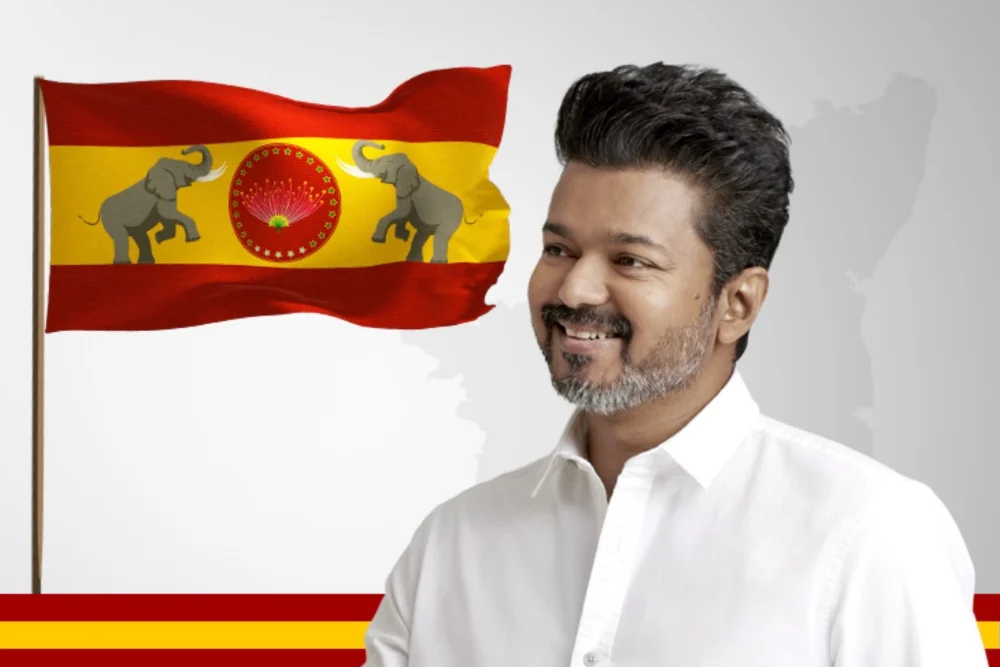
CHENNAI – In a historic shift that has redrawn the political map of Southern India, Joseph Vijay Chandrasekhar, the superstar actor turned political disruptor, was sworn in as the Chief Minister of Tamil Nadu on Sunday morning. The ceremony, held at Chennai’s Jawaharlal Nehru Indoor Stadium, marked the dawn of a new political era, effectively ending the nearly 60-year-long duopoly of the Dravidian parties—the DMK and AIADMK—that have governed the state since 1967.
Governor Rajendra Vishwanath Arlekar administered the oath of office and secrecy at 10:00 a.m. local time, formalizing a transition that has captivated the nation. Alongside Vijay, a nine-member cabinet was inducted, signaling the debut of his party, the Tamilaga Vettri Kazhagam (TVK), into the complex machinery of state governance.
A Historic Inauguration and Cabinet Composition
The new cabinet reflects a blend of political loyalty and administrative necessity. Among the ministers inducted were TVK General Secretary N. Anand, key party strategists Aadhav Arjuna and K.A. Sengottaiyan, and Selvi S. Keerthana, who holds the distinction of being the sole woman in the inaugural council.
In a move suggesting his intent to maintain a firm grip on the state’s internal security and administrative machinery, Vijay has retained the crucial portfolios of Public Administration, Police, and Home. This consolidation of power is viewed by analysts as a strategic effort to stabilize the administration during the initial, often volatile, phase of his premiership.
The Path to Power: A Week of High-Stakes Uncertainty
The path to the Chief Minister’s office was far from assured. The April 23 election results delivered a stunning verdict: the TVK, in its maiden electoral outing, secured 108 seats. While this was an extraordinary achievement for a party less than two years old, it fell 10 seats short of the 118-seat majority mark.
For several days, Tamil Nadu remained in a state of political paralysis. When Vijay met with the Governor on Wednesday to stake his claim, he could only demonstrate the support of 113 legislators—his own party’s 108 plus five seats from the Congress, which had famously pivoted away from its long-term ally, the DMK, to support the newcomer.
The ensuing 72 hours were characterized by intense "horse-trading" and fevered speculation. Reports emerged of back-channel negotiations between the DMK and the AIADMK, the state’s traditional rivals, to form a "Grand Coalition" aimed at preventing Vijay from taking office. AIADMK General Secretary Edappadi K. Palaniswami further stoked rumors by instructing his 47 MLAs to remain in Chennai, hinting that "unprecedented" developments might require their participation.
The impasse was finally broken between Thursday and Friday. The VCK, led by Thol. Thirumavalavan, broke its silence to offer unconditional support, followed by the Indian Union Muslim League (IUML) and the four seats held by the Left parties (CPI and CPI(M)). With a final count of 120, the TVK-led coalition secured the numbers, with the TVK’s own effective strength resting at 107—a result of Vijay vacating one of the two seats he contested. A vote of confidence is expected on or before May 13.
National Implications: The Southern Consolidation
The presence of Rahul Gandhi, Leader of the Opposition in the Lok Sabha, at the swearing-in ceremony was more than a gesture of goodwill; it signaled a broader national realignment. For the Congress party, the Tamil Nadu alliance represents a return to state-level power after six decades on the periphery.
This shift coincides with a remarkable resurgence for the Congress in the South. With the party already governing Karnataka and Telangana, the addition of Tamil Nadu—coupled with a landslide victory for the Congress-led United Democratic Front in neighboring Kerala—gives the party a dominant footprint across the southern peninsula. This "Southern Wall" is expected to serve as a significant check on the BJP-led central government as the nation looks toward the next general election.
A Comparative Verdict: The National Landscape
The election cycle in India has delivered a mixed bag of results that underscore the volatility of the current political climate. While Vijay’s rise dominated the headlines in Tamil Nadu, the BJP continued its march elsewhere. In West Bengal, the BJP effectively ended Mamata Banerjee’s long-standing dominance, securing 207 seats, while the Trinamool Congress (TMC) was reduced to 80. In Assam, the BJP retained a comfortable majority, securing 82 of 126 seats.
In the Union Territory of Puducherry, the NDA held its ground, with the All India N.R. Congress and the BJP securing 16 seats combined, allowing N. Rangasamy to return for a fifth term. For the TVK, winning two seats in Puducherry provides a modest but vital symbolic foothold outside the state of Tamil Nadu.
The Architect of the TVK: From Screen to Statehouse
The rise of Joseph Vijay Chandrasekhar is a phenomenon rooted in a unique intersection of cinema and civil society. Launching the TVK in February 2024, Vijay brought a level of grassroots organization rarely seen in Indian politics. By leveraging his 85,000-strong fan club network, he transformed passive fandom into an active, disciplined political apparatus.
His achievement is historically significant: his 35% popular vote share surpasses the debut performance of M.G. Ramachandran, the legendary actor who transformed the political landscape of Tamil Nadu in 1977.
The atmosphere at the stadium was electric, with prominent figures from the Tamil film industry, including actress Trisha Krishnan, in attendance. The event also brought an ironic closure to the ongoing controversy surrounding Jana Nayagan, the H. Vinoth-directed film that has been mired in certification disputes and piracy issues. The film, which has yet to secure a release date, finds itself in a strange position: its lead actor is no longer just a box-office draw, but the executive head of the state.
Challenges Ahead: Expectations and Governance
As the cheering subsides, the reality of governance begins. Vijay faces the immediate task of managing a diverse coalition and meeting the high expectations of a populace that voted for change.
Key Priorities for the New Administration:
- Administrative Stabilization: With the police and home portfolios under his direct control, Vijay is expected to launch an immediate review of state law and order.
- Coalition Management: Maintaining the support of the Congress, VCK, and Left parties will require delicate negotiation, as these partners have distinct ideological agendas that do not always align with the TVK’s platform.
- The "Confidence" Test: The upcoming floor test on May 13 will be the first major hurdle for the government to prove its stability.
- Economic Policy: Balancing populist welfare promises with the fiscal realities of the state will be the ultimate test of the new administration’s longevity.
For now, the state of Tamil Nadu watches with bated breath. The era of the Dravidian giants has faded into the background, replaced by the charismatic uncertainty of a political novice who has already achieved the impossible. Whether Vijay can translate his cinematic "Thalapathy" (Leader) persona into effective, long-term governance remains the most compelling question in Indian politics today.











No comments yet. Be the first to join the conversation!