

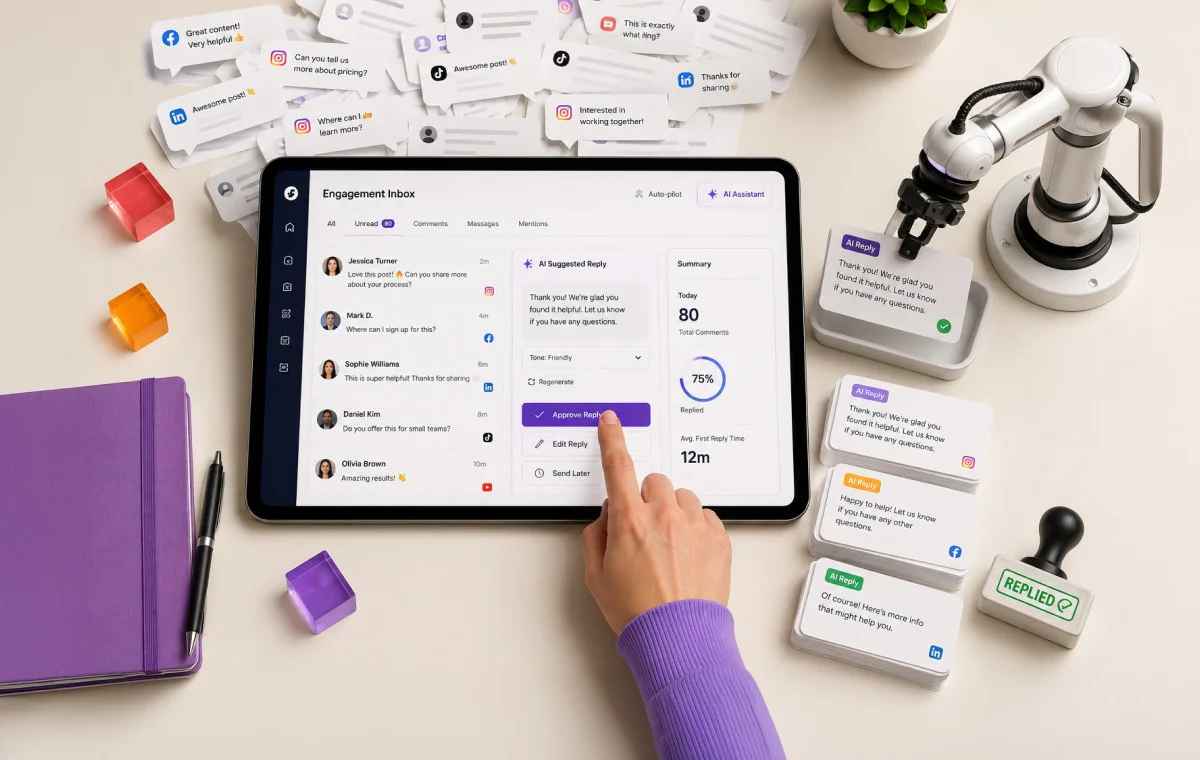
Fourteen clients. Three team members. Eighty comments by noon.
For the modern social media agency, this is not a hypothetical worst-case scenario—it is a standard Tuesday. The problem often begins with ambition: agencies start the week with the best intentions, promising comprehensive engagement and lightning-fast response times for every client. By Thursday, that promise has devolved into triage, where teams scramble to put out fires while burying the rest of their notifications. By the following Monday, entire comment threads sit unread, and the inevitable happens: a client notices the silence.
As a weary user on the r/SocialMediaManagers subreddit recently lamented, the sheer volume of messages across multiple platforms—spanning business pages, personal accounts, and cross-channel DMs—has become an insurmountable wall for even the most dedicated teams.
This is not a failure of time management, nor is it a lack of discipline. This is a failure of arithmetic. As agency client rosters grow, the manual labor required to maintain genuine, high-quality engagement grows exponentially, while the human capacity to provide it remains stubbornly linear.
The Myth of the "Manual" Standard
Most agencies attempt to bridge this gap using two flawed strategies, both of which inevitably fail to deliver the results clients pay for.
The first strategy is "Going Silent." In this scenario, the agency prioritizes the "visible" work—publishing posts, managing stories, and launching campaigns—while letting comment sections languish. The logic is that the client cares more about the output than the conversation. However, the data suggests otherwise. According to the 2025 Sprout Social Index, 73% of social media users explicitly state that if a brand fails to engage or respond to them on social channels, they will take their business to a competitor. When an agency chooses to ignore comments to save time, they are essentially eroding the very trust the client’s content was designed to build.
The second strategy is "Full Automation." Agencies often turn to rigid auto-reply bots to handle the overflow. While this solves the "time" problem, it creates a "brand" problem. Generic responses like, "Thanks for reaching out! We’ll get back to you soon!" are perceived by audiences as digital dead-ends. These responses signal that "nobody is home," training the audience to expect a lack of human connection. The more a brand relies on these robotic interactions, the more it devalues its own social presence.
The Two-Layer Workflow: A Structural Evolution
The solution lies in shifting from a binary mindset—human versus machine—to a tiered operational framework. High-performing agencies are moving toward a "Two-Layer Workflow" that treats comment management as a logic-based pipeline rather than a Herculean task.
Layer 1: The Speed Layer
The Speed Layer is designed for immediate, transactional interactions. By utilizing keyword triggers—such as "price," "link," "availability," or "how to buy"—agencies can deploy automated responses that do not sound like robots.
The goal here is not to replace human nuance but to facilitate the "first touch." When a customer asks for a link, they aren’t looking for a deep conversation; they are looking for a path to conversion. By automating this, the agency provides an immediate response that redirects the user to a DM. Data from Communipass (2026) indicates that comment-triggered DMs achieve open rates between 80% and 100%, vastly outperforming the 20% average for email marketing.
Layer 2: The Human Review Layer
For everything that falls outside of a transactional trigger—complex questions, complaints, emotional feedback, or brand-specific inquiries—the system pivots to the Human Review Layer.
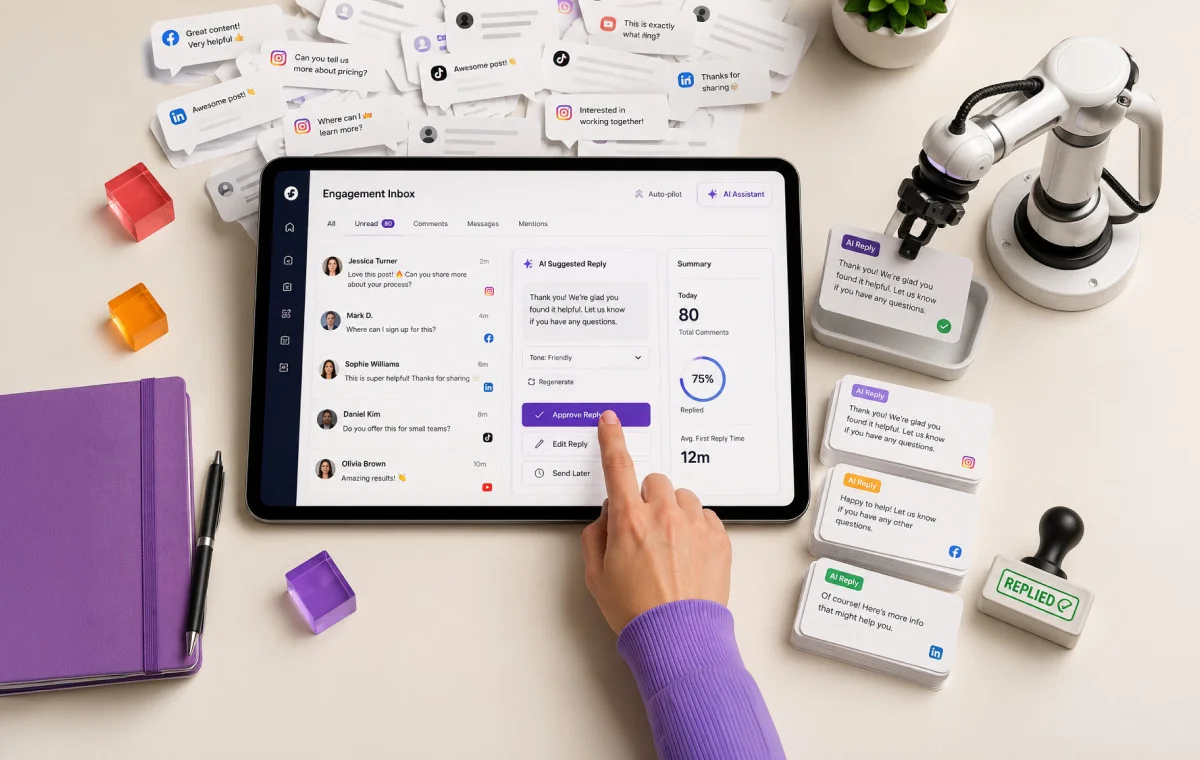
In this layer, the agency leverages AI to analyze the context and draft a response based on the client’s specific brand voice. The team member’s role is no longer to draft content from scratch, but to act as an editor. The cognitive load is shifted from "creative writing" to "quality control." This allows a three-person team to maintain the nuance of a boutique agency while operating with the efficiency of a massive firm.
The Infrastructure Gap: Why a Unified Inbox is Mandatory
The two-layer workflow is functionally impossible if the team is still jumping between 14 separate platform dashboards. The "platform-switching tax" is a major productivity killer, as team members lose context and momentum every time they move from an Instagram tab to a LinkedIn notification.
To survive, agencies must adopt a unified social media inbox. This is the central nerve center where every comment, mention, and DM from every connected client account lands in a single, linear queue.
Tools like SocialPilot have become the industry standard for this transition. By centralizing communication, AI-driven tools can ingest the full history of a conversation, ensuring that the draft provided to the team member is not just grammatically correct, but contextually accurate. The shift from "log in, search, write, repeat" to "review, adjust, send" is what separates agencies that burn out from those that scale.
The Hidden Math of Your Agency
If your agency is still handling engagement manually, you are likely operating at a significant financial deficit without realizing it. Consider the following variables:
- Total Daily Comments: (Number of accounts × Average posts per day × Average comments per post)
- Daily Labor Cost: (Total comments × 3 minutes of effort) ÷ 60
If your team is spending more than one hour per day per person just on manual comment replies, your current model is unsustainable. At that level of volume, human error is inevitable, and the quality of engagement will naturally degrade.
Implications for the Future
The modern agency is at a crossroads. As social platforms continue to prioritize "community-first" algorithms, the volume of engagement will only increase. Agencies that rely on goodwill and manual effort to handle this volume are essentially ignoring the math of their own business.
Official feedback from industry leaders suggests that the agencies of 2026 and beyond will be defined by their ability to delegate. By offloading the "Speed Layer" to automation and utilizing AI to assist in the "Human Review Layer," agencies can reclaim their time and focus on what truly drives client growth: high-level strategy and creative development.
Every unanswered comment thread is a silent, incremental cut to the trust a brand has spent months cultivating. As we look ahead, the question for agency owners is no longer "How do I find more time?" but "How do I build a system that respects the value of the human connection?"
The two-layer workflow is not merely an operational upgrade; it is the necessary evolution for any agency hoping to survive the demands of the modern social landscape. If your agency is still managing comments on a case-by-case basis, you are not just working harder—you are working against the inevitable reality of the digital age. It is time to let the math dictate the workflow, not the other way around.











No comments yet. Be the first to join the conversation!