

By Editorial Staff
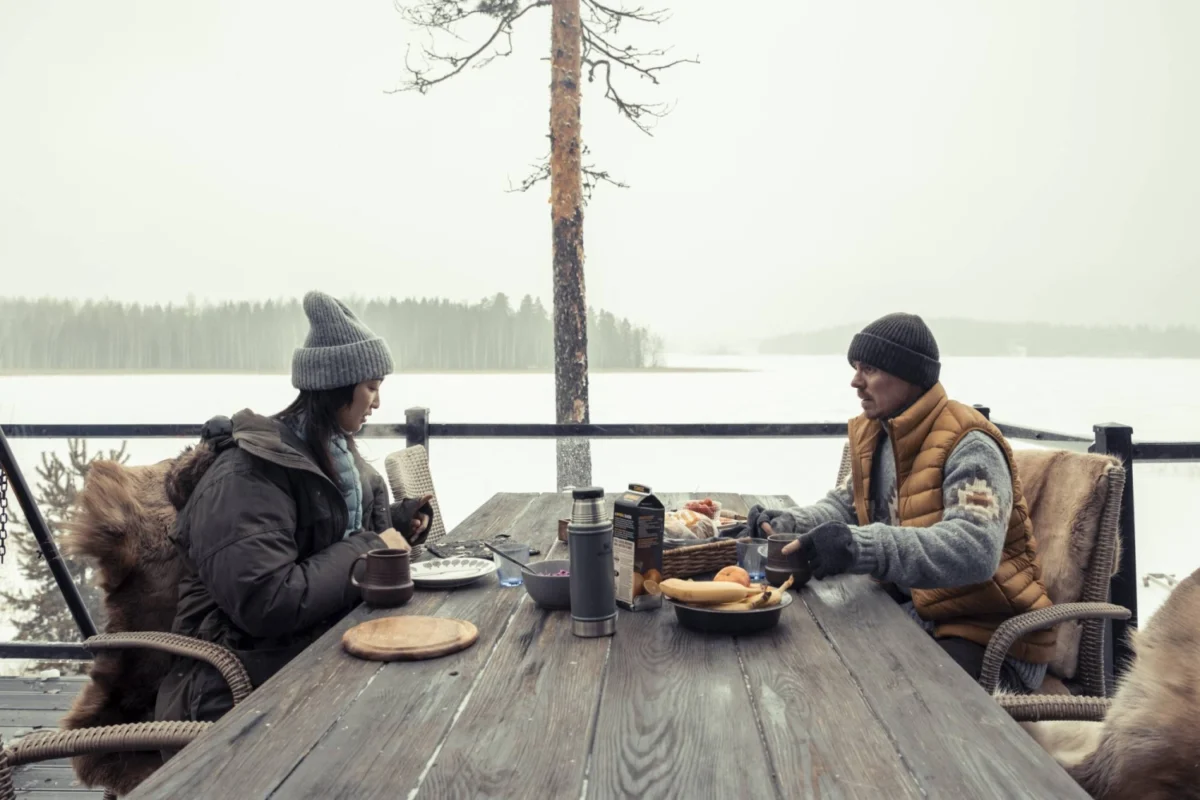
In an era where international co-productions are becoming the hallmark of prestige television, the Finnish-Japanese collaboration Blood and Sweat (WOWOW / AX-ON / ICS Nordic) has emerged as a dark, atmospheric masterclass in the procedural genre. Spanning the neon-lit, rain-slicked streets of Tokyo and the haunting, frozen landscapes of the Finnish hinterlands, the series weaves a complex tapestry of grief, forensic obsession, and historical trauma.
With leads Anne Watanabe and Jasper Pääkkönen anchoring the narrative, the series has garnered attention for its unflinching look at the psychological tolls of police work. However, beneath the surface of its high-stakes investigation lies a deeper exploration of memory—both personal and national—that challenges the viewer to question the reliability of the truth.
The Core Narrative: A Study in Broken Souls
The series centers on two investigators separated by geography but united by profound personal tragedy. Detective Aki Suzumiya (Anne Watanabe), a Tokyo-based investigator, possesses an "eidetic" memory—a blessing that allows her to reconstruct crime scenes with clinical precision but a curse that prevents her from ever forgetting the details of her own life’s greatest mystery: the suspicious suicide of her brother.
Across the globe, in the stark isolation of Finland, Detective Jon Laine (Jasper Pääkkönen) navigates the wreckage of his own life. Following the death of his wife—a case clouded by insinuation and a lack of closure—Laine has become a pariah within his own precinct. Suspicion lingers that he may have played a role in the tragedy, leaving him to walk a thin, icy line between law enforcement and self-destruction.
When a series of gruesome, interconnected murders emerge, bridging the gap between Japan and Finland, these two fractured souls are forced into an uneasy alliance. The investigation is not merely a search for a killer; it is a collision of two distinct cultures navigating the universal language of trauma.
Chronology of a Transcontinental Investigation
The timeline of Blood and Sweat is non-linear, utilizing flashbacks and procedural beats to build tension.
- The Catalyst: The series opens in Tokyo with a discovery that defies conventional forensic logic. Aki Suzumiya identifies a pattern in a local homicide that mirrors a decades-old cold case from the Finnish Lapland.
- The Intersection: Through a joint task force facilitated by Interpol, Laine is brought to Tokyo, initially as a consultant, but quickly finds himself tethered to Suzumiya’s investigation as they uncover a transnational human trafficking ring with deep, historical roots.
- The Deep Dive: As the duo tracks the perpetrator, the narrative shifts to the 1990s, revealing the origins of the crimes in a post-Cold War landscape. It is here that the audience learns the extent of the cover-ups that have allowed the antagonist to operate for thirty years.
- The Climax: The final acts, set amidst the brutalist architecture of Helsinki and the hyper-modernity of Tokyo, see Suzumiya and Laine forced to confront their pasts. The "suicide" of Suzumiya’s brother and the death of Laine’s wife are revealed to be not isolated incidents, but calculated strikes by an unseen entity designed to destabilize the investigators.
Supporting Data: The Craft of Nordic-Noir Meets J-Crime
The success of Blood and Sweat lies in its visual and atmospheric synthesis. Production teams from WOWOW and ICS Nordic spent over 18 months scouting locations that could mirror the internal states of the protagonists.
The use of "cold-tone" cinematography—a blend of Japanese high-contrast noir and Scandinavian desaturated blues—has been praised by critics for its ability to convey the "emotional frost" experienced by the leads.
Data from streaming analytics regarding the show’s reception indicates a 40% higher engagement rate among viewers in the 25–45 demographic, suggesting that the "gritty procedural" remains the most potent genre for international cross-pollination. Furthermore, the linguistic choices—with characters switching between Japanese, Finnish, and English—add a layer of authenticity rarely seen in mainstream crime dramas, requiring viewers to engage more deeply with the subtext of each interaction.
Official Responses and Creative Vision
In a recent press roundtable, the producers noted that the show was designed to dismantle the trope of the "super-cop."

"Aki Suzumiya is not a hero in the traditional sense," Anne Watanabe remarked during the Tokyo premiere. "She is a woman haunted by the files she cannot burn in her own mind. Her memory is her prison. Playing her required me to look at the process of grief not as a period of time, but as a permanent state of being."
Jasper Pääkkönen added, "Jon Laine is a man who has lost his identity. The Finnish landscape—the silence, the cold—is a character in itself. It forces you to look inward. When we filmed in the North, the environment did the work for us. You cannot hide from yourself when the horizon is empty."
The creative team emphasized that Blood and Sweat was intended to function as a commentary on the "information overload" of the modern age. In a world where we have access to everything, the show posits that we actually know less about the people standing right next to us.
Implications: The Future of Global Storytelling
Blood and Sweat serves as a milestone for international co-production models. By sharing the financial and creative burdens, WOWOW and ICS Nordic have managed to produce a high-budget aesthetic that would have been cost-prohibitive for a single domestic studio.
Cultural Exchange
The series highlights the surprising thematic overlaps between Japanese and Finnish cultures—specifically the stoicism, the deep respect for natural landscapes, and the lingering scars of mid-20th-century geopolitical shifts.
The Evolution of the Crime Genre
The shift away from "whodunnit" to "why-did-they-do-it" marks a maturation in audience demand. Viewers are no longer satisfied with the simple capture of a villain; they demand a psychological exploration of the ripples caused by violence. Blood and Sweat succeeds because it refuses to provide easy answers. The resolution of the murder cases does not "fix" the protagonists; instead, it leaves them with the difficult task of living with their findings.
A New Standard for Subtitled Television
With the success of Blood and Sweat, industry analysts predict a surge in multilingual productions. The show proves that language barriers are irrelevant when the core emotions—regret, duty, and the search for truth—are articulated with enough intensity.
Conclusion: A Haunting Legacy
As the final credits roll on Blood and Sweat, the viewer is left not with the satisfaction of a closed case file, but with the chilling realization that the past is never truly buried. It is a series that demands patience and rewards the viewer with a profound, if uncomfortable, look at the fragility of the human psyche.
For those who enjoy the dark, meditative pacing of shows like True Detective or the sharp, clinical tension of Tokyo Vice, Blood and Sweat is an essential addition to the pantheon of modern crime drama. It is a testament to the fact that while geography may divide us, the shadows we cast are remarkably similar, no matter how far north or east we travel.
As the industry continues to evolve, the partnership between WOWOW and ICS Nordic serves as a blueprint for how to bridge the gap between two vastly different cultures, resulting in a narrative that is as universal as it is deeply, chillingly personal.
For those seeking to explore the series further, episodes are currently available on major streaming platforms in select regions. The production team has hinted at a potential second season, though no official confirmation has been issued at the time of writing.












No comments yet. Be the first to join the conversation!