Lina Irawan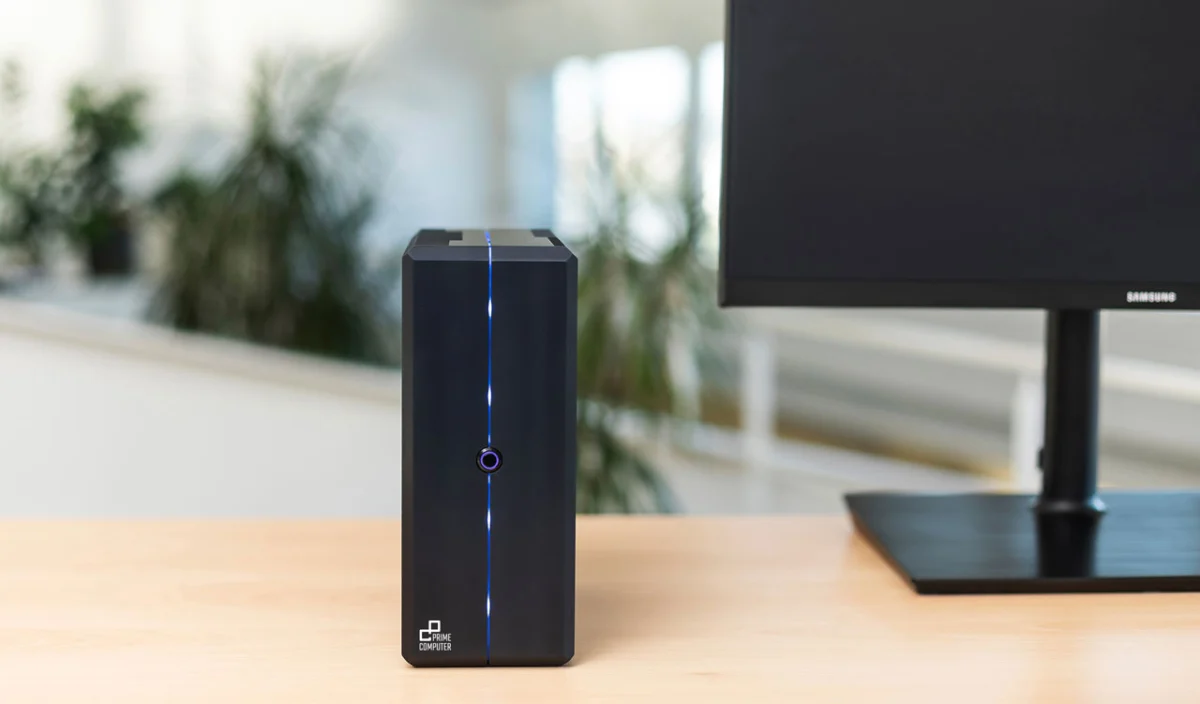
In the landscape of modern computing, the relentless pursuit of raw performance has often come at the expense of acoustic comfort and environmental sustainability. For decades, the workstation market has been defined by roaring fans, complex liquid cooling loops, and a staggering carbon footprint. However, Swiss manufacturer Prime Computer is challenging this paradigm with the launch of the PrimeStation Pulsar, a mini-PC that manages to marry high-end workstation performance with an entirely fanless, climate-neutral architecture.
Main Facts: A Paradigm Shift in Mini-PC Design
The PrimeStation Pulsar is not merely another compact desktop; it is an engineering statement. At its core, the system is built around the AMD Ryzen 7 Pro 5750G, a formidable 65W APU that delivers workstation-grade processing power without the need for active cooling.
The machine’s defining feature is its chassis—a robust, CNC-machined aluminium block that serves a dual purpose. It functions as both a sleek, industrial-grade exterior and a massive passive heatsink. By utilizing thermal conduction to move heat from the processor directly into the finned exterior of the chassis, Prime Computer has successfully eliminated the need for mechanical fans. This creates a 0dB noise profile, making the Pulsar an ideal candidate for noise-sensitive environments, such as professional recording studios, high-end offices, or medical facilities where dust circulation must be strictly minimized.
Beyond the hardware, the company has made a bold commitment to sustainability. Prime Computer claims the Pulsar is 100% climate-neutral, a designation achieved by calculating and offsetting the carbon footprint of the entire product lifecycle—from raw material extraction and manufacturing to shipping and operational energy consumption.
Chronology: From Concept to Silent Workstation
The journey to the Pulsar began with Prime Computer’s philosophy of "Green IT." Founded in Switzerland, the company identified a gap in the enterprise market: professionals required powerful hardware but were increasingly burdened by the maintenance costs and environmental impact of traditional, fan-cooled workstations.
- Early Development (2020): Prime Computer engineers began testing the thermal limits of passive cooling systems capable of handling 65W TDP processors. The challenge was to prevent thermal throttling while maintaining a compact form factor.
- The AMD Integration (Early 2021): The release of the AMD Ryzen 7 Pro 5750G provided the missing piece of the puzzle. With its high efficiency-to-performance ratio, the APU allowed for significant compute power within a manageable thermal envelope.
- The Launch (October 2021): The official unveiling of the PrimeStation Pulsar positioned it as the flagship of their fanless lineup. The announcement sent ripples through the enthusiast and enterprise communities, drawing comparisons to other high-end passive cooling solutions like the "Beast" from MonsterLabo.
- Market Reception: Since its launch, the Pulsar has been viewed as a high-premium, specialized niche product, balancing the high cost of Swiss engineering against the long-term benefits of durability, silence, and environmental responsibility.
Supporting Data: The Technical Architecture
To understand the capability of the PrimeStation Pulsar, one must look at the synergy between the APU and the memory architecture.
The Engine Room: AMD Ryzen 7 Pro 5750G
The processor is a powerhouse of the 7nm FinFET era. It features 8 cores and 16 threads, with a base clock speed of 3.8GHz and a boost capability of up to 4.6GHz. With 16MB of L3 cache, it is more than capable of handling multi-threaded workloads, rendering, and complex data analysis. Crucially, the integrated Radeon Vega GPU cores—running at up to 2.0GHz—provide a visual performance level that allows the machine to function as a workstation without requiring a power-hungry, heat-generating discrete graphics card.
Memory and Storage Flexibility
The system is highly configurable to meet diverse professional needs:
- RAM: Supports 8GB, 16GB, 32GB, or 64GB of DDR-4 3200MHz memory across two DIMM slots.
- Storage: The Pulsar offers a hybrid storage approach, featuring one NVMe M.2 slot for high-speed primary storage and an additional 2.5-inch SATA III bay for bulk storage or data redundancy.
- Connectivity: Despite its compact dimensions (W: 9.1cm, H: 22.5cm, L: 20.3cm), the I/O is comprehensive. It includes Intel Wireless AX200 for Wi-Fi 6, Bluetooth 5.2, and a high-bandwidth 2.5Gbps Ethernet port. For display output, it utilizes HDMI 2.1 and DisplayPort 1.4, ensuring compatibility with modern 4K and high-refresh-rate monitors.
Official Responses and Engineering Philosophy
Prime Computer’s official stance on the Pulsar is rooted in the "Total Cost of Ownership" (TCO) model. While the upfront price of $2,179 is significant, the company argues that the long-term savings are substantial.
"The Pulsar isn’t just about speed; it’s about reliability," a company spokesperson noted during the launch. By eliminating fans, Prime Computer has removed the most common point of failure in any workstation—mechanical moving parts that attract dust and eventually seize. The absence of fans means there is no dust accumulation inside the chassis, which is a major contributor to component failure over time. This makes the Pulsar an exceptionally low-maintenance solution for IT departments that manage hundreds of workstations across remote or satellite offices.
Furthermore, the "Climate Neutral" certification is not just a marketing slogan. Prime Computer works with independent third-party organizations to audit their entire supply chain, funding reforestation and renewable energy projects to neutralize the exact tonnage of CO2 generated by the production of each unit.
Implications: The Future of Desktop Computing
The arrival of the PrimeStation Pulsar carries significant implications for the future of the desktop market.
The Death of the "Noise Floor"
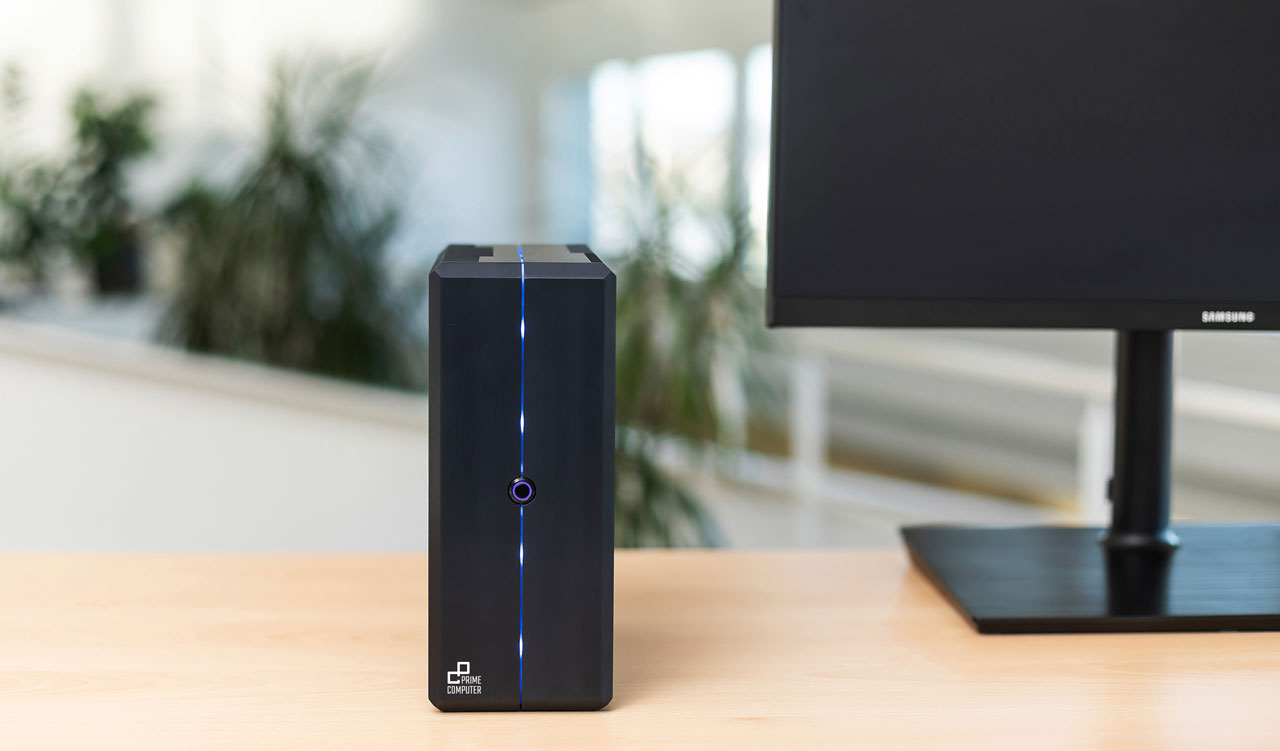
For professional audio engineers and content creators, the "noise floor" of a room is critical. Traditionally, this has required the construction of soundproofed "machine rooms" to house noisy workstations, with long cables running to the user’s desk. The Pulsar renders this obsolete, bringing the workstation directly to the workspace without compromising the acoustic integrity of the environment.
Sustainability as a Corporate Mandate
As more corporations adopt Environmental, Social, and Governance (ESG) goals, the hardware procurement process is changing. Companies are no longer looking just at raw speed-per-dollar; they are looking at the carbon footprint of their infrastructure. Prime Computer is ahead of the curve, providing a blueprint for how hardware manufacturers can take responsibility for their products’ lifecycle.
The Trade-off: Price vs. Performance
It is important to acknowledge the limitations. The Pulsar is not intended for the gaming enthusiast who wants to swap GPUs every two years, nor is it aimed at the budget-conscious consumer. With its fixed APU architecture, the upgrade path is limited compared to a standard ATX tower. Users seeking to push the boundaries of extreme thermal loads or massive discrete GPU power might find the "MonsterLabo" approach—which favors raw size and modularity—more suitable.
However, for the target demographic—architects, developers, audio engineers, and eco-conscious enterprises—the Pulsar is a masterpiece of efficiency. It proves that a machine can be powerful without being loud, and sustainable without being fragile.
Conclusion
The PrimeStation Pulsar is a testament to the fact that computing does not have to be a noisy, energy-intensive process. By marrying the raw efficiency of the AMD Ryzen 7 Pro 5750G with a high-performance thermal chassis, Prime Computer has created a workstation that is as quiet as it is capable.
As we look toward a future where environmental impact and hardware reliability are inextricably linked, the Pulsar stands as a beacon of what is possible when engineering is guided by both performance and planetary health. It is a niche product, certainly, but it is one that sets a new gold standard for the quiet, sustainable workstations of tomorrow. Whether you are working in a sterile laboratory, a silent studio, or a modern office, the Pulsar offers a compelling argument for leaving the fans—and the noise—behind.


 Layla Zulfa
 Nana Wu