

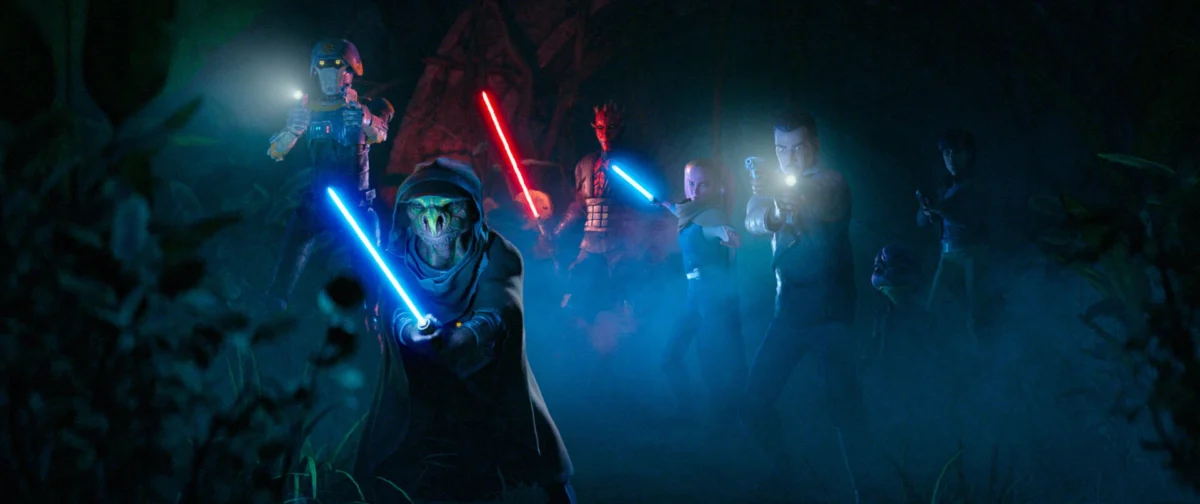
The dust has settled on the planet Janix, and for the audience, the landscape of Star Wars: Maul – Shadow Lord has been irrevocably altered. In the climactic two-part Season 1 finale, the creative team—led by Lucasfilm’s Chief Creative Officer Dave Filoni, Supervising Director Brad Rau, and Head Writer Matthew Michnovetz—delivered a masterclass in tension, culminating in the appearance of one of cinema’s most formidable icons: Darth Vader.
What follows is an exploration of the creative philosophy, technical precision, and narrative ambition that went into bringing the Dark Lord of the Sith into the orbit of Maul, setting the stage for a darker, more complex second season.
Main Facts: The Arrival of the Dark Lord
The season finale of Star Wars: Maul – Shadow Lord pivots on a singular, terrifying moment. As Maul, the former Sith apprentice, finds himself pushed to his limits, a figure emerges from the mist. It is not an Inquisitor, nor a Jedi Knight. It is Darth Vader.
The decision to include Vader was not merely a "fan-service" cameo; it was a deliberate narrative choice intended to establish a hierarchy of evil. Throughout the season, Maul has operated as a "broken, scrambling version of evil." By contrast, Vader represents a "perfected" instrument of destruction. For the creative team, the goal was to showcase the inherent power gap between the two, leaving no doubt that while Maul is a lethal threat, he is vastly outmatched by the Emperor’s primary weapon.
Chronology: Crafting the Climax
The journey to the finale was a multi-stage process that required intense collaboration between departments.
The Planning Phase
Work began long before the cameras started "rolling." Filoni, Rau, and Michnovetz spent months dissecting the role of the antagonist. The goal was to ensure the audience felt the same genuine shock as the protagonists. The production team utilized a rigorous "previs" (pre-visualization) phase, creating proxy versions of sets to define lighting, camera lenses, and character movement. This ensured that when the animation team took over, the "painterly" style of the show remained consistent while honoring the cinematic weight of the Star Wars legacy.
The Execution
The finale, spanning episodes 9 and 10, serves as a high-stakes convergence. Episode 9 concludes with a long, exhausting hunt through the night, which seamlessly bleeds into the morning light of episode 10—the moment of Vader’s reveal. The directors ensured that the choreography was precise, referencing the physical presence of David Prowse to inform the character’s movement, silhouette, and terrifying, silent intensity.
Supporting Data: The Anatomy of a Menace
The creation of this specific iteration of Darth Vader was built on "math, science, and trigonometry," according to Brad Rau. To achieve the desired level of horror, the team focused on several key pillars:
1. The Power of Silence
The most striking choice in the finale is the omission of dialogue for Vader. Filoni argued that the character simply has "nothing to say" to those beneath him. By removing his voice, the team leaned into a "slasher-film" aesthetic, comparing his presence to iconic horror figures like Michael Myers or Jason Voorhees. The rhythm of his mechanical breathing—a rhythmic, suffocating sound—carries the weight of his menace more effectively than any monologue could.
2. Design and Silhouette
Art Director Andre Kirk and designer Chris Madden were tasked with evolving Vader’s look to fit the show’s unique animation style. They returned to the source: the original 1977-1980 era films. By studying behind-the-scenes footage of David Prowse in the wrestling ring and on set, they identified the specific "brute force" physicality that defined the character. The result is a silhouette that feels heavier, more imposing, and more dangerous than previous animated iterations.
3. Lighting and Cinematography
Director of Lighting and Visual Effects Joel Aron collaborated with the team to define the "scuffiness" and shine of the helmet. By treating the helmet as a dynamic surface that reflects the environment, they maintained a sense of realism that contrasts with the stylized animation of the characters. Every step and every motion was mapped out by Animation Director Keith Kellogg to ensure that Vader’s speed and precision felt both unnatural and inevitable.
Official Responses: The Creative Vision
The creative team remains deeply committed to the idea that Vader is not just a character, but a catalyst for growth—and tragedy—for the rest of the cast.
"The challenge with using Darth Vader here is to show Maul the horror of what you can become when you have power and evil come together," Filoni explains. He notes that the inclusion of Vader helps define the character arcs of both Maul and his young charge, Devon Izara.
"We had long talks with Sam Witwer, the voice of Maul," says Head Writer Matthew Michnovetz. "This is obviously not an Inquisitor. It must be an apprentice. It certainly doesn’t look like Anakin Skywalker. It knows how you think. It knows the Jedi and it knows the Sith."
Brad Rau emphasizes the emotional impact on the characters: "The devil himself is being framed in several shots below us with Vader above us, and he has fear on his face. If we do it right, just seeing that guy scared after everything he’s done up to this point is terrifying."
Implications: The Road to Season 2
The aftermath of the finale leaves the characters in a state of profound vulnerability. The loss of the syndicate and the traumatic events on Janix have stripped Maul of his illusions of grandeur.
The Evolution of Devon Izara
One of the most compelling aspects of the finale is the agency given to Devon Izara. Her decision to join the "Shadow Lord" is not a passive event; it is a calculated choice made in the wake of the death of her mentor, Daki. The writers intended for Devon to be tested by "the devil on her shoulder and the angel," forcing her to synthesize her experiences into a new, dangerous path. As Michnovetz teases, the secret of Maul’s betrayal of his former masters is a ticking time bomb that will likely define the tension in the upcoming season.
The Changing Landscape
The finale effectively ends the "Age of the Syndicate" and introduces a new, more uncertain era. With Maul "left undone" and his empire in ruins, the audience is left to wonder how he will pivot to rebuild. The show has successfully transitioned from a story about a man trying to regain power to a story about a mentor molding a new generation in the shadow of the Empire.
As the team looks toward Season 2, the stakes have never been higher. The mystery of how Maul will integrate himself into the machinery of Crimson Dawn, combined with the lingering, unspoken trauma of Devon’s training, ensures that Star Wars: Maul – Shadow Lord will continue to push the boundaries of the Star Wars mythos.
The age of the Shadow Lord has truly begun, and for the survivors on Janix, the nightmare is only just starting. All episodes of Season 1 are currently available for streaming on Disney+, inviting fans to re-examine every frame of this pivotal chapter in the Star Wars galaxy.











No comments yet. Be the first to join the conversation!